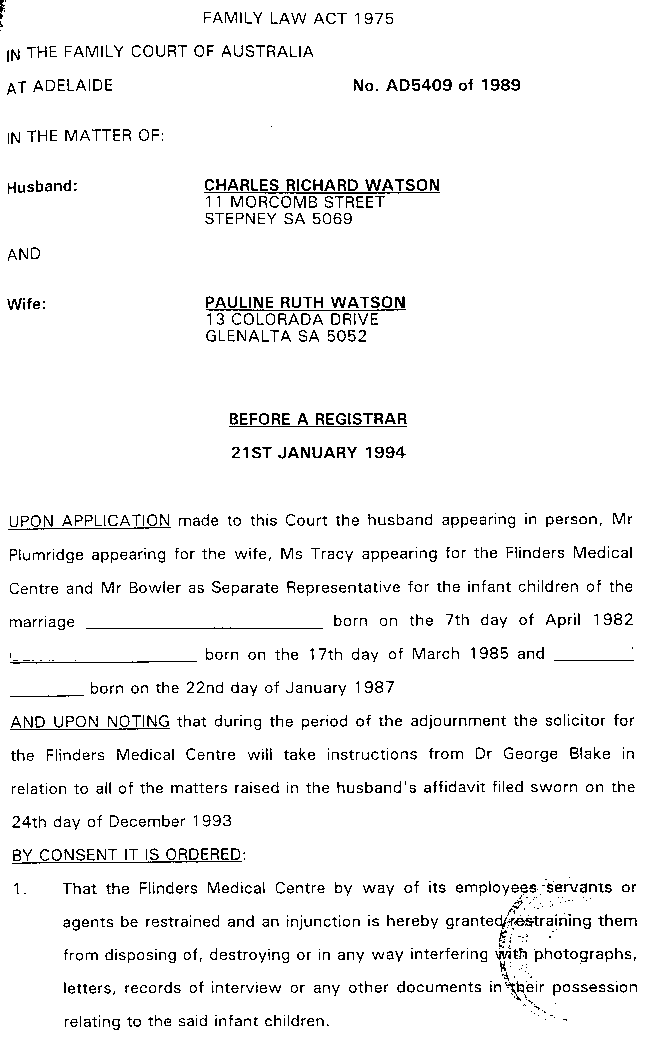
FAMILY LAW ACT 1975
IN THE FAMILY COURT OF AUSTRALIA
AT ADELAIDE No. AD 5409 of 1989
IN THE MARRIAGE OF:
NIGEL (Husband)
and
FIONA (Wife)
CORAM: THE HONOURABLE JUSTICE BURTON
DATE(S) OF HEARING: 7, 8, 9, 10 and 20 June 1994
DATE OF JUDGMENT: 28 June 1994
JUDGMENT
APPEARANCES:
The husband appeared in person
Mr R Deegan (instructed by Hume Taylor & Co, 84 Flinders Street, Adelaide) appeared on behalf of wife
Mr J Bowler (instructed by Legal Services Commission, 82-98 Wakefield Street, Adelaide) appeared on behalf of infant children of the marriage
This is the husband's application for access to the three children of the marriage JEREMY born on the 7th day of April 1982, HELEN born on the 17th day of March 1985 and SASHA born on the 22nd day of January 1987. The husband seeks alternate weekend unsupervised access from 5.00 pm on Friday until 6.00 pm on Sunday and in addition seeks to take Jeremy to New Zealand for a three week period during the 1994 Christmas holidays.
There is presently in existence an interim order made by consent on the 8 March 1994 granting the husband access to the three children on alternate Sundays between 1.00 pm and 3.00 pm under the supervision of a pastor of the Bethesda or Paradise Assemblies of God churches.
The wife opposes the orders sought by the husband and seeks to have the interim order continued for a further six months and then be the subject of a review.
There is also before the Court an application by the wife for sole guardianship of the children which has not previously been dealt with and that was part of the proceedings before me.
The husband was unrepresented during this trial which extended over five sitting days and that has produced difficulties to which I will refer later in these reasons.
The parties were married on the 24 March 1979 when they were both aged 23. The wife had previously been married when she was 19. That marriage lasted for about two years. The wife is a music teacher by profession. The husband, at the time of the marriage, had a science degree and during the marriage he studied for and in 1982 obtained his Ph.D. The husband was born in the United Kingdom but was raised in New Zealand where most of his immediate family still reside.
They first lived in Sydney until shortly before Jeremy was born when they came to Adelaide. From 1982 until 1992 the husband was employed in or about Adelaide as a scientist and in the latter years as a senior research scientist with the Department of Defence at Salisbury.
They separated on the 30 June 1989 when the wife and the three children left the then matrimonial home. The wife complained of the husband's conduct during the marriage as the reason for her departure, including in her allegations, complaints that he behaved in an authoritarian and patriarchal manner towards her and the children. The husband found the breakdown in the marriage difficult to accept and shortly after separation took leave and travelled in Queensland for some weeks, during which time he remained in contact with the wife by writing to her.
On the 31 August 1989 the wife applied ex-parte for an order for interim custody of the three children and a non-molestation injunction. This was arrested on the 18 September 1989 by a visiting Judicial Registrar. That application, on the face of it, shows no grounds for the order being made ex-parte and the husband's grievance at such an order having been made in his absence is justified.
When served with the application a week after the order was made, the husband responded however by consenting to the custody order and seeking access. There was some delay in the husband's access application being dealt with while he went to New Zealand for a few weeks, but on the 27 November 1989 an order was made granting him access to the three children each Saturday from 11.00 am to 5.00 pm. On the 20 December 1989 this order was varied to provide that he have access to the three children from 9.00 am to 5.00 pm on each alternate Saturday and from 9.00 am to 5.00 pm on each intervening Sunday.
In September 1990 the husband took leave without pay from his employment and travelled in South East Asia and India until the middle of December 1990. During this time he sent post cards to the children every few weeks. In January 1991 consent orders for settlement of property were made. In February 1991 a decree nisi for dissolution of marriage was granted upon the application of the wife.
During 1991 the husband took access substantially in accordance with the terms of the last order. The wife always had some reservations about the husband's access. In a statement to the police made by her on the 2 January 1992, she said that from immediately after the separation she had kept a book relating to access and comments made by the children and the husband. She said she only wrote negative comments in the diary. This is an early indication of her opposition to access taking place and her attitude to the husband.
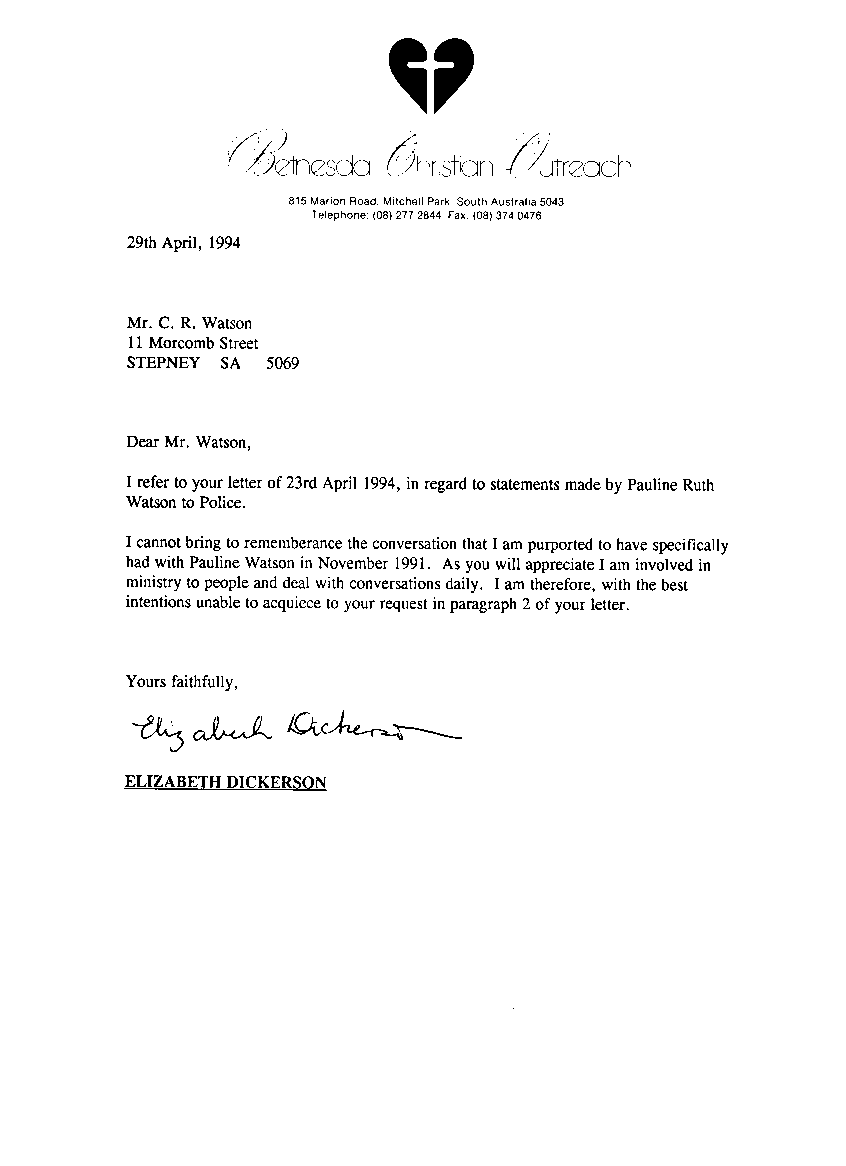
In early November 1991 the husband informed her that he intended going to New Zealand again for three weeks. He took access to the children on the 16 November 1991. During that day the wife spoke to a person named Liz Dickerson. As a result of that conversation she spoke to both Helen and Sasha upon their return from access.
At the time that she spoke to them they were both in the bath.
The wife asked them both a series of leading questions. According to her statement to the police, made shortly thereafter, her first question was "Has Daddy every touched you in a way you don't like?". The wife says that in response Helen said her father had put his hand on her bottom but had not touched her vagina. Sasha was present during this questioning, and when she was asked if Daddy touched her, she said "Yes" and pointed to the area of her vagina. The wife then said "Does he put his wee-wee down there?". Sasha replied "Yes". The wife said "Does wet runny-stuff come on your leg?". Sasha said "Yes, and it comes inside of me. "
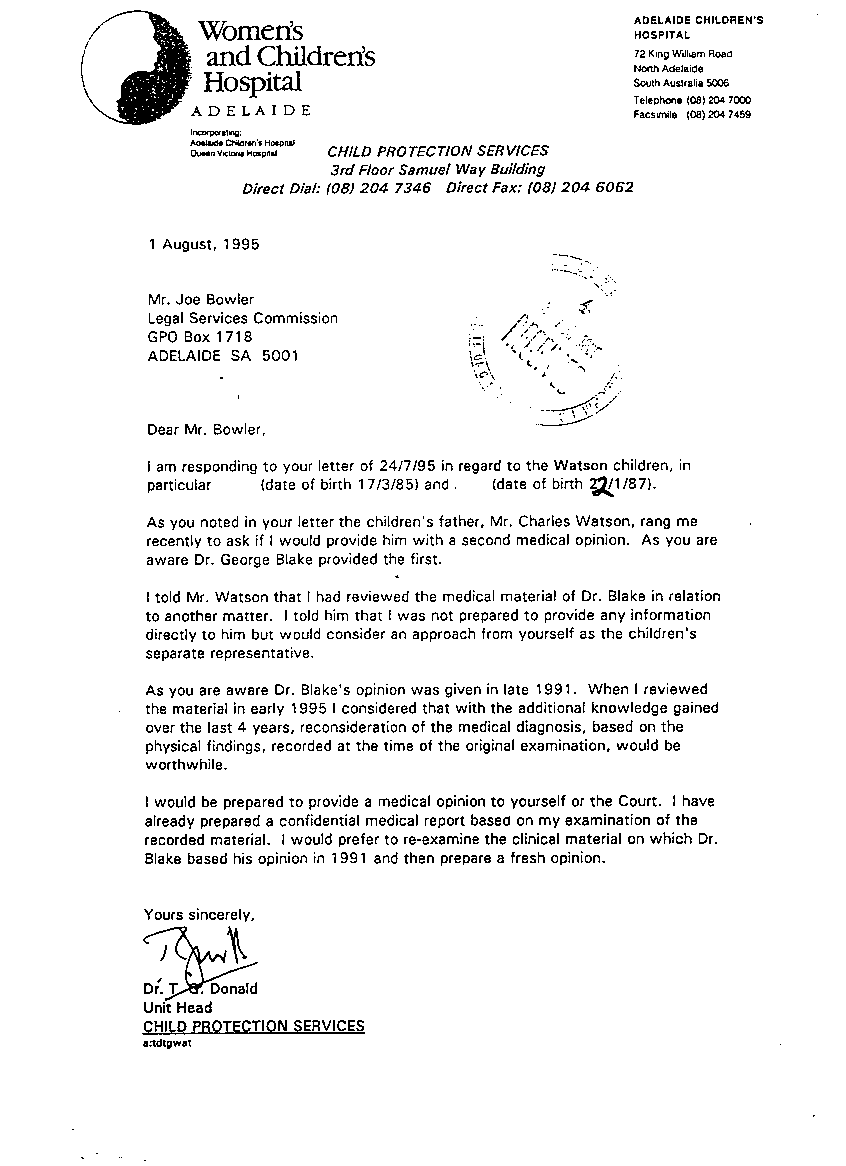
As a result of this conversation the wife contacted the police and there followed an investigation by the police and an assessment of the children by the Child Protection Services Unit at the Flinders Medical Centre. The children were first examined by Dr George Blake, a Senior Paediatrician.
He examined Sasha on the 18 November 1991. Her genitalia were examined with a colposcope. He reported in a report dictated by him on the date of the examination as follows:
"The mons, labia, clitoris, urethra, all appeared normal. The vestibular walls were somewhat inflamed, but no discharge and no signs of scarring were seen. The hymenal opening appeared to be somewhat enlarged and on measurement in the unstretched position was approximately 5 mm horizontal and 4 mm vertically. The hymenal opening appeared abnormal, with irregulailty and attenuation of the hymenal tissue itself. No obvious fissures in the hymen itself, but the hymenal posterior edge was continuous with the vaginal mucosa. The anus and perianal tissue appeared normal.
Dr Blake concluded as follows:
"My conclusion was there was physical evidence for previous intererence[SIC]".
Dr Blake saw Helen on the 9 December 1991. In a report dictated on the 11 December 1991 he reported as follows:
"The mons, both labia, clitoris and urethra all appeared normal. The vestibular walls were slightly inflamed, with a small amount of purulent discharge stretching between the labia. The hymenal membrane itself appeared abnormal, with an enlarged hole measuring 7-8 mm horizontally and 5-6 mm vertically using callipers held nearby. The hymenal tissue between approximately 4 o'clock and 8 o'clock appeared attenuated, with the hymenal opening having an attenuated edge between the same area."
Dr Blake concluded his report by saying:
"My conclusion was there was physical evidence for previous interference (Muram 3 classification) "
Dr Blake re-examined Helen on the 3 January 1992, he reported in a report dictated that day:
"Her genitalia showed no discharge. The hymenal membrane had an enlarged aperture as before"
During November and December 1991 the wife and Sasha were interviewed by Peter Mulheam, a social worker with the Child Protection Services Unit at Flinders Medical Centre on four occasions each. Jeremy was interviewed by Mulhearn on two occasions and Helen was interviewed by Karen Fitzgerald, a senior clinical psychologist with the Child Protection Services Unit on the 29 November 1991. The interview between Sasha and Mulhearn on the 29 November 1991 was recorded and observed by a police officer. A further interview of Helen by Karen Fitzgerald conducted on the 26 March 1992 was recorded and witnessed by a police officer.
In March 1992 the husband returned to South Australia and on the 14 March 1992 he was charged with unlawful sexual intercourse and indecent assault of both Helen and Sasha and granted bail. On the 20 March 1992, on the wife's application, access to all three children was suspended and a Separate Representative appointed.
In May 1992 the husband, in breach of his conditions of bail, left South Australia and went to Queensland. On the 24 July 1992 an order was made discharging, the previous access orders in respect of the three children.
In September 1992 the husband returned to South Australia, surrendered to the police and his bail was restored.
On the 25 November 1992 the husband filed this application for access which included an application to take Jeremy to New Zealand for the 1993 Christmas holidays. The husband had no access, either supervised or unsupervised, during 1992. In February 1993 the Crown entered a Nolle Prosequi to each of the counts relating to Helen and Sasha with which the husband had been charged.
On the 5 February 1993 the husband, who was by then unrepresented, sought an order for access to the children prior to another proposed departure from Australia on the 11 February 1993 to see his family in New Zealand. An order was made on the 9 February 1993 granting him access for one hour each fourth Sunday, such access to be supervised by a pastor of the Bethesda Church or the Paradise Assemblies of God Church. On the husband's return this order was varied by consent on the 8 March 1993 to provide that he have access between 1.00 pm and 3.00 pm on alternate Sundays, subject to the same supervision. On that day an order was made, also by consent, that the children and the parties attend interviews with Ms Ann Thornton, a clinical psychologist at times to be arranged by the Separate Representative of the children.
Ms Thornton conducted interviews with each member of the family during March and April 1993 and produced a comprehensive report dated the 19 April 1993. In that report she concluded that the husband showed such self-preoccupation and self-interest that it prevented him from being able to give primary consideration to the emotional needs of his children. She noted the children's desire to have access with their father notwithstanding Helen and Sasha's conviction that he had, sexually abused them. She expressed concern about the husband's long term commitment to access but recommended that supervised access take place on a regular basis with all three children being present at the same time.
Following receipt of Ms Thornton's report, the husband left Adelaide again, going overseas and to Queensland and not returning until October 1993. In evidence he said that he had formed the opinion that the supervised access recommended by Ms Thornton was of no value to the children and he therefore had no contact with the children between May and October 1993. In January 1994 the husband filed a further application seeking an interim access order dispensing with the supervision.
During January and February 1994, at the request of the Separate Representative, Ms Thornton interviewed each member of the family again. She prepared a written report dated 6 March 1994.
In the interviews Helen repeated her belief that her father had sexually abused her, but said that she loved him and that she wanted to see him very much. She stated that she would like to see him every month for about 2-2 1/2 hours with someone supervising and with Jeremy and Sasha present too.
Sasha was considerably less certain about whether or not the sexual abuse had taken place. She cave uncertain answers saying on one occasion "I have been telling Mum that I lied, but I probably didn't lie, but I could have". She said that she could not remember incidents in the past, but she was sure that her father had not hurt her. She was unsure why she did not want to be alone with him.
Ms Thornton concluded that:
"Mr Watson continued to show little appreciation of his children's emotional needs despite repeated attempts to encourage him to do so in the light of making recommendations to the Court for long term access arrangements with his children. This highlights the need for intensive therapeutic contact with (the husband) to assist him both to appreciate and respond to the effects on the children of their belief that they had been abused by him and thereby allow him to rebuild a trusting relationship with his children. It was encouraging that (the husband) made a commitment to do this."
Ms Thornton's recommendations were summarised by her as follows:
"My recommendations as stated on 19 April 1993 remain unchanged. I recommend that:
Access of all three children with their father be supervised.
All three children attend access together.
The supervised access be regular and frequent to facilitate relationship building, eg one per fortnight, but only of short duration, 1-2 hours, to allow the children to adjust to this new situation.
(The husband) has therapeutic input to ensure that his interactions with the children are likely to be constructive and allow rebuilding of the relationship and to ensure the children's emotional as well as Physical safety.
The access arrangements to be reviewed at six-monthly intervals to monitor the children's emotional status. "
The trial was conducted by the husband upon the basis of him asserting his innocence of sexual abuse of Helen and Sasha and submitting that the methodology employed in the investigation of the sexual abuse complaint was so flawed that the evidence should not be accepted. In addition to his own evidence he called a member of his church to attest to his character and interest in his children and Dr Keith Le Page, an experienced psychiatrist, to comment on the methodology employed by the Child Protection Services Unit at Flinders Medical Centre.
One of the great difficulties in this case is that the husband was unrepresented at trial, while the wife and the Separate Representative were both represented by counsel. The husband's case suffered the glaring deficiency of a failure by him to test by cross-examination the evidence given by the wife's and the Separate Representative's witnesses. This situation places a trial judge in a considerable dilemma. In Jones v National Coal Board (1957) 2 All ER 155 Lord Denning at pace 159 said:
"The Judge's part in all this is to harken to the evidence, only himself asking questions of witnesses when it is necessary to clear up any point that has been overlooked or left obscure, to see that the advocates behave themselves seemly and keep to the rules laid down by law,, to exclude irrelevancies and discourage repetition; to make sure by wise intervention that he follows the points that the advocates are making and can assess their worth; and at the end to make up his mind where the truth lies. If he goes beyond this, he drops the mantle of a judge and assumes the robe of an advocate; and the change does not become him well. Lord Bacon spoke right when he said that:
'patience and gravity of hearing is an essential part of justice; and an over-speaking judge is no well-tuned cymbal'. "
That statement of the role of a trial judge was made in the context of each party being represented by counsel.
The dilemma posed to the judge in a case such as this is that where evidence-in-chief of a damming nature is so feebly challenged or not challenged at all, so that it is adduced to the Court untested, should the judge assume the role which competent counsel acting for the unrepresented party would have undertaken. The answer to this question I feel must be "No". If a judge assumes the role of rigorously cross-examining a witness on behalf of one of the parties then clearly the judge's impartiality is seen to be in question. Thus while the judge may undertake some questioning of a witness to clarify aspects of his evidence which have left the judge uncertain as to its meaning, except in cases where it appears to a judge that blatant untruths have been left unchallenged, he should not go beyond the role described by Lord Denning in Jones v National Coal Board (supra) even if one party is unrepresented.
I therefore have before me much evidence and many opinions given by witnesses with appropriate qualifications to give the same, which had they been subjected to rigorous cross-examination by counsel with a complete knowledge of the husband's case, may have withstood that challenge or may have been found to have been based on inadequate foundations. However as that evidence has not been rigorously tested, except where it appears that it is within my right as a judge to reject the same for valid reasons, I must accept what has been put before me by properly qualified witnesses.
The wife's case for the imposition of a condition of supervision on access is based on the following grounds:
1. That there is an unacceptable risk of sexual abuse of Helen and Sasha if access is unsupervised.
2. That Helen and Sasha have a belief that they have been sexually abused by the husband and could suffer emotional damage if access is unsupervised.
3 . That access to all three children should be given so as not to appear to favour one child or the other, and therefore access to Jeremy should take place with Helen and Sasha and also be supervised.
Although she did not press it to the extent of seeking a discharge of all access orders, the wife's case also is that the husband is so incapable of focussing on the children's needs, rather than his own, that access of any description is of little value to them at the present time.
The duty of this Court in proceedings involving custody and access is to regard the children's interest as the paramount consideration. Where sexual abuse is alleged, although it must be a relevant factor with regard to the welfare of the children, it is not the paramount issue for determination. In M & M (1988) FLC 91-979 at 77,080 the High Court said..
"The Family Court's consideration of the paramount issue which it is enjoined to decide cannot be diverted by the supposed need to arrive at a definitive conclusion on the allegation of sexual abuse. The Family Court’s wide ranging discretion to decide what is in the child's best interests cannot be qualified by requiring the Court to try the case as if it were no more than a contest between the parents to be decided solely by reference to the acceptance or rejection of the allegation of sexual abuse on the balance of probabilities".
Nevertheless it is the duty of the Court to decide whether or not there is an unacceptable risk of sexual abuse having regard to the evidence which has been adduced before it.
The evidence of Dr Blake, an experienced paediatrician, was that there had been some interference to both girls. In his evidence at the trial Dr Blake said that in the absence of evidence of some obvious accidental trauma, that interference by some person or object was the only plausible explanation for the condition of the children's hymens. He excluded the possibility of self-infliction. He concluded that in each case the injuries were not acute and were at least three weeks old and that in each case something or someone had damaged the hymen and that it was possibly sexual interference.
The evidence of Helen's allegations of sexual abuse came from the wife, Karen Fitzgerald and Ann Thornton. An interview of Helen by Constable Alison Moyle, taken on the 26 March 1992, was also tendered by consent.
The husband called Dr Le Page to comment on the methodology of the overall investigation and the various interviewers. He was critical of the methodology over all and in particular that no investigator sought clarification of the wife's initial questioning of the children. He was critical of the wife's questioning of both children and I accept that criticism. The wife, without any previous disclosure of sexual abuse or hint of disclosure by the children, obtained affirmative answers to leading questions put by her to the children. In response to this criticism Karen Fitzgerald in evidence in rebuttal pointed out that Sasha had introduced an answer to the wife which was not prompted by a leading question. The wife's version of that conversation is as follows:
"I said, 'Does wet runny stuff come on your leg?' Sasha said, 'Yes and it comes inside of me "'.
That evidence is contained in the wife's original statement to the police on the 2 January 1992. In addition to no investigator checking the accuracy of the conversation she was not cross-examined on it. It remains untested therefore whether she was quoting the child verbatim or giving a narrative version of the conversation. On the face of it she was quoting the child verbatim.
In the many interviews of Sasha since that time she has never repeated anything which approximated that allegation.
The initial disclosures therefore consist entirely of answers to leading questions which contained information in them and one piece of information volunteered by Sasha which has never been repeated.
Dr Le Page contended that the whole of the subsequent statements by the children in interviews must be looked at, bearing in mind the flawed nature of the initial disclosures and the strong possibility of contamination arising therefrom and from the wife's subsequent conduct.
Dr Le Page was also particularly critical of the interviews of Sasha conducted by Peter Mulhearn on the 29 November 1991 and the 4 December 1991, transcripts of which were tendered in evidence.
I accept the criticisms of Dr Le Page of Mr Mulhearn's interviews. He repeatedly focussed the child's attention on her father and what he might have done to her. Bearing in mind the child at the time of this interview was not 5 years of age, the repetitive nature of the questioning was excessive to the extent of being badgering. Such disclosures as he was able to draw from the child were vague and non specific as to time and place. I find there is also a distinct possibility that the answers were influenced by contamination from earlier discussions with the wife and possibly Helen.
The interviews of Helen by Karen Fitzgerald and Alison Moyle were carried out in a far more appropriate manner. To Karen Fitzgerald, Helen was quite specific about the nature of the father's interference with her and the place where it occurred, namely, in a bedroom at their old house on an access visit. This information was given by Helen without being led by the interviewer. Dr Le Page was not critical of the interview of Helen by Alison Moyle, to whom Helen also made disclosures of sexual abuse by the husband. His contention remained however that the evidence gained by Ms Fitzgerald and Ms Moyle was rendered suspect because of the nature of the initial questioning by the wife.
The husband has at all times denied sexually abusing the children although on at least one occasion to Ms Thornton he has been somewhat vague in his denial.
As I have previously said it is not of necessity part of the Court's role to make a finding whether sexual abuse has occurred or not. However I do accept the evidence of Dr Blake that they have suffered some external interference which could possibly have been caused by sexual abuse of them. There is no evidence before me that it might have happened in any other way. There is no evidence of opportunity of anyone committing this abuse apart from the husband. The children at no time have accused anyone other than the husband.
However I am unwilling to take the next step of finding on the balance of probabilities that the husband has committed this abuse. My concern is that the evidence of the children's disclosures may have been contaminated by the wife's initial conversation with them, that the evidence of those who interviewed her was not adequately tested in cross-examination to establish it as evidence upon which I should rely to make such a conclusive finding, and that I am not satisfied with some of that evidence in any event, particularly the evidence of Mr Mulhearn.
The important finding I have to make however is not whether sexual abuse has occurred, but whether or not there is an unacceptable risk that it might occur if access is granted on an unsupervised basis. Having regard to the evidence of Dr Blake of the probability of external interference and the absence of evidence before me of any possible perpetrator other than the husband, I am of the opinion that despite the unsatisfactory state of the rest of the evidence, there is an unacceptable risk of sexual abuse of the children if unsupervised access is granted at the present time.
Helen and Sasha are still only 9 and 7 1/2 years old and are still vulnerable. However, even if I accepted all the evidence of sexual abuse, I am not satisfied that it follows that access at all times in the future will need to be supervised. When these two children are older and more independent and more confident of their own ability to be in control of situations when left alone with their father, I consider there is a possibility that subject to such access being in their best interests and the children beina agreeable that it could be granted without supervision. At this time however I place it no higher than a possibility. A lot will depend on the girls' attitudes and beliefs in the future.
I turn now to the evidence of Ann Thornton and her conclusions concerning the relationship between the husband and the children. Ms Thornton was adamant that throughout the course of her interviews with the husband extending over a period of a year, he has at all times been unable to focus on the interests of the children and has always placed his own interests ahead of theirs. There seems little doubt that the husband has in fact behaved in this manner over quite a long period of time. His extended absences on overseas and interstate trips show little regard for the feelings of his children, but rather a preference to satisfy his own needs. On occasions when things have not gone his own way he has simply walked away from the situation. In this respect I accept Ms Thornton's evidence.
Her evidence is that the girls want to see their father at frequent intervals for short periods of time, provided they feel safe. At the present time to feel safe, the girls require a supervisor. Ms Thornton dismisses the possibility that the girls' attitude has been influenced by their mother. I do not dismiss that possibility. The wife is an extremely embittered person who, on her own evidence, would not permit any access at all if she had professional support for that view. She grudgingly accepts the professional advice she has received from Ms Thornton and others that she should accede to supervised access. From her evidence and demeanour in the witness box I have no doubt that the view that the children have at the present time, that they are unsafe unless there is supervision, has been well and truly fostered and nourished by the wife. In so finding, I am not denying that she may well have other grounds for feeling extremely bitter towards the husband. That such bitterness existed long before the allegations of sexual abuse is evidenced by her keeping of a diary restricted to negative occurrences on access periods from the date of separation.
The husband's ability to relate to his children was very much at issue. Ms Thornton was adamant that his focus during the access periods which she observed, both personally and through videos which the husband produced in evidence, showed that his concern was for his own interests rather than for that of the children. In this respect I am satisfied that she is being hypercritical, at least in respect of recent access periods.
The husband produced in evidence two videos of recent supervised access. The videotaping of the access was carried out by himself and was done presumably for the purpose of adducing it in evidence to satisfy the Court that there is a good relationship between himself and the children. Since his relationship with the children was an issue, which had been raised by Ms Thornton in her reports, he cannot be criticised for attempting to adduce evidence to rebut her opinion. Ms Thornton however was critical of the husband directing the children in a manner that the access was structured to meet the requirements of the video taping. I consider that to be an unrealistic criticism bearing in mind the case the husband had to answer.
In particular, the one video which Ms Thornton viewed at the trial showed the three children freely engaging in conversation with the husband on a supervised access occasion. Ms Thornton was critical of some of that conversation in that she said the husband focussed attention on his needs rather than those of the children. I do not accept that. For instance, during the video the husband produced old passports in which the children showed quite a lot of interest. I accept Ms Thornton's criticism that he may have had a secret agenda in so producing the passports, namely, to persuade Jeremy to be enthusiastic about taking a holiday in New Zealand. Nevertheless, the children were interested enough to ask intelligent questions about the passports and the husband responded appropriately and intelligently. The subject held their attention and was informative for them.
The husband was criticised by Ms Thornton for showing an interest in Jeremy's forthcoming cricket match and asking Jeremy to enquire from his mother whether or not he could watch him. This she said was evidence of him focussing on his own interests. I am unable to accept that. It is an entirely natural thing for a father to take an interest in his son's sporting activities and for a son to want a parent to be there watching him. The husband's request that Jeremy ask his mother if he could watch him play cricket was done in a polite and entirely appropriate manner, which showed proper deference to the wife's custodial role. What possible objection could there be to the husband discreetly watching his son play cricket?
Similarly, when the husband heard from one of the girls that Jeremy was now learning the saxophone, he showed considerable interest in Jeremy's progress with that instrument. He attempted to entertain the children for a while by playing his guitar. This also was criticised by Ms Thornton. As the husband appeared to be a reasonably accomplished guitarist, I see no reason to criticise him for attempting to entertain his children for a short time by playing the guitar to them.
The extent to which children's attention can be maintained in the extremely artificial environment of access to three children of different ages and interests being confined to one room is limited. The husband resorted to a variety of means of maintaining their interest. He explained the working of the zoom apparatus on the video. He produced a series of cards relating to the planets. The children took considerable interest in them and read them aloud and enquired about them in an intelligent and interested manner. The husband responded knowledgeably. The husband received no credit from Ms Thornton for this activity.
I do not find that Ms Thornton has been deliberately biased. However, I am of the opinion that she was influenced in her present appraisal of the interaction of the husband and the children by her previously justified opinion that in the past the husband's preoccupation with his own interests had rendered him incapable of appreciating the children's interests. I found Ms Thornton unwilling to give the husband credit for having made some progress in at least advancing the children's interests closer to his own in his list of priorities.
The wife's mother was put forward as a possible supervisor for the children. She gave evidence of her willingness to do so. While I have no doubt that she is motivated by wanting to assist and act in the best interests of the children, I do not consider that she would be an appropriate supervisor. She is so firmly convinced that the husband is a child molester, that she said that she would be unwilling to supervise access on a visit to a public place, such as an art gallery, because the children might at some time slip out of her sight. That attitude of extreme cautiousness hardly augurs well for access supervised by her being relaxed happy occasions.
Ms Thornton's recommendations are that access continue in pursuance of the order in existence, namely, on a fortnightly basis for two hours and supervised by a pastor of a church. I found her reasons for saying that such access should always take place with the three children confined to the same room unconvincing. I consider that it places an unreasonable impediment to the husband achieving a relationship with the children whereby they feel secure in his presence if access is indefinitely confined to the three children seeing him together under supervision in the same room. I do not accept Ms Thornton's argument that such access enables the husband to develop a better personal relationship with the children. I do not accept her view that if access was taken where the children could be involved in some external activities, such as visiting a concert, a sporting event, the zoo or some other interesting venue, that the access would become activity orientated rather than directed towards a relationship between the husband and the children. No matter how much children like a parent I cannot conceive that access restricted to the three of them being confined together in a room with him is more beneficial than sharing pleasurable outings with him on occasions.
The husband, who is an intelligent man, has satisfied me that he can converse intelligently and interestingly with the children on a variety of topics, subject to him not using such occasions to advance his own interests. I am satisfied that it is for the benefit of the children that access continue. For the reasons I have given, of the existing unacceptable risk of sexual abuse and for the reasons given by Ms Thornton as to the girls' perceived need for a supervisor, I propose that supervised access should continue for the time being. In this respect I accept the submission of counsel for the wife that this trial was premature.
I am not satisfied that on a permanent basis access should be identical for all three children. In the short term I accept that it could cause jealousies if access to Jeremy was more liberal and enjoyable than the access permitted for Helen and Sasha. There should come a time however when the divergent interests of the children will require access to be more flexible. This is a matter which I urge Ms Thornton, the Separate Representative and the wife to consider over the next few months.
I propose to continue the existing access order in its present form, but I do that in anticipation that a review of access will take place at the expiration of six months and that variations be agreed or referred back to the Court.
If Ms Thornton feels that because of my criticism of her current assessment that she is unwilling or unable to provide such a review, then I indicate that the Separate Representative should inform me of that as soon as possible so that I can order a review in the form of a report pursuant to S. 62A by a Welfare Officer of this Court. As such a review, if carried out by a Welfare Officer who has not previously been involved, could take some time, I expect the Separate Representative to advise me as soon as possible if Ms Thornton is not available.
Before making formal orders in this matter I repeat my view that a case involving disputed medical evidence and disputed evidence from psychologists relating to the possibility of sexual abuse should not come before the Court with a party unrepresented. It is not the injustice to the unrepresented party which concerns me, although that is relevant, my principal concern is that the Court should be in a position to adjudicate on the evidence before it in the best interests of the children. As Lord Denning said in Jones v National Coal Board (supra) at page 159:
"Was it not Lord Eldon, L. C., who said in a notable passage that 'truth is best discovered by powerful statements on both sides of the question' (see ex-parte Lloyd (1822), Mont. 70, n.) and Lord Greene, M. R., who explained that justice is best done by a judge who holds the balance between the contending parties without himself taking pan in their disputations? If a judge, said Lord Greene, should himself conduct the examination of witnesses, 'he, so to speak, descends into the arena and is liable to have his vision clouded by the dust of the conflict. "' See Yuill (1945) 1 All ER 183 at page 189.
Notwithstanding my remarks however and the order I propose making that there be a review of access arrangements in six months time, that review will be confined to matters arising from access over the next six months and the future of such access. It is not an opportunity for either party, except by leave, to adduce new evidence or argument in relation to issues decided by me in these reasons.
I am also asked by counsel for the wife to deal with her application for sole guardianship. I have formed the opinion that her application is also premature. I prefer to see the husband's response to these orders before making the wife the sole guardian. If. as he suggested that he might, he detaches himself from the children altogether as a result of not getting what he wants from these proceedings, the wife's case for sole guardianship will be very much stronger than it is at the present time.
At present, if the husband continues to show a genuine interest in the children and they respond to him, I am of the opinion that notwithstanding the lack of communication between the husband and the wife, that he has quite a lot to offer his children and it is quite possible that his contribution as joint guardian in the future will benefit them, particularly with respect to their future education.
For the foregoing reasons I therefore make the following orders:
1 . That until further order the wife do give and the husband do take access to the infant children of the marriage JEREMY born on the 7th day of April 1982, HELEN born on the 17th day of March 1985 and SASHA born on the 22nd day of January 1987 on alternate Sundays between 1.00 pm and 3.00 pm. Such access to take place in the presence of and under the supervision of a pastor of the Marion Uniting Church or such other pastor or person as may be agreed by the Separate Representative or appointed by the Court.
2. That there be a review of this order after the expiration of six months from the date hereof.
3. That Ms Ann Thornton do interview the husband, the wife and the three children prior to such review and provide a report to the Court directed to future access arrangements and the welfare of the children.
4. That in the event of Ms Thornton being unavailable to carry out such interviews and prepare such report then I direct that such interviews be carried out by a Welfare Officer of this Court and that a report pursuant to Section 62A be prepared directed to future access arrangements and the welfare of the children.
5. That I direct that when such report has been prepared that the Separate Representative do apply to the Listing Registrar to have this matter set down for further hearing before me.
6. That the wife's application for sole guardianship be adjourned to the adjourned hearing date of the review of access.
Liberty to apply.
The hypertext version of this Judgment can be found at
http://www.geocities.com/CapitolHill/Lobby/7077/Burton.htm
Other Relevant Documents
http://www.geocities.com/CapitolHill/Lobby/7077/Burton.htm
http://www.geocities.com/CapitolHill/Lobby/7077/Hume.htm
http://www.geocities.com/CapitolHill/Lobby/7077/Appeal.html
http://www.geocities.com/CapitolHill/Lobby/7077/Olya.htm
http://homestead.dejanews.com/user.dr_watson/files/index.html
http://www.geocities.com/CapitolHill/Lobby/7077/form42.html
http://www.geocities.com/CapitolHill/Lobby/7077/legalaid.html
http://www.geocities.com/CapitolHill/Lobby/7077/hc.html
http://www.geocities.com/CapitolHill/Lobby/7077/gall.html
http://www.geocities.com/CapitolHill/Lobby/7077/78B.html
http://www.geocities.com/CapitolHill/Lobby/7077/transcri.html
http://www.geocities.com/CapitolHill/Lobby/7077/blake.html
http://www.geocities.com/CapitolHill/Lobby/7077/diary.html
http://www.geocities.com/CapitolHill/Lobby/7077/Postmans.jpg
http://www.geocities.com/CapitolHill/Lobby/7077/Scsa3.gif
http://www.geocities.com/CapitolHill/Lobby/7077/Scsa4.gif
http://www.geocities.com/CapitolHill/Lobby/7077/Scsa5.gif
http://www.geocities.com/CapitolHill/Lobby/7077/Scsa6.gif
http://www.geocities.com/CapitolHill/Lobby/7077/Scsa7.gif
http://www.geocities.com/CapitolHill/Lobby/7077/Eugene.gif
http://www.geocities.com/CapitolHill/Lobby/7077/Flinders.gif
http://www.geocities.com/CapitolHill/Lobby/7077/Donald.gif
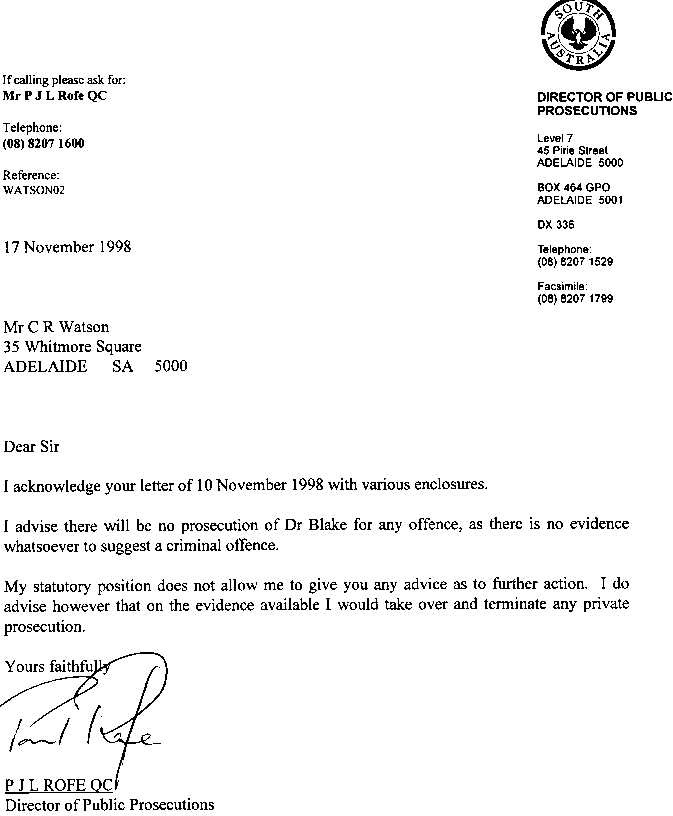
http://www.geocities.com/CapitolHill/Lobby/7077/Rofe.gif
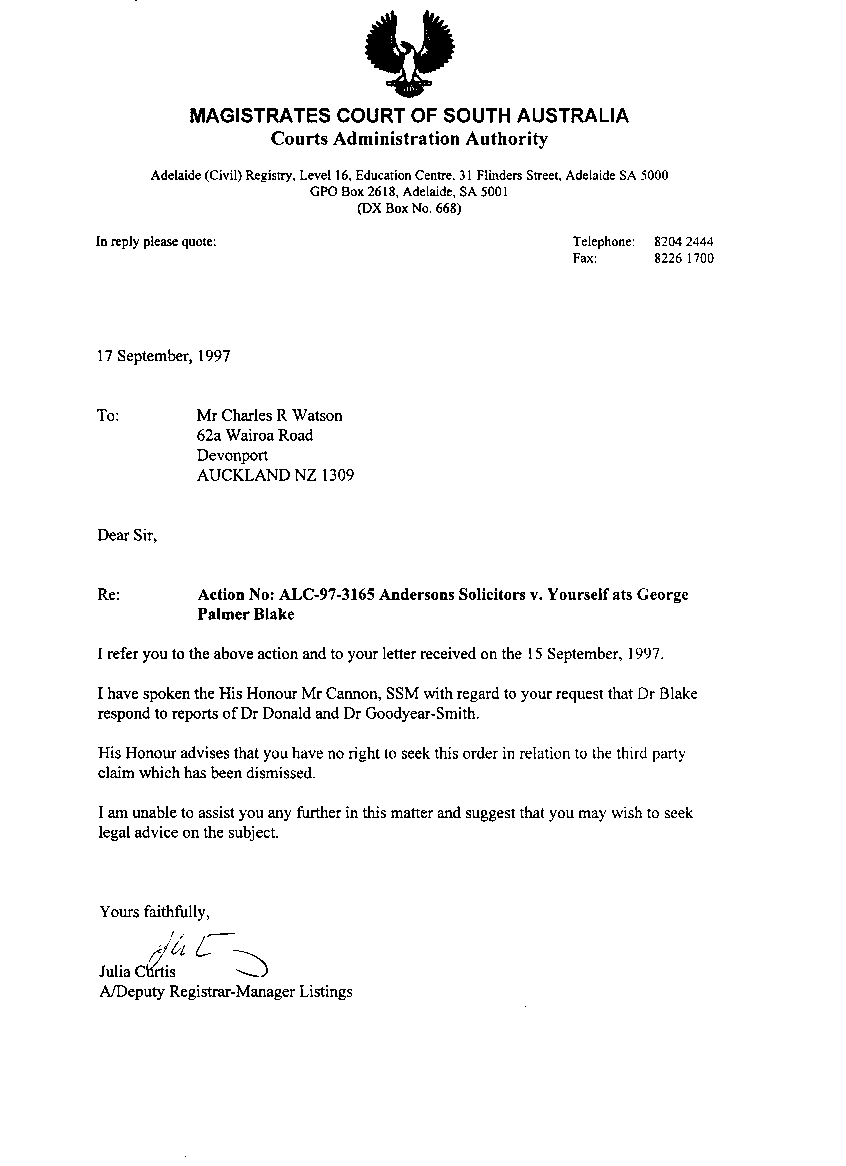
http://www.geocities.com/CapitolHill/Lobby/7077/Cannon.gif
http://www.geocities.com/CapitolHill/Lobby/7077/Liz.gif
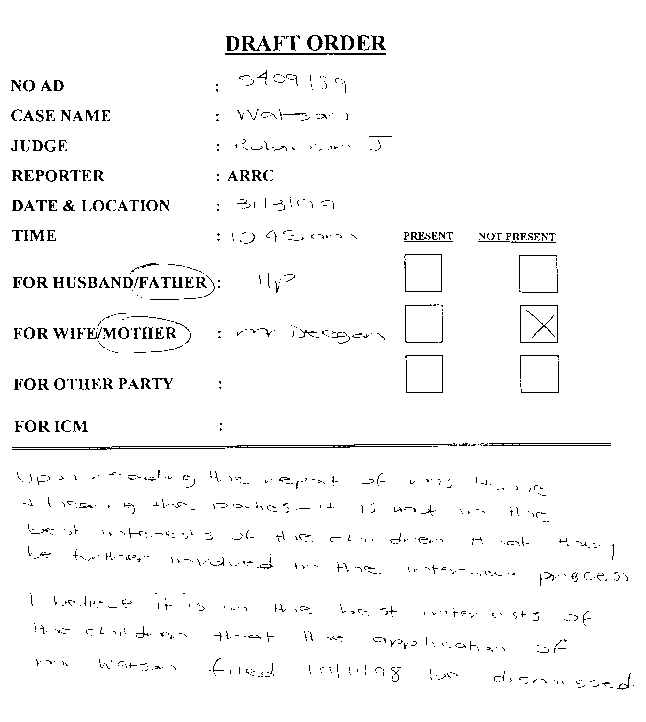
http://www.geocities.com/CapitolHill/Lobby/7077/Robinson.gif
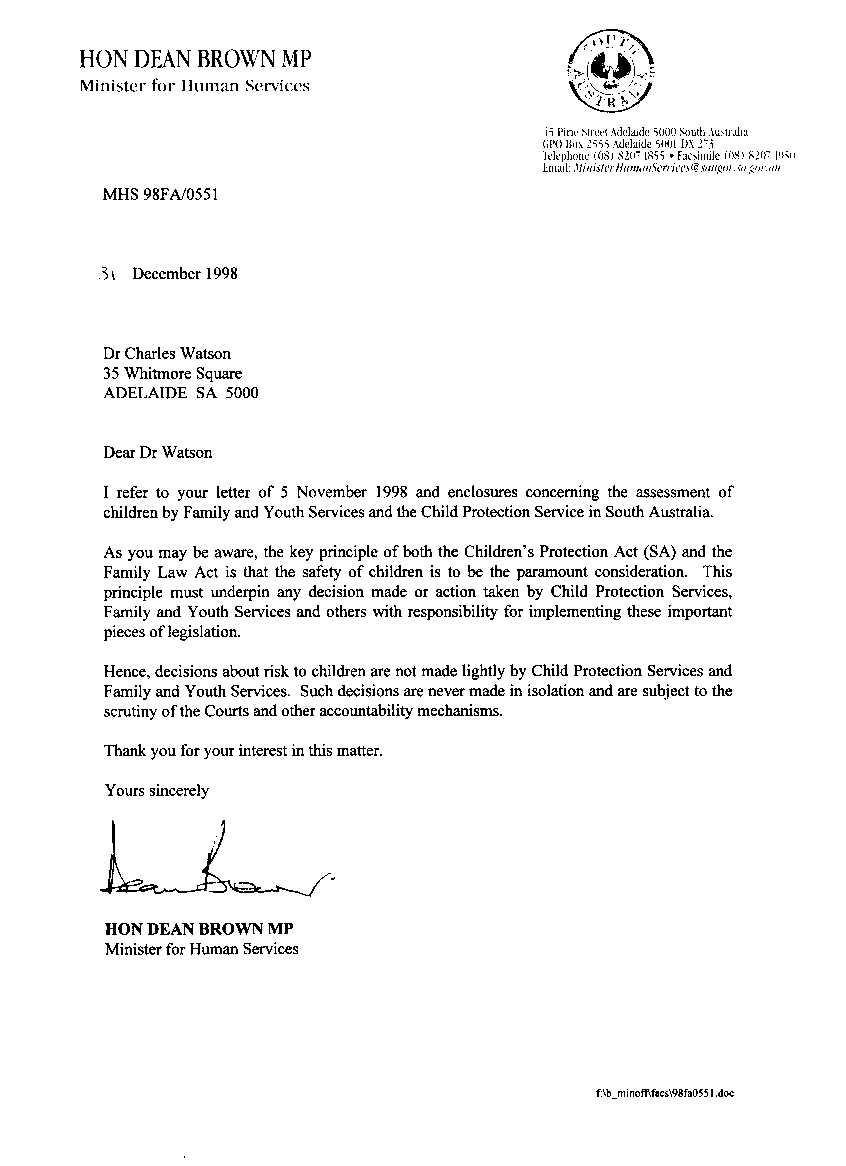
http://www.geocities.com/CapitolHill/Lobby/7077/Brown.gif
http://www.austlii.edu.au/au/cases/cth/high_ct/unrep99.html
http://www.austlii.edu.au/au/legis/cth/consol_act/fla1975114/s121.html
http://www.austlii.edu.au/au/legis/cth/consol_act/fla1975114/s22.html
http://www.austlii.edu.au/au/legis/cth/consol_act/fla1975114/s43.html
http://www.austlii.edu.au/au/legis/cth/consol_act/fla1975114/s60b.html
http://www.austlii.edu.au/au/legis/cth/consol_act/fla1975114/s68f.html
http://www.unhchr.ch/html/menu3/b/a_ccpr.htm
http://www.unhchr.ch/html/menu3/b/a_opt.htm
http://www.unhchr.ch/html/menu3/b/k2crc.htm
http://www.geocities.com/CapitolHill/Lobby/7077/WATSON.HTM