MS SIMPSON: Thank you. Other than the correspondence which is already in evidence, I am not proposing to call anything further.
CHAIRMAN: Do you wish to address the matters that are in evidence?
MS SIMPSON: Yes, thank you, I can make some submissions now.
CHAIRMAN: Thank you.
MS SIMPSON: Thank you. I will begin by addressing the first of the complaints which were identified by the board and, in particular, by Miss Eszenyi at page 16 of the transcript of the last hearing day, and that is that the doctors, and in particular, Dr Blake, has told lies.
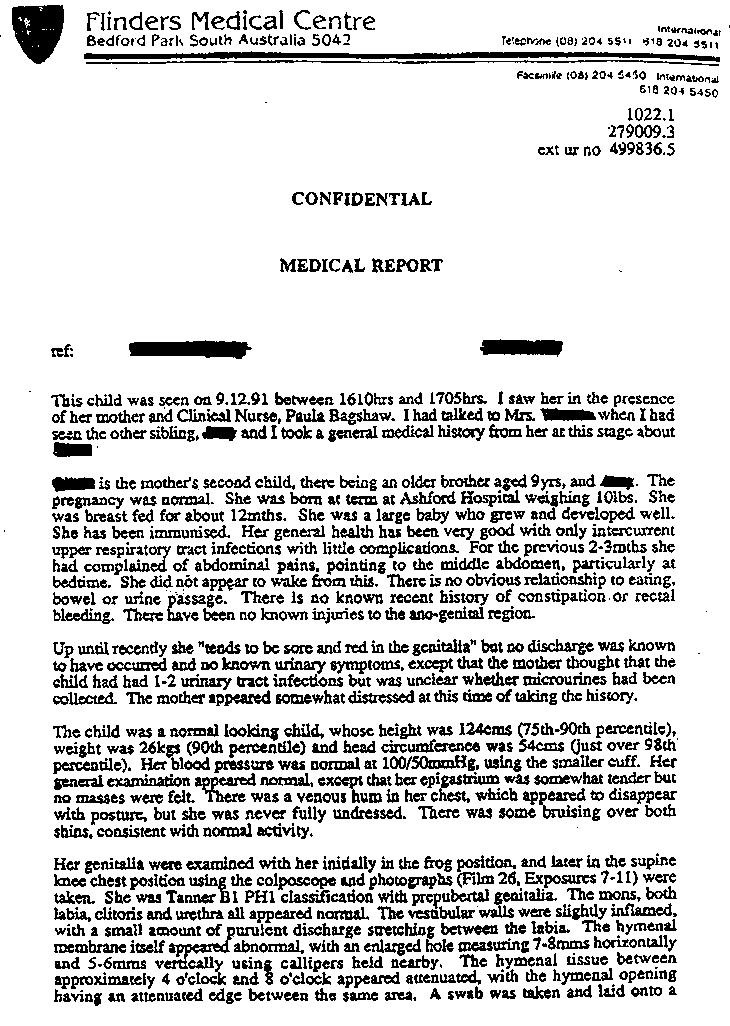
The evidence in support of that, as Dr Watson said in evidence himself today, is the assessment report which is now exhibit P5. I will just very briefly take the board to that, exhibit P5, and in particular at page 11, the bottom of the page, and it was already put in evidence to Dr Watson today, but in my submission that reference to "the doctors are lying" quite clearly comes as a result of an interview by Miss Fitzgerald, the clinical psychologist at Flinders Medical Centre in the Child Protection Service, with the mother of Helen.
The mother of Helen, Fiona, reported to Miss Fitzgerald that when she had raised the topic of possible sexual abuse with her daughter, Helen made two remarks. The first one is not relevant particularly in these proceedings but the second is: she made a comment that "the doctors are lying".
In my submission the board could not possibly rely on the remark, first of all made by a child of six at the time, but to her mother in the context that is described there as supporting as a matter of fact that Dr Blake has told lies, and I don't think I need to develop that much further. It is quite clear, in my submission, that no finding could comfortably be made on the basis of that report. Secondly, the complaint is that Dr Blake obstructed Dr Watson in his attempts to find out information relating to what can only be the medical examination of the children because that was all that, in my submission, it is clear on the evidence that Dr Blake was involved in.
I refer the board to the evidence given by Dr Watson today, which sets out the chronological sequence of events which, in my submission, is relevant to that complaint. It is also apparent in exhibit P4, which is the judgement of Burton J in the Family Court - I draw the board's attention in particular to the fact that on 14 March 1992 Dr Watson was charged with unlawful sexual intercourse and indecent assault of both Sasha and Helen, and was put on bail.
In evidence today Dr Watson said that on the first working day after that, 16 March 1992, he telephoned Dr Blake to get some information about the physical examination. In my submission it would have been entirely inappropriate for Dr Blake to discuss matters with Dr Watson in those circumstances. Not only in my submission was he constrained by confidentiality - vis-a-vis the two girls who were his patients - but in addition it was then a matter in the hands of the police, so in my submission in any event it would not have been appropriate.
However, in my submission, Dr Blake was never obliged to give any information regarding those very sensitive matters to Dr Watson. We simply say that in those particular circumstances after 14 March 1992 and until 5 February 1993 it would have been inappropriate in any event for him to discuss those matters with Dr Watson.
During 1992, as well, Dr Watson was absent from South Australia for large periods of time. He returned to South Australia in September 1992, having left in May. I draw the board's attention to the postcard which was sent to Dr Blake at some stage - and it is either the beginning of 1993 up until perhaps June of 1993 - and ask the board to take it into account simply on the basis that it was not a situation where any medical practitioner, having dealt with a very sensitive medical examination of two very small girls, would have been obliged to speak to the alleged perpetrator of that abuse and, in particular, having received a postcard which was, on Dr Watson's own admission, intended to be offensive.
Notwithstanding that we accept that if there had been a medical need for discussion with Dr Watson relating to those examinations any offence offered by that person would not prohibit a medical practitioner speaking to the person asking for the information but, in these circumstances, it was not appropriate, in my submission, given the confidentiality of the circumstances surrounding those examinations for Dr Blake to speak personally to Dr Watson if he chose not to.
Having said that however it is my submission that it is clear from the correspondence which is now in evidence as exhibits Dl and D2 that there were attempts to communicate with Dr Watson, notwithstanding that some of those he apparently did not receive due to the fact that he was both away and had no address for mail to be forwarded to. It is my submission that Dr Watson was not left in a state where he had been ignored or where people had paid him no attention whatsoever; in fact there was quite a flurry of activity which he generated between April and around September 1993, where he received replies - I'm sorry. I withdraw that - where replies to his queries were at least sent to him. I ask the board to accept that they were sent from not only the Flinders Medical Centre, from Karen Fitzgerald there; from Prof Blandford; from Dr Pilowsky and from Dr Maxwell at the Australian Medical Association.
Dr Watson in fact was away from around April 1993 until October 1993, so in my submission it sits rather ill in his mouth to say that Dr Blake made no attempt to give him this information when he was in fact away.
Now, I say that but I also accept that Dr Blake had no intention of giving him any information in any event. I also understand - and from what Dr Watson has said today it seems clear, especially if he did not receive those replies, that he may have felt that there was no appropriate response to his inquiries, but it's my submission that there is no evidence that there was any unprofessional conduct on the part of Dr Blake; quite the reverse in fact.
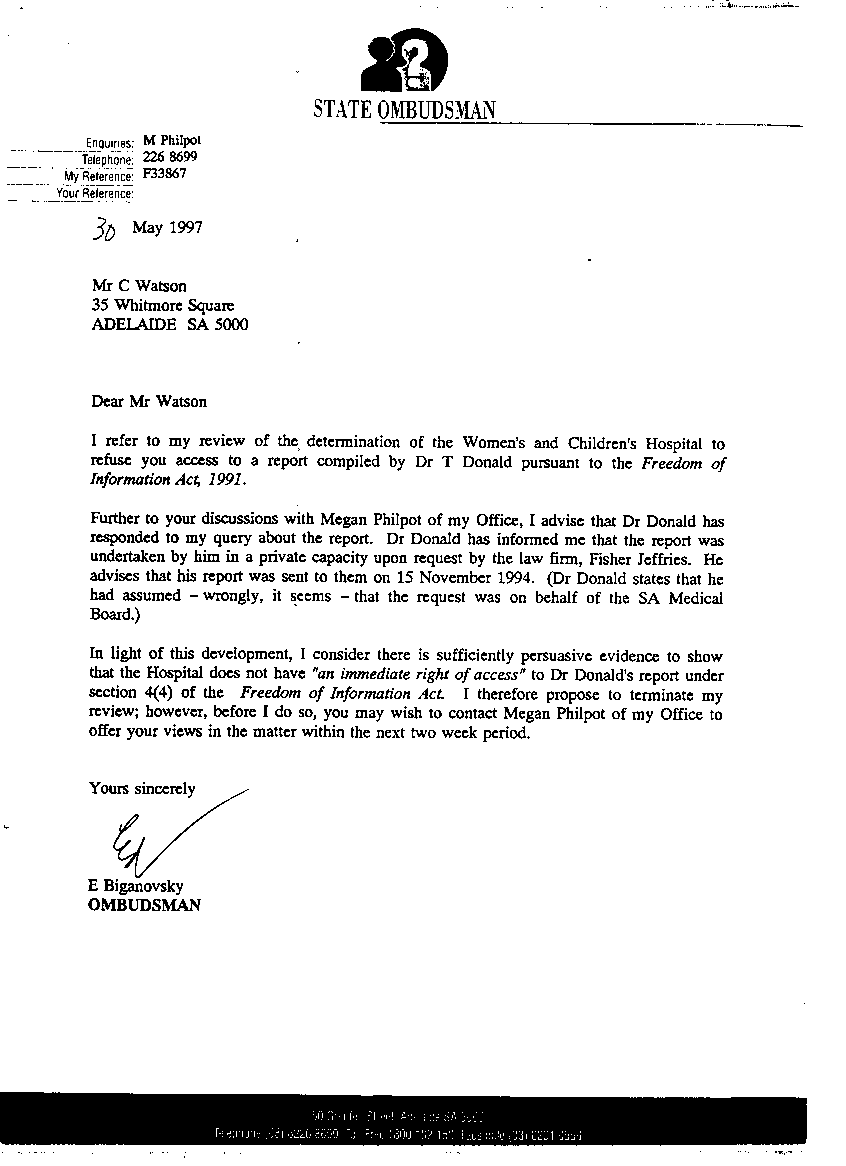
I am sorry. I have also omitted a reference to the ombudsman's correspondence, which is now in evidence as exhibit P7, and further correspondence from the Australian Medical Association. I don't have the dates of that correspondence as yet because I haven't got a copy of those letters - - -
CHAIRMAN: It's all right.
MS SIMPSON: - - - but it forms part of that series of letters following a series of inquiries generated by Dr Watson. In 1994, and from the beginning of 1994, Dr Watson pursued a legal method of gaining access to the records of Flinders Medical Centre; that is, by seeking those through a Family Court process. Those records were refused to him in that legal application.
In June of 1994 however there was a Family Court hearing and in the course of that hearing Dr Blake gave evidence. His evidence was accepted by Burton J and the relevant passage appears at page 8, and if I might just refer the board to that now. It is part of exhibit P4. Page 8 of that exhibit, Burton J says in the last paragraph:
As regards the third of the complaints: it is that Dr Blake's conduct was unprofessional in that he involved himself in an evaluation which did not comply with internationally-recognised guidelines.
Firstly I say that there is no evidence that Dr Blake did involve himself in an evaluation.
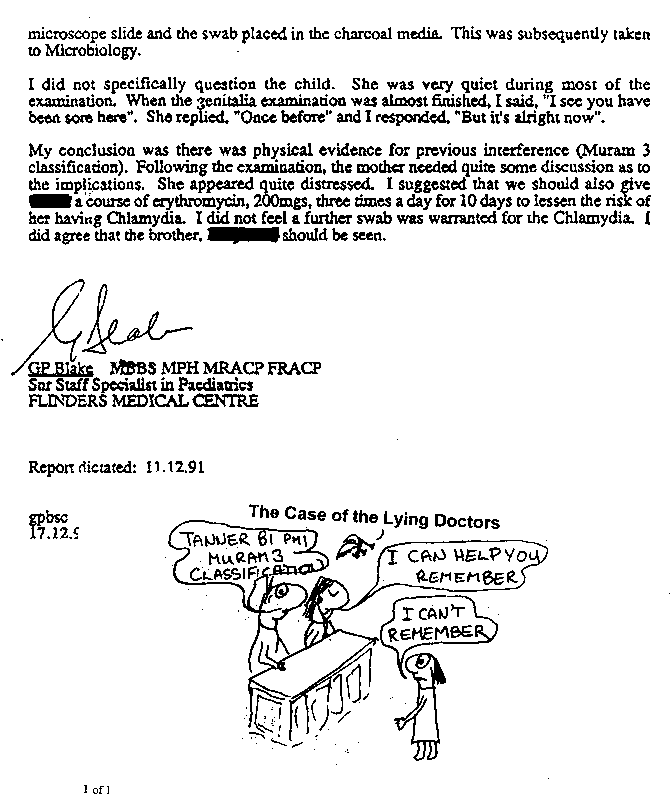
To begin with the evidence is that he was the one who conducted a medical examination and other staff at the Child Protection Service conducted the evaluation. To some extent I am dependent here on plain understanding of what the words are evaluation. If it is that the evaluation covers everything that the Child Protection Service does and it might - then it is my submission that Dr Blake's role in that evaluation was simply that of a medical examiner looking for physical signs of sexual abuse, and that appears plain, in my submission, firstly from Dr Blake's reports, which are exhibit Pl - it is exhibit P2 in relation to Sasha; that's the statement to the police officer, and a further statement to a police officer, exhibit P3. In addition, exhibit P5, which is the assessment report of Miss Fitzgerald and Mr Mulhearn.
At page 1 it is set out there the reason for referral and the services provided and the history of the referral is set out regarding both Sasha and Helen. It is then recorded that Mr Peter Mulhearn interviewed Sasha on 19 November, 20 November, 29 November and 4 December; Jeremy on two other occasions, and Fiona on five occasions.
Miss Fitzgerald interviewed Helen on 29 November 1991, 5 December 1991, 17 December 1991 and then Fiona on two other occasions. There is also a remark that the police witnessed the last three interviews of Sasha and the final interview of Helen and, finally, Dr George Blake medically examined Sasha on 18 November 1991 and Helen on 9 December 1991, and a reference to his medical reports.
So in that sense we accept that Dr Blake was involved in the evaluation of the allegations of child sexual abuse that had been raised but only in the context of the medical practitioner conducting the physical examination. As far as the
internationally-recognised guidelines go, there is before the board Dr Le Page's protocol - I think is the shorthand reference to it; in fact, it is the child sexual abuse the investigative and forensic methods position statement I'm sorry. that's in the appendix. It appears to be really a paper presented to a Family Law section of the Law Council of Australia in 1990 and it has been apparently prepared by Dr Le Page and two lawyers from Adelaide.
The only relevant section to physical examination appears at pages 309 to 310 of that document and it is our submission that there is no evidence to suggest that the factors that are set out there were not complied with by Dr Blake in any event.
The weight however that can be put on such a document, in our submission, is very slight indeed because it has not been tested in any way before the board. Dr Le Page has not been called to give evidence to speak to that. Indeed Dr Le Page is a psychiatrist and, in our submission, may not be the appropriate specialist to comment on a specialist paediatrician's physical examination of a child unless there was evidence to suggest that he was qualified to do so.
The same submission applies to the material now in evidence as exhibits P10 through to P13, which is the report of Dr Le Page, exhibit P10, dated 24 May 1994. In my submission that only addresses interview techniques and not physical examination.
The British Journal of Hospital Medicine article, exhibit Pll, as I mentioned earlier, contains a reference to the physical examination at page 57 - it is paragraph 10 of that document and it goes from page 57 to page 58, and again in my submission there is no evidence to suggest that Dr Blake has departed from what is suggested in there at all.
There is no expert evidence in fact before the board to suggest that there has been any breach of any standard of professional practice by Dr Blake in his conducting of the examination of Helen and Sasha. Fourthly, the complaint is that Dr Blake's conduct was unprofessional in that he misdiagnosed one or both of the two girls, Sasha and Helen. Firstly, before any finding of unprofessional conduct on that basis could be made it is my submission that the board would have to find in the first place that Dr Blake owes a duty of care to Dr Watson.
It is true that under the Medical Practitioners Act negligence could be a basis for unprofessional conduct. There are two stages before a finding of negligence could be found in my submission and that is, firstly, that there must be a duty owed to the person making the complaint - in this case it is Dr Watson - and secondly, that there has to be a breach of the standard of care owed because of that duty.
In my submission there is no evidence to suggest either With regard to the first, I refer the board to the judgement of Hillman v Black and Govan and others. It is a judgement of Duggan J delivered on 13 April 1995. I have three spare copies, which I could - - -
CHAIRMAN: Thank you. We will label that D3.
MS SIMPSON: It is not really an exhibit. It is just a reference.
CHAIRMAN: All right.
MS SIMPSON: I won't take the board to it in particular now, but at pages 18 to 29, Duggan J sets out the relevant law with respect to a situation where a father who has been accused of abusing his daughter brings an action in negligence against amongst others - doctors who have made findings which might indicate that there has been some sexual abuse of the child, and his finding in that case was that there are a number of reasons why no duty of care can be said to be owed to that father.
I rely on that judgement for the proposition that there is no duty of care owed by Dr Blake to Dr Watson in these proceedings and therefore there could be no finding of negligence on the basis of a complaint brought by Dr Watson.
If I am wrong about that and if the board feels that it is capable of looking at the standard of care in a vacuum - that is, it can assess Dr Blake's standard of professional practice without concerning itself with whether or not a duty of care is owed to Dr Watson - it is my submission that in any event there is no evidence at all to suggest that there has been any breach of a standard of care; in. fact there is no evidence of what the standard of care is from any expert witness here in circumstances of this kind.
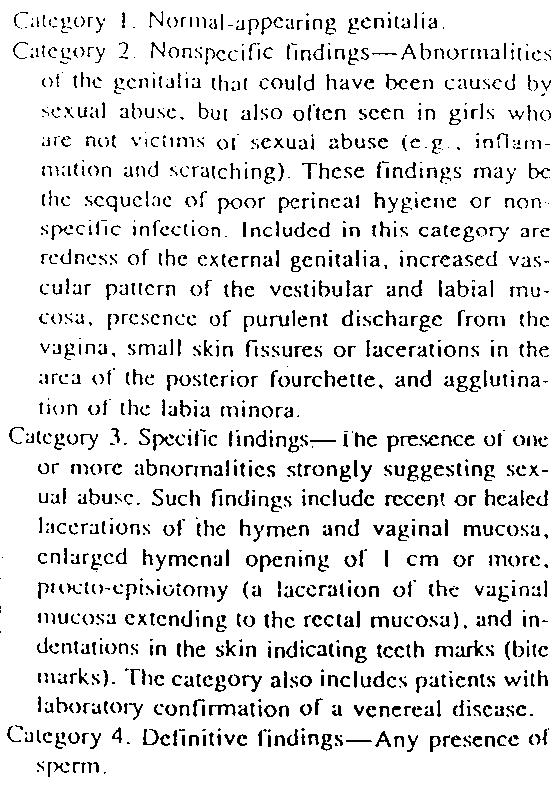
There is certainly no evidence of any breach of the relevant standard of care, so on the last complaint - that is, of misdiagnosis - it is my submission that there simply is no evidence other than an assertion by Dr Watson that in his opinion Dr Blake's evaluation does not fall within the classification that Dr David Muram suggests in a letter, which is now an exhibit - I'm sorry, I don't have the number. P8, thank you.
It is a letter to the editor and it appears to be to a journal - I think, a Journal of Adolescent, Paediatric Gynaecology - an American publication. There are two letters to the editor: one is from Dr David Muram and another is in response from Dr Richard Rheindoler.
It is my submission that assertions by Dr Watson relating to whether or not category 3 applies to his daughters is not evidence on which the board can rely to make a finding that there has been a misdiagnosis by Dr Blake.
I mean, just to look at category 3, specific findings are suggested there: the presence of one or more abnormality strongly suggesting sexual abuse, and then it sets out what those findings might include but it is quite clear that those findings which are mentioned there are not exclusive; that is, it doesn't suggest that they are the only ones that apply and, in my submission, the only evidence of an expert nature regarding that is Dr Blake's report itself. In my submission an assertion from Dr Watson that because a hymeneal opening measurement of less than 1 centimetre is recorded by Dr Blake therefore there has been a misdiagnosis is not acceptable or admissible evidence upon which a finding of unprofessional practice could possibly be made. Unless there is anything further those are my submissions.
CHAIRMAN: Thank you. Dr Watson, you have a right to summarise your case.
DR WATSON: yes.
CHAIRMAN: It is my intention that - if all are we will then adjourn and see if we can agreeable come to a conclusion about this matter today rather than have to call you all back again, so it will be a little bit late but that is my intention.
DR WATSON: Right.
CHAIRMAN: Are you both agreeable to that.
MS SIMPSON: Yes, thank you.
DR WATSON: Thank you.
CHAIRMAN: At this stage it is usual to try and present a brief summary of the main things that you want us to take into account. Is that all right?
DR WATSON: Yes. I will address the complaints in order. Firstly, Helen did make the statement, "the doctors are lying"; that has been confirmed through cross-examination in the Family Court. This hearing is under section 54(1)(d) of the Medical Practitioners Act on behalf of Helen. I am not appearing because of damages to myself. I am not arguing proximity to Dr Blake in that he has neglected a duty of care to me. I am only arguing that he has neglected a duty of care to the children, who cannot be represented until they are 18 years of age. And that is the tragedy of this situation: that Helen, the day before yesterday, said to me that she wanted $10,000,000. Now, she may have a claim to sue Dr Blake for $10,000,000 in 8 years' time, but it is not really going to do her any good in the interim.
I am still having negligible contact. I have had 10 hours with my children this year. it has been like that for the last 3 years. A great deal of hardship has fallen on the children because of Dr Blake's refusal to admit that he has made a mistake and to make an apology.
Regarding my second allegation about obstruction: I see in light of the correspondence that was sent to me by the Flinders Medical Centre by Jill Maxwell and others - that attempts had been made to at least acknowledge my concerns in the early days and some of those acknowledgements I haven't received, so it is unfair for me to blame Dr Blake for obstruction when he did in fact, in that case of the letter, do the right thing.
I understand that he has to be immune from - as a prosecution witness, while I was charged he had to be immune from harassment from me, and I was able to obtain stuff through the police. The tragedy with this is that Dr Blake has washed his hands of the responsibility of doing this and the police won't prosecute because they don't believe there is a case there.
Dr Blake made the assertion that there was physical evidence of abuse and that was right at the beginning of the evaluation, before the girls were interviewed, and that was used by the interviewers as strong evidence to press their questioning, which led to being coercive and brainwashing - effectively brainwashing - the children; putting thoughts in their heads.
Now, if Dr Blake had done an honest evaluation and said that there was no physical evidence of abuse when he examined the girls he could have reassured Mrs Watson, sent them home and that would have been the end of the situation.
Regarding my failure to bring a second opinion to this board or to the Family Court: there are a lot of cases that have gone before where contradictory medical evidence has been taken piecemeal by judges and other contradictory evidence has been disregarded.
We have a problem here in the state of South Australia. There have been a lot of cases where there has been contradictory evidence regarding allegations of child sexual abuse and these issues haven't been addressed; they haven't been resolved. The experts won't even sit down and agree on a methodology, and that's what I am pleading with the board to do, so that nothing like this happens to children like Helen and Sasha.
The community as a whole needs to be able to go to the Child Protection Service and know that they are going to do a fair evaluation of any one who is suspected of being abused, and for people to go ahead - like Dr Blake - and jump the gun and jump to a conclusion before all the evidence has been looked at and before all the versions of the story have been heard - I have been precluded right from the outset from the evaluation. The only chance I, get is through cross-examination in the courts. The papers that I put for the submissions to support the - that he hasn't complied with the international guidelines, the third complaint - it seems to me that Dr Blake's observations on the face of it should have classified Helen as category 1.
I just can't get around that.
Dr Blake we are at loggerheads as far as getting a second opinion. I would like to ask Dr David Muram, or someone locally who could give an opinion. I don't expect you to accept my opinion, because I have no expertise, apart from what I have read in this area.
The fourth complaint is that Dr Blake has misdiagnosed the children. I'm convinced that that is the case and I challenge Dr Blake now to speak to me about his findings; try to convince me that there is physical evidence for previous interference, which is what he says in his statement, if he still holds that opinion. If he has changed his opinion then I would like to know and I would like an apology for the sake of the children. That's all I have to say.
CHAIRMAN: Thank you.
MS SIMPSON: There is just one, if I may.
CHAIRMAN: Sorry, Ms Simpson.
MS SIMPSON: There's just one small matter. It was asserted by Dr Watson that Dr Blake's examinations occurred before the girls had been interviewed. That is correct as regards Sasha. It's not correct as regards- Helen. Helen had been interviewed three times before she was examined. Thank you.
CHAIRMAN: We intend to go in here and see if we can talk this through to a conclusion tonight. The reason for that is that this is an exhausting process for all of you and it seems to me a better thing for us to try and resolve it if we can. If we can't, well, that will become fairly clear early on, and we will come back and say to you we need to reserve our judgement and think, but if we can we will come back and give you our findings.
ADJOURNED 5.15 PM
RESUMING 5.30 PM
CHAIRMAN: Thank you for agreeing to stay. I should mention each time we adjourn we try and think through what we have heard, so we have been able to come to our conclusions reasonably, we feel. A few opening points. I would like to acknowledge that this whole area is a difficult and stressful area for everybody, for yourself and other people in your position and for the medical teams and evaluation teams, and everybody. It's a very stressful difficult area and requires a great deal of thought and attracts a great deal of controversy, and we are aware of that.
We also would say to you that representing your own case is difficult. It's open to you to have a lawyer or not and you are free to do that, and we recognise that it's difficult and we hope that you can see that we have tried to help you along the way to be able to present your case effectively, or at least to be able to understand how this works so that you can deal with the situation.
DR WATSON: Yes.
CHAIRMAN: Now, turning to the actual allegations we have come to some conclusions. Firstly, on the matter of - Dr Blake's conduct was unprofessional and he was lying. That allegation seemed to rely, in the evidence that was presented, mainly on a transcript of another person's interview at a time when your daughter was about six and we would take the view that information derived at such a distance cannot be really seen as evidence of Dr Blake lying.
We also note that in the materials that were provided by yourself that that statement also occurred in conjunction with other statements which seemed to go in the opposite direction, so we conclude that that is not evidence of unprofessional conduct and that idea that Dr Blake was lying in this matter has not been supported.
On the matter that the conduct was unprofessional and he obstructed you, we have spent quite a lot of time thinking about that issue and the point we would wish to make is that many ethics committees - not legal committees, ethics committees - would take the view that it would be unethical for Dr Blake to take part in personal conversations with you, as an example of an overarching ethical rule that the profession is expected to follow, which is that they should not take part in conversations with people who are not directly their patient, but rather relative to the patient, where there are legal proceedings going on. That is a widely understood rule of medicine.
DR WATSON: Yes.
CHAIRMAN: And like many ethical situations, can be argued through to exceptions, but no evidence was put before us that this should be an exception. Furthermore, it seems to us that some part of the perceived obstruction resulted from the fact that you were unable to be contacted. Now, there may be many explanations for that and we are not allocating any blame.
We are simply saying that the letters were sent and you didn't receive them, and I think it seemed to us from the evidence that was presented that that was part of the way in which you felt obstructed, that you hadn't heard back, and the fact that you couldn't have heard back about some parts of it does not support an obstruction viewpoint. The other aspect of this, and it touches on some of the other allegations too, is that we know from your summing up that you had doubts about the value of getting the second opinion. I think you felt that it might not be well listened to in court, a second opinion.
DR WATSON: Even if I could find one I'm unable - - -
CHAIRMAN: Please, I'm just explaining to you our understanding of the evidence. So we don't doubt that you knew that you could pursue a second opinion, but we didn't - and there were times when you indicated that it wasn't easy to get people to offer such an opinion, at least to come here to offer it, so we are prepared to accept that you may have had trouble in other settings getting second opinion. But there doesn't seem to be any doubt that you knew that it was possible, but we didn't really hear a lot of evidence about the problems you had in obtaining that, but that would have been a method of trying to get round this problem.
How readily available to you or not that was, is not available to us to know, but taking all those into account we don't think that Dr Blake was obstructive in an ethical sense or a clinical duty of care sense, although we do recognise that you were probably deeply distressed, but Dr Blake's first duty was to the people who he was assessing, which was your daughters. So we do not find him guilty of some deliberate obstruction to - or absence of compliance with a duty of care.
On the matter that he was unprofessional in that he involved himself in a valuation which did not comply with the internationally recognised guidelines, we take the view that the work of Dr Blake was to provide what is often called a medical assessment in this setting. I emphasis that because there are other settings in which a medically trained person might acquire other kinds of information as well, but in this setting the task seems clear; it's a physical assessment with whatever investigations are thought to be important, so that we confine ourselves to the role of the physical assessment. Now, we found no evidence that there are internationally recognised guidelines, and indeed a number of the documents that were put before us said that, although it's clear that there is an international striving towards trying to get guidelines that others can use and agree upon, but David Muram, for example, says there aren't any and he puts his views and others put theirs. We couldn't say whether in 1995 a point has been reached where there's a lot of agreement internationally about guidelines, but we certainly had no evidence that there is an internationally recognised set of guidelines.
The board takes the view that the evidence put before us is that Dr Blake was perceived as a senior paediatrician and Burton J talked to his perception of those qualifications and of his care, and we find nothing to suggest otherwise, in what has been put to us, and in looking at the data presented about physical examination we find that the reports of what Dr Blake did, which was the data that we had about - the evidence we had about his reports are consistent with most of the actual statements as they applied to the physical examination, and we didn't attempt to look at other people in the teams efforts.
The other point I would wish to raise is that it is important for a senior commission to be able to work in ways which also reflect their experience so that there would be, within any set of guidelines which were derived and which had a fair amount of international credibility, an array of ways of interpreting them. That is the nature of a guideline; it is not a rule. So we do not find that his conduct was unprofessional in that matter. On the last issue that his conduct was unprofessional and he misdiagnosed one or both of your children, we did not find evidence that allowed us to arrive at a conclusion of misdiagnosis. The evidence that was presented from his bit was accepted; it was clearly presented.
It was accepted in Burton's statements very clearly. It is of course true that although it's only one part of the data, and it's an important part, we acknowledge that, and Burton J referred to that on several occasions in his findings, but he did not refer to any views that there may have been a misdiagnosis and we heard no evidence that led us to think there might have been.
That is not to say that we have assessed all the evidence that goes into the diagnosis, but we were presented with no evidence that led us to a view of misdiagnosis here, and we are not allowed to take into account anything other than what is provided to us, which is all the materials what we read, what you have told us, and taking into account the things that Ms Simpson has told to us. So we do not find him guilty of misdiagnosis. In summary, we do not find any of the allegations proven or lead to an allegation - to a conclusion of unprofessional conduct, and that is the end of our statement. Are there any other things you wish to say, Ms Simpson.
MS SIMPSON: I ask for costs of the hearing, if it please the board.
CHAIRMAN: In the light of the way this has gone we would allow that. We would want it either to be drawn up and agreed upon between the parties or sent to us to be taxed. Mr Wilde can explain to you what that means, Dr Watson. Thank you.
ADJOURNED 5.44 PM
HyperText:
http://www.geocities.com/CapitolHill/Lobby/7077/blake.html
http://www.geocities.com/CapitolHill/Lobby/7077/gall.html
http://www.geocities.com/CapitolHill/Lobby/7077/78B.html
http://www.geocities.com/CapitolHill/Lobby/7077/form42.html
http://www.geocities.com/CapitolHill/Lobby/7077/hc.html
http://www.geocities.com/CapitolHill/Lobby/7077/legalaid.html