
| Home | News/Activities | Position Papers/Articles | Statements of Support | Photos | Links | Contact us |
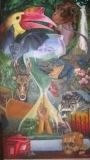
Mt. Kanlaon, Its Myths and Wildlife, Painting by Masaste
1 2 3 4 5 6 7 8 9 10 11 12 13 14 15 16 17 18 19 20
|
Table of Contents:
|
|
Mt. Kanlaon Natural Park Management Plan June, 2008 (official management board document with information on the profile of the protected area and the management plan of the park)
II. INTRODUCTION III. PROFILE OF THE PROTECTED AREA. A. Historical Context and Rationale for Protected Area Establishment B. Regional and Local Development Context C. Physical Features: Location, Geology, Soils, Topography, Hydrology, Climate, Hazards D. Biological Features: Habitats and ecosystem; Fauna E. Social, Economic and Cultural Profile: 1. Population, demographics, and migration patterns; 2. Indigenous groups’ cultural profile; 3. Land use, ownership and tenure; 4. Resource use practices; 5. Poverty levels; 6. Social indicators; G. Current and Proposed Programs and Projects in MKNP H. Current PA Management Structure and Capabilities for Management I. Major Management and Development Issues and Concerns
IV. MANAGEMENT PLAN . . . . A. Vision, Missions, Goals, and Objectives B. Strategies: 1. Management zoning; 2. Integrated protection, rehabilitation and monitoring; 3. Research and documentations; 4. Community-based resource management; 5.Establishment of non-destructive livelihood alternatives; 6.Information, education and communication; 7. Human resource development; 8. Sustainable resource generation & mobilization; 9. Institutionalization of PA administration & networking; 10. Disaster management 1. Biodiversity conservation and environmental restoration, preservation of landscape, unique habitats and species and cultural characteristics; 2. Economic and social programs; 3. Management structures, capacity, and participation; 4. Disaster Management; E. Management Standards and Guidelines
V.PROPOSED MANAGEMENT STRUCTURE AND INSTITUTIONAL ARRANGEMENT VII. BUDGET AND FINANCING PLAN VIII. MONITORING PLAN . . . . A. Monitoring System, B. Evaluation System IX. REFERENCES
|
 Mt. Kanlaon Natural Park
Management Plan: June 2001(Con't)
3. Fauna
The fauna of MKNP shows a pattern of “high diversity or species richness as elevation decreases while low species richness as elevation increases”. The presence of high species richness of fauna in the lowland elevation areas of MKNP can be attributed to its various types of habitats. A greater number of habitat types results in a greater species richness of fauna. Lowland areas also have several plant species that serve as food resource for wildlife.
a. Birds
Bird species richness on the lowland habitat corresponds to 52 species, while 13 and 7 species for montane and mossy forest habitats, respectively. The Jungle fowl, Gray Swiftlet, White browed Shortwing and Snowy browed Flycatcher are some of the birds seen in all 3 habitats. The recent inventory data showed that bird endemism is highest in low land areas (42.3%) vis-à-vis montane forest (30.77%) and mossy forest (14.28%). Of the 22 endemic species listed, 3 are included in the IUCN List of Threatened Species as endangered. Previous studies showed that these were found at lowland areas and include the Visayan Tarictic Hornbill, White-winged Cuckoo Shrike and the Flame-temple Babbler. The Negros Fruit Dove and the Negros Bleeding Heart are two Negros endemics classified as endangered, which have been recorded in previous studies. Table 3 lists some of the important bird species found in MKNP.
Several species of birds are utilized by local communities for food, pets, medicine, and for trade. Among the 28 listed species hunted for their meat, three are Philippine endemic including the Yellow-breasted fruit dove, Visayan Tarictic Hornbill and the White-winged Cuckoo Shrike. The nests of four sies are gathered for food of which one is Philippine endemic. Some species also serve as environmental indicators for local people. They are used to predict the coming of rain and the time for planting.
|
Table 3. Birds of MKNP, their conservation status and local importance. Endemic species are in boldface. Conservation status is based on IUCN (1996). |
||||
|
Species |
Common name |
Local Name |
Conservation Status |
Local Uses |
|
Ptilinopus arcanus |
Negros Fruit Dove |
Manunton |
Negros endemic-critically threatened |
Food, trade, pets |
|
Ptilinopus occipitalis |
Yellow breasted fruit dove |
Dondonay |
Phil endemic- relatively common |
- do - |
|
Macropygia phasianella |
Slender billed cuckoo dove |
Manok-manok |
Non endemic- common |
- do - |
|
Gallicolumba keayi |
Negros Bleeding Heart |
Bangbanganay (lugom-lugom, yugom-yugom, tukmo) |
Endemic-crtically threatened |
- do - |
|
Ducula pickeringii |
Gray imperial pigeon |
Balod |
|
|
|
Columba vitiensis |
Metallic wood pigeon |
Agum-on (lubad-lubad, yugom-yugom) |
Widespread-uncommon |
|
|
Rionilurus diserurus |
Blue headed Racket Tailed parrot |
Tingiw |
Endemic-uncommon |
|
|
Loriculus philippensis |
Phil. Hanging parakeet |
Kulansi (kusi) |
Endemic-common |
|
|
Spizaetus philippensis |
Phil. Hawk Eagle |
Dapay |
Phil. Endemic-vulnerable |
|
|
Haliastus indus |
Brahminy kite |
Dapay |
Widespread-common |
|
|
Spilornis holospilus |
Serpent Eagle |
Tikwi |
Widespread-common |
|
|
Gallus gallus |
Jungle fowl |
Ilahas |
Widespread-common |
|
|
Chrysocolaptes lucidus |
Crimson backed wood pecker |
Maranday |
Widespread-common |
|
|
Coracina ostenta |
White winged cuckoo shrike |
Iyak-iyak |
Phil. Endemic-vulnerable |
|
Halcyon lyndsayi |
Spotted wood king fisher |
Salaksakan |
Endemic- near threatened |
|
Stachris speciosa |
Rough templed tree babbler |
Pilik-pilik |
Endemic-endangered |
|
|
Otus megalotis |
Oriental screech owl |
Bukaw |
Endemic critically threatened |
|
|
Penelopides panini |
Tarictic Hornbill |
Tularik |
Endemic-critically threatened |
|
|
Aceros l. Waldeni |
Writhed billed horn bill |
Talusi |
Visayas endemic- critically threatened |
|
b. Mammals, Amphibians and Reptiles
Six (6) species of fruit bats and 4 species of large mammals are mostly found in lowland and montane forests of the park. The MKNP survey recorded low species endemism in lowland habitats (40%) compared to both the montane and mossy forest habitats (66%). Mammals found in the lowland areas are not included in the IUCN Red List. However, the said list indicates that the Visayan Warty Pig found in the montane forest is critically endangered similar to the Philippine Spotted Deer found in the mossy forest habitat. Table 4 shows the list of important species of mammals in MKNP.
The Mammals of MKNP have high endemism in higher elevation, with species, specially the endangered ones very restricted in distribution, preferring habitats with less disturbance and a dense vegetation. Most of the listed mammalian species such as wild cat/civets, pigs, deer and fruit bats are food source for local hunters.
Table 5 also provides a listing of the species of amphibians and reptiles found in the park.
|
Table 4. Mammals of MKNP, their conservation status and local importance. Endemic species are in boldface. Conservation status is based on IUCN (1996). |
||||
|
Species |
Common Name |
Local Name |
Conservation Status |
Local Uses |
|
Cervus alfredi |
Phil. Spotted Deer |
Usa |
Visayan Endemic- endangered |
Pet, food, trade |
|
Sus cebifrons |
Visayan Warty Pig |
Talunon |
Visayan endemic- endangered |
Pet, food, trade |
|
Prionalurus vampyrus |
Philippine flying fox |
Kabug |
Widespread- threatened |
|
|
Acedoron jubatus |
Giant fruit bat |
Kabug |
Phil. Endemic- uncertain |
|
|
Rionalurus bengalensis |
Little leopard cat |
Maral |
Non Endemic- vulnerable |
|
|
Table 5. Amphibians and Reptiles of MNKP, their conservation status and local importance . Endemic species are in boldface. Conservation status is based on IUCN (1996). |
||||
|
Species |
Common Name |
Local Name |
Conservation Status |
Local Uses |
|
Phyton reticulatus |
Reticulated phyton |
Magkal |
Widespread- common |
Food, trade, pets |
|
Varanus salvator |
Monitor Lizard |
Halo |
Vulnerable |
- do - |
|
Hydrosaurus pustulatus |
Sail fin lizard |
Ibid |
Common |
- do - |
|
Platymantis spelacus |
Negros cave frogs |
Paka |
Unknown |
|
|
Platymantis negrosensis |
Negros forest frog |
Manwit |
Endemic-common |
Food, trade |
|
Planymatis hazelea |
Hazel’s forest frog |
Paka |
Endemic-common |
|
|
Rana erythrae |
Common green frog |
Manwit |
Non endemic-common |
|
Table 6 summarizes the local uses for faunal resources in MKNP. As indicated, many species are primarily used for food while others are collected as pets or as sources of materials for medical purposes.
|
Table 6. Faunal resource use in MKNP. |
||
|
No. of Species |
Uses |
Conservation Status |
|
28 species of birds |
Meat serves as human food |
Three are Philippine endemic species (Yellow-breasted Fruit Dove, Visayan Tarictic Hornbill, and the White-winged Cuckoo Shrike. |
|
The nests of four swift species |
Gathered for food |
One of this is endemic to the Philippines Chaetura picina |
|
13 species of birds |
Collected as pets |
6 species have economic uses as part of the pet trade. |
|
3 species of birds |
Community environmental indicators |
C. picina and the Pied Wagtail, whose presence is believed to signal the coming of rain; while the call of the Philippine Frogmouth signals for the appropriate time for sowing rice seeds. |
|
6 mammalian species |
Reported as a food source for local hunters |
These include two (2) species of fruit bat: the Common Short-nosed Fruit Bat and the Musky Fruit Bat; the Leopard Cat; the Common Palm; the Visayan Warty Pig and the Philippine or Visayan Spotted Deer, which are already in the threatened list of mammals. |