|
|
         
|
Shelters Made From Tarps Making a shelter from a tarp is easy. These shelters can range from
something to keep the sun off, to a simple tent like structure that can be
used in place of a tent. These shelters can be used both for emergencies
and for general camp use. All the shelters shown here are intended for use
as a sleeping shelter, but most can be adapted to a general use shelter by
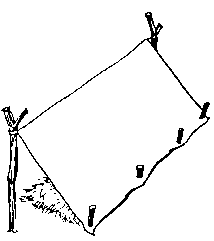
enlarging the size of the tarp to about 4m (12 feet) by 3m (9 feet). Sleeping Shelters: These shelters require few materials, and consequently can be brought along on many trips. For trips that require minimal packing these shelters can be used to replace a tent. On regular trips you can carry one of these as a backup. For most of these shelters you'll require a tarps around 2m (6 feet) by 1.5m (four feet), and about 3m (8 feet) of rope. If the shelter is to be your primary shelter take a nylon or canvas tarp. If you're using the tarp for emergency use a plastic tarp can be used to reduce size and weight. The best source of these plastic tarps are hardwear or paint shops. Simply get a medium thickness drop cloth, and cut it to size. If you are getting a tarp especially for making shelters get one with grommets. This will ease attaching ropes to the tarp. If you cannot get a tent with grommets you'll have to use this little trick. First find a rock about a third the size of your fist and place it on the tarp (if you can't find a rock several pine cones, a snow ball or a ball of dirt will do). Then pull the tarp around the rock and twist it. This should give you a t-shaped tie-in point. You tie the rope around the narrow part. A lean-to is not enough to sleep in. You must also insulate yourself from the ground. If you have a sleeping pad you can use this. If you don't you'll have to make a pad. Here are two ways of doing this: 1) Collect some green pine branches and/or long grass. Place this on the ground to form a mat. 2) This is a better form of the one above. Get several green pine branches. Drive the branches into the ground at about a 60 degree angle, with all the branches angled in the same direction (towards your feet). Continue this until you have a sleeping mat of the correct size. You can further increase the warmth of this bedding by filing in the spaces with more branches and grass. Basic Lean-to's This is the simplest of lean-to's. The upright forked sticks can be replaced by two tree's the right distance apart. The cross-piece can be either a rope or a stick. This one is good for blocking the wind. A large version of this can be used as a cook shelter or as a wind break. The top of the tarp should be about 1m (3 feet) above the ground. The tarp should be sloped steeply. To increase your warmth a small fire can be built near the open face of the lean-to. The closed side of the shelter should face directly into the wind.
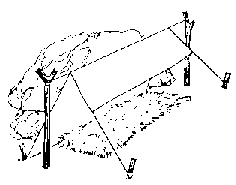
This is a slightly more advanced shelter. This one has the added advantage that it blocks falling rain. Like the one above this one also can be enlarged for other uses.
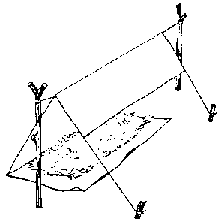
This shelter is based on the one above, but it includes additional ground insulation. This one requires a larger tarp. You build the above shelter, but bring the tarp back underneath to form a floor.
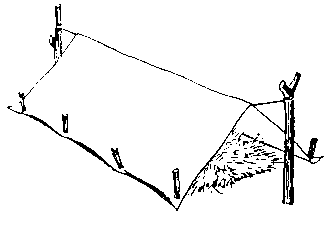
This is a more tent like shelter. Like the above shelter the uprights can be replaced by tree's, and the rope cross piece can be replaced by a stick. This shelter has the advantage of protecting both sides of you from the weather, and it blocks both rain and wind. However, you cannot use a fire with this one. To increase the warmth of this shelter keep the roof low (you should just barley be able to crawl in). If your tarp is large enough you can bring it underneath and form a floor.
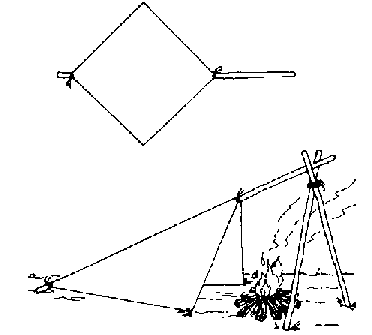
This shelter is also similar to a tent as well, but allows you to use a fire for extra heating. It's also different in that you orientate the shelter so that the "point" points into the wind. You can use either a tree or stick for the upright, but if you intend to use a fire you must use a stick. The roof support should be a stick, as a rope is not stiff enough to give you enough foot space. The high point of the shelter should be about 1m (3 feet) off the ground. You sleep with your head towards the opening.
|
This Page Copyright (2004), Knights of Dionysus
Authored by: Bryan Heit