|
|
|
Map and Compass Compass Basics Finding a bearing Compass Basics Types of Compasses: There are hundreds of compass styles. These range from simple compasses
that tell you the direction you're facing, to compasses that have an
accuracy of a few tenths of a degree. There are marine compasses,
aeronautic compasses, and many others. For basic back country use the
"Sylvan" type compass (it's also known as a mountaineers compass). This
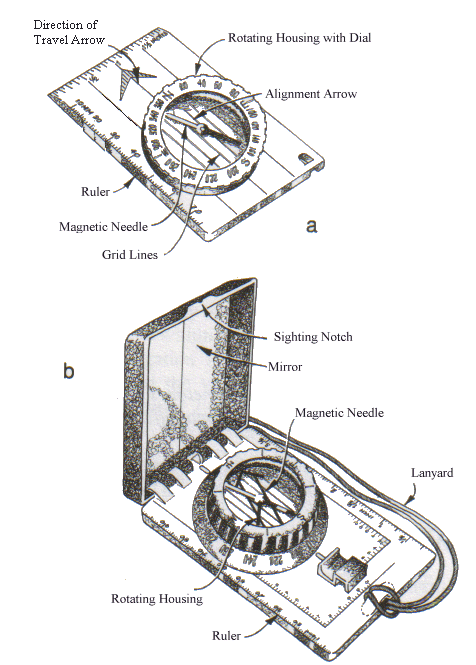
compass comes in two main forms; with or without a mirror. The picture
below shows these two types of compasses, and describes some of the parts.
Although not shown B has all the parts A does, but some of these were
removed for clarity. The type 'a' compass is a good compass for beginner
use, as the number of gadgets are limited. Type 'b' compasses are excellent
for outdoor use as they take the most accurate measurements. Compass Parts Compasses have several parts; here is a description of some of the most common ones and what they do: Magnetic Needle - this is the heart of a compass. This needle is magnetically charged, and freely floats in the dial (usually in light oil). It will align itself with the earths magnetic filed. Generally speaking the red (or black) end points north, and the other end (usually white) points south. Rotating housing - An important part of the mountaineers compass. This dial has magnetic bearings printed on it (in degrees), and the alignment arrow. This is used to enter or determine bearings. Alignment arrow - this is printed on the rotating housing. It is used to align the magnetic arrow. When the magnetic arrow is within this arrow the compass will point along the desired bearing. Direction of travel arrow - this arrow is printed on the base plate, and points in the direction of the bearing. Grind Lines - these are printed on both the base plate and the rotating housing. These make it easier to align the compass on a map. Base Plate - the bottom of the compass. Mirror - Some compasses have a sighting mirror. This allows the compass to be easily aligned while taking a bearing. Sighting notch - part of the mirror, this notch eases taking bearings Declination markings - Some compasses have an additional declination grid, which eases measuring declination (see below for a description of declination. Lanyard - Allows the compass to be hanged on the neck. Ruler - Can be used to measure distances on a map, the size of animal
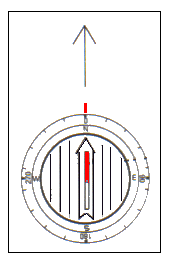
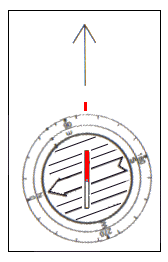
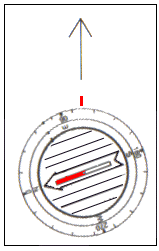
tracks, the size of *that* mosquito ... Setting a bearing on a compass This is the first skill on a compass to be learned. What this will allow you to do is find a direction relative to you, in degrees, and only takes four simple steps. Step 1: Hold your compass level, with the direction of travel arrow
pointing directly away from you.
Step 2: Rotate the housing until the bearing you're looking for is
aligned with the direction of travel arrow (in this case 110 degrees):
Step 3: Rotate your body (while holding the compass level, with the
direction of travel arrow pointing directly in front of you), until the
magnetic needle is inside the alignment arrow, with the red end of the arrow
at the "tip" of the alignment arrow. Once this is done you are facing the
desired bearing (in this case 110 degrees).
A Small Trick - Backtracking To backtrack it isn't necessary to calculate the return bearing (which can be done by subtracting 180 degrees from your current bearing). Instead keep the old bearing, and align the magnetic needle "backwards" (use the white end in place of the red end). This will automatically give you the proper return bearing.
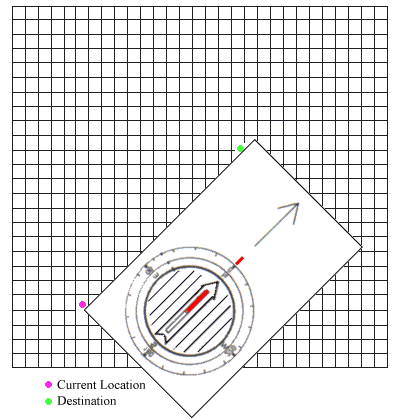
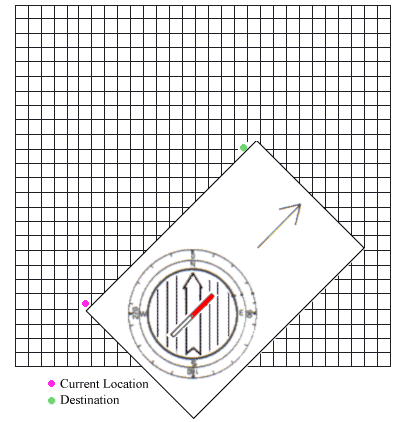
Finding a Bearing On a Map Finding a bearing on a map requires you to know two things. First you have to know where you are on the map, and secondly you have to be able to find your destination on the map. Once this is done its simple to find a bearing from off the map. If you need to know how to do the above things, see the maps section. To keep things simple the "map" is being represented as a grid, with the
assumption that the top of the grid is north. Step one: Place your compass on the map with the straight edge of the
compass joining your current location and your destination.
Step 2: Align the grid lines ON THE ROTATING HOUSING with the
north/south grind lines on the map. The alignment arrow must point NORTH on
the map. This is the important part; double check to make sure you did it
right.
Step 3: The bearing will be displayed on the rotating housing. It'll be
the bearing that sits on the direction of travel arrow, in this case
approximately 45 degrees. Finding a Bearing to an Object This is an important step in the navigation process. This allows you to find along what bearing an object lies. You can then use this to locate things on a map (such as where you are), or you can use this object as a reference point to navigate by. Finding this type of bearing is easy. Step 1: Hold the compass level in your hand, with the direction of travel arrow pointing towards the object in question. If you're using a compass with a mirror align the object in the sighting notch, making sure that the pivot point of the magnetic needle is aligned with the line through the mirror (when your looking at the reflection of the compass in the mirror - see your compass documentation for more info on this). Step 2: Rotate the housing until the magnetic needle is inside the alignment arrow, with the red end of the magnetic needle pointing towards the point of the alignment arrow (yep, just like setting a compass to a known bearing). If your compass has a mirror do this looking at the reflection. This gives you increased accuracy because you can rotate the dial, and make sure the compass is still pointing at the object in question, all at the same time. Step 3: Read the bearing off the dial.
Declination: If you reached this part so far without trouble, good. Unfortunately this will add a whole new level of difficulty to the above procedures. This is because magnetic north (the north your compass points to) isn't the same as the north the earth revolves around (which is the north used on maps). The magnetic north pole is located off the coast of Canada's Bathurst Island (in the far north) Because of this compasses will only read true if you are on the line connecting the north pole of the earth with the magnetic north pole. In North America this line runs through the eastern great lakes. To determine the difference between magnetic and true north, look at your map. It'll be printed on there. This value must be added or subtracted from the magnetic bearing to get the true bearing, and vice versa. Here are some examples to help you out: Example 1: You measure a bearing of 104 degrees, and magnetic declination is 14 degrees east. In order to find the true bearing you must subtract the 14 degrees to the measured bearing, so your true bearing would be 118 degrees. (in other words true north is at 346 degrees magnetic). Example 2: You find a bearing on a map of 112 degrees, and magnetic declination is 22 degrees east. In order to find the magnetic bearing on your compass (which is the bearing you want to fallow) you must add 22 degrees to get the magnetic bearing. Note: This procedure must be reversed if your declination is west of true. So the rule goes: West of true: Add to convert from magnetic to true, subtract to go from
true to magnetic
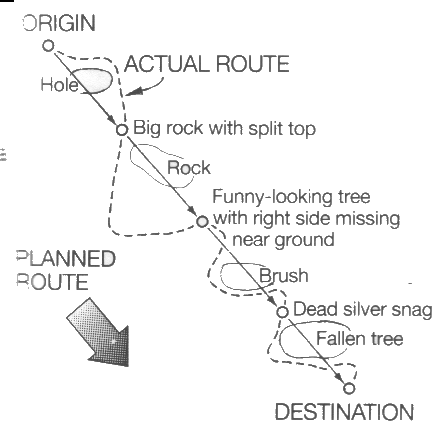
Following a Bearing Following a bearing isn't as easy as it sounds. Unfortunately things tent to get in the way, and you have to be able to move around them without moving off your bearing. There are several ways to do this. Method 1: Find an obvious land mark along the bearing. This land mark
should be easy to find, and not too distant. Make your way to this object,
then find another object along the bearing and repeat. It is essential that
the object be exactly along the bearing, as this type of navigation tends to
amplify errors.
Method 2: This method is similar to method one. What you have to do in
this case if find two land marks, in line with each other, BEHIND YOU.
These objects should be large, and it's okay if they are somewhat distant.
Navigating like this is easy because you know you're one the right bearing
as long as these two objects are in line with each other. This method of
navigation is more accurate then the above method, but it gets less accurate
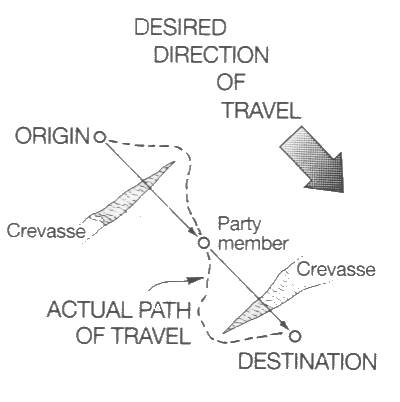
the farther you move away from your reference points. Method 3: This method requires two people. One person moves ahead,
working his/her way around obstacles. When they get around the obstacle
they move back onto the bearing. The person who stayed in place moves their
partner back onto the bearing using voice commands. This person then moves
to their partners location, where this process is repeated. Although slow
this process is extremely accurate. This method also has the advantage that
it can be used in low visibility conditions, or in places where landmarks
are lacking (i.e.. heavy forest, plains ...).
Of course all these methods can be mixed.
Finding an object on a map Step 1: Take the bearing Step 2: Place the compass on the map, with the rotating housings grid lines aligned with the north/south lines on the map. Step 3: Align the edge of the compass with your current location. Do not rotate the dial. The object you found lies along this bearing. If you cannot find the object on the map continue to step four. Step 4: Draw the line from your location along the bearing on the map. Step 5: Move to another location, preferably one at least 1/8th the estimated distance to the unknown object. Repeat steps one to four. Where the two lines intersect is the location, on the map, of the object in question. Note: this is essentially the opposite of finding your location on a map, using cross bearings. |
This Page Copyright (2004), Knights of Dionysus
Authored by: Bryan Heit