Introduction
General Information
Trip Planning Resources &
Contacts
Padang
Keresik Tua
Letter "W" Waterfall
Sungei Sangir
Sungei Penuh
Tapan Road

This is 44km stretch of road that leads from Sungei Penuh to Mauro Sako. It will take a 3 hour ride to cover that distance. At an altitude of 800m, it has a nice mix of highland and lowland birds. Large trucks, goods vehicles and buses often ply that road so do take care not to stand in the middle of this narrow road especially around blind corners.
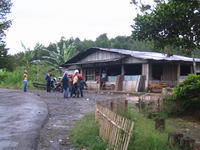 A short distance before the large national park
signboard is a
small wooden shack. It is a provision shop that sells bottled drinks,
snacks and simple food of questionable hygiene standard. It
also sells
petrol so some inter city truck drivers stop there for their break.
A short distance before the large national park
signboard is a
small wooden shack. It is a provision shop that sells bottled drinks,
snacks and simple food of questionable hygiene standard. It
also sells
petrol so some inter city truck drivers stop there for their break. About a kilometre beyond the provision shop is a concrete building. It used to be accommodation but is now closed. Its compound is surrounded by tall pine trees. At its carpark, there are several wooden huts that offer convenient shelter when it rains.
GETTING AROUND : At Sungei Penuh’s KSNP office, there is a ranger called Afnir. He gave me a ride up to Tapan Road before sunrise each morning and returned to collect me in the evening. The road leading to the National Park is full of potholes so do not expect a quick ride. It took us between half and hour to and hour to get near to the hotspot. Afnir was keen to use a car but I had to insist on a scooter due to budget restrictions.
 BIRDS
SEEN : Along the way to the national park early in the
morning, several
Lesser Forktails (which were on the road) were scared off by our
scooter.
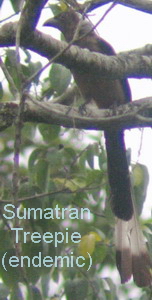
Several Sumatran Treepies (endemic) were seen
several times between the large
national park’s signboard and the closed accommodation. Fire
Tufted Barbets and
Black Browed Barbets were easily spotted as they kept calling noisily.
On the
empty branches, Ashy Drongos and Lesser Yellownapes went about doing
their
business. The fruiting trees played host to Ochraceous Bulbuls, Sunda
Bulbuls
and Sumatran Green Pigeons. Temnick’s Sunbirds and Orange
Bellied Flowerpeckers
also flitted about. The most beautiful bird I saw there was
the Orange
Spotted Bulbul. The orange spots in front of its eyes together with its
yellow
cheeks and black throat gave it a very unique look.
BIRDS
SEEN : Along the way to the national park early in the
morning, several
Lesser Forktails (which were on the road) were scared off by our
scooter.
Several Sumatran Treepies (endemic) were seen
several times between the large
national park’s signboard and the closed accommodation. Fire
Tufted Barbets and
Black Browed Barbets were easily spotted as they kept calling noisily.
On the
empty branches, Ashy Drongos and Lesser Yellownapes went about doing
their
business. The fruiting trees played host to Ochraceous Bulbuls, Sunda
Bulbuls
and Sumatran Green Pigeons. Temnick’s Sunbirds and Orange
Bellied Flowerpeckers
also flitted about. The most beautiful bird I saw there was
the Orange
Spotted Bulbul. The orange spots in front of its eyes together with its
yellow
cheeks and black throat gave it a very unique look.
Other birds seen were Golden Babbler, Yellow Vented
Bulbul, Scaly
Breasted Bulbul, Sumatran Drongo, White Throated
Fantail, Grey Headed
Canary Flycatcher, Chestnut Capped Laughingthrush, Blue
Masked Leafbird (endemic),
Green Billed Malkoha, Sunda Minivet, White Headed Munia, Blue Nuthatch,
Black
and Crimson Oriole, Hill Prinia, Black Eagle, Long Tailed
Shrike, Pacific Swallow, Rufous Tailed Tailorbird, Great Tit,
Sumatran
Treepie, Oriental White-eye.
I was unfortunate enough to encounter one when I was birding alone along Tapan road.
Afnir had just let me alight from his scooter and had headed back to town. Day was just beginning to break, and even the first goods vehicle for the day had not even passed me. I was there all alone.
It was about a 3 hours walk beyond the large national park’s signboard. I was in the middle of nowhere as the nearest towns were several hours away by transport each way. I was all ready to find a pitta.
In front of me, about 30m ahead, at the apex of a bend, I encountered a tiger!
Never underestimate the power of a tiger's roar - it can be used to stun its prey. When it roared AT me, I could feel the impact of each roar enter the front of my body, mess up everything inside me and proceed to leave from my back with barely any discernable decrease in intensity. Imagine being hit by an aeroplane's jet engine for just a split second. Each roar was projected so cleanly through me with so much energy that both my legs just collapsed under me. My mind went totally blank with fear. If it had wanted to eat me then, I'd be the proverbial "Sitting Duck". I knew I did not want to die but I was just too terrified move.
That tiger roared for several more times. All that while, it was hidden in the bushes ahead of me. Time stood still as those bushes continued to rustle. Although I had never prayed before, I distinctly remember asking for divine intervention.
When I had finally regained composure, I backed off slowly. Thankfully, the rustling seemed to get less as the tiger headed away.
I was really lucky that that tiger was not in the mood for breakfast that morning. Later, according to the rangers, what I had experienced was a situation where the tiger probably had its young nearby and the roars were to warn me to keep away.
Tigers generally move to the edge of the forests at night to feed and will proceed back deep into the forest again in the day to avoid people.
Nevertheless, I was way too shaken to continue and decided to terminate my birding trip prematurely. It is a pity that I did not get to bird watch at the fabulous lowland birding site, Mauro Sako, where tigers are also seen.
If you decide to bird watch in that area, it might be safer to do so in a large party or have a car follow you.
A month after I returning home, I still had a phobia of entering forests
