Introduction
General Information
Trip Planning Resources &
Contacts
Padang
Keresik Tua
Letter "W" Waterfall
Sungei Sangir
Sungei Penuh
Tapan Road
GENERAL
INFORMATION
Beyond the top hotels and the Padang’s Tabing Airport, little English is spoken or understood so it is important to learn the important Bahasa Indonesia phrases before your arrival.
The Internet is available in cafes at most of the larger towns. The going rate at most cafes was 5,000Rp per hour. Handphones are a common sight in towns and not unusual in villages. Getting a signal at populated areas should not be a problem.
In Padang, there are ATMs with PLUS. In the larger banks, you can withdraw rupiah using your VISA card. Keep in mind that some of the larger towns have Western Union outlets for you to receive money in the event of an emergency.
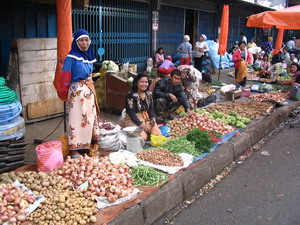 As in most countries in Asia,
expect to bargain for many products
and services. Foreigners are expected to pay more so don’t be
surprised
that the opening offer to you is up to 10x that of the one given to
local standing right beside you. Keep your cool when that
happens - It
will happen a lot! – and negotiate with a smile.
Don’t get offended or
plussed as they expect you to bargain. It always helps to know what the
locals would pay before before you begin bargaining. The initial price
frequently comes down quickly if you persist a little.
As in most countries in Asia,
expect to bargain for many products
and services. Foreigners are expected to pay more so don’t be
surprised
that the opening offer to you is up to 10x that of the one given to
local standing right beside you. Keep your cool when that
happens - It
will happen a lot! – and negotiate with a smile.
Don’t get offended or
plussed as they expect you to bargain. It always helps to know what the
locals would pay before before you begin bargaining. The initial price
frequently comes down quickly if you persist a little. After using the toilet, it is an established local practice to “wash up” instead of using toilet paper. So, don’t be surprised if your accommodation does not have toilet paper. A separate hose or scoop will be provided instead. Those who find this way of cleaning up awkward should stock up on toilet paper before staying at mid to budget level accommodation.
Water right out of the tap is not potable. Bottled drinking water is cheap & easily available.
The hygiene standard in Sumatra is different from most parts of the developed world. If one does not take precautions when consuming one’s food, it is easy to fall ill. I subscribe to the BOIL IT, COOK IT, PEEL IT, FORGET IT rule. If any food does not fit either of the first three criteria, just forget about eating it. This simple, yet effective, rule has kept me from getting any sort of stomach upset.
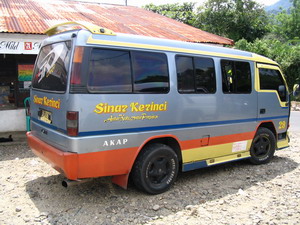 Budget birders will come to rely on minibuses a
lot. They are cheap
and convenient. You can flag the minibus down or ask to alight anywhere
along its route. There is no need to find a bus-stop. The minibus will
leave the terminal when there are enough passengers. Be warned that the
drivers love to play techno music at ear-splitting levels. They do this
to keep them awake on long drives and also to let potential passengers
know that they are arriving. Use earplugs if you value your hearing.
Most of the time, when the bus is not full, the ride can be quite
pleasant. However, I was once squashed with 25 people in a 12 seater
minibus! That was possible only because the locals were
incredibly
cooperative and good-natured. They contorted their bodies to make way
for the next passenger. Those who boarded later had to sit on other
passengers’ laps with their heads pressed against the roof.
Also, don’t
be surprised to find live chickens wandering under your seat or to be
seated next to large sacks of vegetables. To ensure a better chance of
getting a comfortable ride, avoid taking trips during peak hours or
peak days (eg. eves of public holidays or weekends)
Budget birders will come to rely on minibuses a
lot. They are cheap
and convenient. You can flag the minibus down or ask to alight anywhere
along its route. There is no need to find a bus-stop. The minibus will
leave the terminal when there are enough passengers. Be warned that the
drivers love to play techno music at ear-splitting levels. They do this
to keep them awake on long drives and also to let potential passengers
know that they are arriving. Use earplugs if you value your hearing.
Most of the time, when the bus is not full, the ride can be quite
pleasant. However, I was once squashed with 25 people in a 12 seater
minibus! That was possible only because the locals were
incredibly
cooperative and good-natured. They contorted their bodies to make way
for the next passenger. Those who boarded later had to sit on other
passengers’ laps with their heads pressed against the roof.
Also, don’t
be surprised to find live chickens wandering under your seat or to be
seated next to large sacks of vegetables. To ensure a better chance of
getting a comfortable ride, avoid taking trips during peak hours or
peak days (eg. eves of public holidays or weekends) My fieldguide of choice is “Birds of Sumatra, Kalimantan and Java” by John McKinnon, Karen Phillips and Bas Van Balen. Unfortunately, it has been out of print for several years. I had to settle for an Indonesian version of this book, entitled “Burung-Burung di Sumatera, Kalimatan dan Jawa”. Even though the text and descriptions are in Bahasa Indonesia, each bird’s English name is available inside.

