Introduction
General Information
Trip Planning Resources &
Contacts
Padang
Keresik Tua
Letter "W" Waterfall
Sungei Sangir
Sungei Penuh
Tapan Road
SUNGEI SANGIR
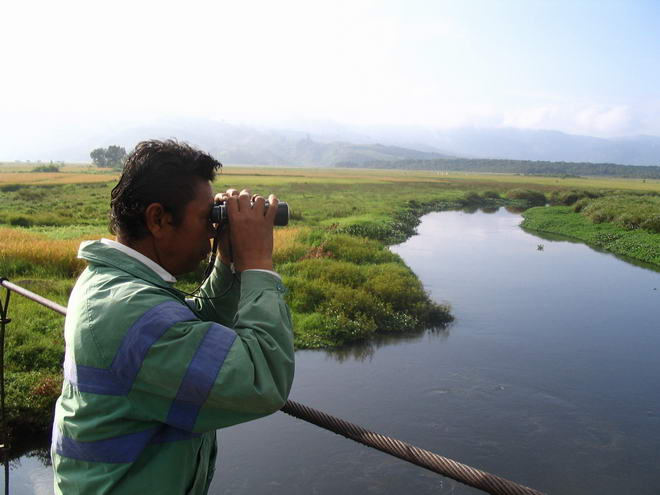
Pak Subandi scans the ricefields on both sides of Sungei Sangir for birds.
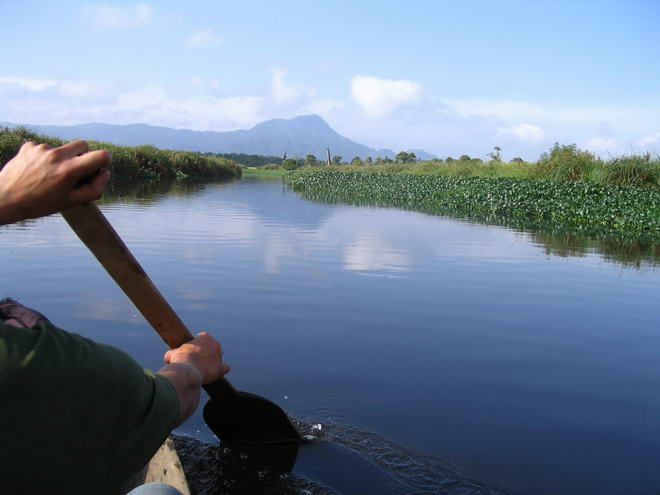
Sungei Sangir passes through the highest freshwater swamp forest in South East Asia. The views along the river are simply breathtaking. The water is unusually placid and it is very relaxing to hear just the water running off the oars. The river passes through several rice fields and a fairly inaccessible swamp forest.
The remote section of this river is home to the Pacific Black Duck and Lesser Adjutant. The Lesser Adjutants are listed as vulnerable under the 2006 IUCN Red List Category. There are only about 5000 of such storks in the world. To see them, you need figure out how to “walk on water”! Otherwise, be prepared to get terribly wet and muddy. Ask Pak Subandi or the boatmen for instructions. It is definitely an experience of a lifetime.

It was very difficult to binoscope these few Pacific Black Ducks because the reeds that we were standing on kept moving.
GETTING THERE : Pak Subandi can arrange transport to Jenir Jaya, which is 20 minutes away. At that obscure little village, we hired two boatmen and relied on a primitive dugout canoe. After overcoming the initial jitters about the boat’s ability to take our weight, the journey was very enjoyable.
 BIRDING
HIGHLIGHTS : We found a flock of about 20-30 Pacific Black
Ducks and a single Lesser Adjutant The Pacific Black Duck's
distribution range stretches from
Indonesia, New Guinea,
Australia to New Zealand. As you can see, Indonesia is the only country
in South East Asia that you can see this bird in the wild.
BIRDING
HIGHLIGHTS : We found a flock of about 20-30 Pacific Black
Ducks and a single Lesser Adjutant The Pacific Black Duck's
distribution range stretches from
Indonesia, New Guinea,
Australia to New Zealand. As you can see, Indonesia is the only country
in South East Asia that you can see this bird in the wild.During the canoe ride, several Purple Herons and Black Eagles flew overhead. White Headed Munias and Cattle Egrets were common in the padi fields. In recent years, the Chestnut Capped Laughingthrush has become uncommon along the trail up to Mount Kerinci. Thankfully, numerous flocks of this bird are still thriving well along both sides of this river. Be prepared to see lots of kingfishers, drongos and pigeons.
Other birds seen there were Long Tailed Shrike, Great Tit, Scaly Breasted Munia, Ashy Drongo, Hill Prinia, Eurasian Treesparrow, Javan Mynah, Oriental Magpie Robin, Zitting Cisticola, Lesser Coucal, Spotted Dove, Purple Heron and White Throated Kingfisher.
LEECHES : None encountered.
MAP/SKETCH : NA
SCOPE: It will definitely come in handy to sight those birds from a long way off. However, you’ll almost certainly get at least a little wet on this trip. Certain sections have to be negotiated on foot. In fact, in order to get to the area around the Pacific Black Ducks and Lesser Adjutant, you will have to walk on reeds that float above several feet of muddy water. Go ahead, “walk on water”. Just don’t sink right to the bottom!
LESSONS LEARNT : After the trip, do apply the ointment that Pak Subandi has on your legs. It’ll prevent skin infection. Pak Subandi’s legs were fine the next day but mine had had hundreds of pus sacs develop on the numerous fine cuts. No thanks to the grass and the muddy water. I had to waste time to visit the village hospital and take a course of antibiotics to clear it.

A hilarious cigarette advertisement on the wall of one of the wooden houses there. The overwhelming majority of Indonesian villagers do not speak, understand nor read English at all. Finally, a cigarette company with a bit of conscience!

