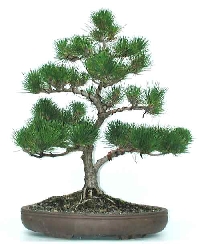
|
When
selecting material for future bonsai we have to take some design
aspects into consideration.
Rootage: one of the most important features on a tree will be a
surface root. Rootage can say quite a lot of things to the
experienced grower. Before buying a tree in a black bag, scratch the
soil away around the base and check for surface roots.
Do not buy trees with grotesque rootage. It will be very difficult
to correct the root system when repotting.
Exposed rootage, yes but on conservative scale.
Evenly spread roots that enter the soil on 60 degrees will be best.
Roots also dedicate the front of your tree.
A good spread will give your tree the appearance of age and
stability and will also contribute to visual impact.
Trunk: this section refers to the whole lower part of the tree up to
and including the first branch. The base of the tree should be a
natural continuation of the rootage, starting at the widest part of
the base, tapering up to the main branch. Therefore the base and
roots play a major role in selection of bonsai stock.
First branch: Your first branch in most cases will be the first of
lowest branches on the tree. Keep in mind that your first branch
will also be in the first third of the overall height in your
design. Your first branch will also be the largest and most
interesting of all the other branches.
Upper trunk and branches: the rest of the trunk should bend with the
base and must continue to taper all the way up. There must also be
enough branches to select when you do your final design.
If your tree shows movement at the base, the movement must continue
all the way up to the top or apex, as we will refer in future.
If the main branches descends (in other words down movement), all
the other branches should follow the same pattern.
Branch placements: these branches must give…
The tree the best front view of the trunk, when examining the tree.
The branches must radiate all around so that one branch does not
overshadow another branch.
The branches must also be shorter and thinner towards the apex.
Apex: (top of the tree) is very important. It is the highest point
of the tree and must point to the front of the tree. In the latter
classification we find the apex will be over the base of the trunk
and tilted slightly forward, showing the correct front of the tree.
A point to remember
When visiting a bonsai show, jot down the names of the trees on show
for they have already proved their bonsai capabilities, being:
a)foliage bust be easily reduce - able;
b)good branch ramification;
c)good surface roots; and
d)break back on old wood.
LIST OF TREES FOR POTENCIAL BONSAI:
Junipers - especially juniperus procumbens nana
Trees of a thousand stars - serissa foetida
Figs - ficus burt davii, ficus retusa, ficus benjamina, ficus
negrensis'
Ficus natalensis
Olives - olea europaea var africana
Pyracantha - firethorn
Contoneaster - microphylla if possible
Pomegranate
White stinkwood - celtis africana
Wisteria
Confers
Maples - acer buergeranium, acer palmatum |