|
We
design our trees around these five classifications, along with the
correct techniques. Semi - cascade, Cascade, Formal upright,
Informal upright, Slanting.
These five main designs are classified essentially by the structure
and flow of the trunk line. It is from these five basic designs that
we learn most of our basic techniques i.e. branching placement,
trunk flow, directions of branches, height, balance, etcetera. It
teaches us all the correct methods of bonsai structure, concerning
all facets of a tree in the design concept. After advance class,
design will become second nature.
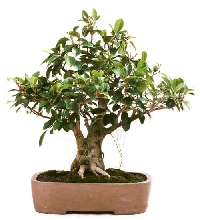
FORMAL UPRIGHT or CHOKKAN DESIGN
The design depicts a definite strictness and formality in its shape.
Formal describe this classification as absolute perfect. These are
however many variations in this design. A good example is a broom
design. The tree has been designed around particular or dominant
characters of either trunk, rootage or branch structure. It should
be recognized as a free form of formal upright.
All chokkan-designed trees should have straight trunks to be
effective.
Rootage should be well spread around the base.
Branches follow a certain pattern i.e. 1st branches - left
2nd branch - back
3rd branch - right
4th branch - left
5th branch - back
6th branch - right
A point to remember:
Where possible NEVER start with a back branch as your first branch.
Formal upright are normally planted in rectangular pots, not too
deep, as this will detract the formal trunk.
INFORMAL UPRIGHT or MOYOGI
DESIGN
Most trees are grown in this design. Generally, there is an
abundance of readily available material. It allows the designer for
more freedom to create in a more natural way. We still have to place
our branches in the left-right-back order to achieve correct foliage
depth.
This design can change its direction on several occasions. The trunk
must be designed with flair and character and can have as many
curves possible. Branches are always grown on the outside of a curve
and NEVER EVER on the inside.
Designing branches:
When designing a branch "clean" the underside of the
branch. Remove any unwanted growth growing down. Branches also have
distinct shapes.
SLANTING TRUNK or SHAKAN
design
This design can develop into some very interesting bonsai trees.
Slanting trunk, windswept or literati can all fall into shakan
design. A leaning bonsai for instance, we know, will not fall over.
The tree can be balanced with a root on the opposite side, keeping
the tree from falling over. It should convey a positive feeling of
stability. Branch placement could be sparse; even deadwood can be
added. It is a gentle and very artistic way of expressing the art of
bonsai. The trunk must have movement and character to create more
visual impact. The apex in this case will be clear of the root base.
SEMI CASCADE or HAN-KENGAI
design
This design can be very simple but very rewarding and you need to be
creative to succeed, as this classification refers to the cascading
area.
The cascading area could be a very distinctive branch or it could be
the trunk descending. It will be correct to place the descending
area below the rim of the pot. Semi cascade does not have to carry
too much foliage weight but the cascading part must obviously look
the part. The downward / cascading part must be the larger part of
the whole design. The trunk is never to long but rather short and
the decent is not on height but on reach. Strong roots are needed on
the opposite side of the cascading branch. The apex should be full
but not distract the attention from the cascading branch.
CASCADE or KENGAI design
As in semi cascade, we now blend The Main branch or trunk completely
down, past the bottom of the pot. If the trunk is used for cascading
it should bend over the rim of the pot and very sharply downwards.
The apex of the tree is not the top of the tree anymore; in fact, it
is now at the bottom. In fact, the top of the tree is now called the
crown.
Cascades will be discussed in more detail in advance class, due to
lack of material for full cascades. |