|
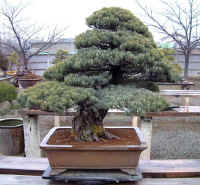
There are many
varieties of White Pine but all have one thing in common: the white
central or stomatic band down the length of the leaf (or needle).
The popular White Pine bonsai come from either China, Japan or
elsewhere in the Pacific Asian Rim area. They are generally styled
very simply with a twist or two onto the trunk and are invariably
grafted onto the stronger Black Pine base. Some varieties have very
dense needle growth while others have very short needle clusters.
However all are Pinus Parviflora with many various cultivars that
include Kokono and Brevifolia. The difference between White Pine and
other pine species is that the White Pine has a cluster of five
needles around each bud. The Scots, Red and Black Pines have needle
clusters of two, and some varieties have clusters of three.
Its natural growth habit is low and spreading, while as a bonsai it
can be any shape with the common style being pyramid form with the
branches in clearly defined steps up to the apex or tip of the tree.
Buying tips
As this is the first article I shall explain the reason for a
bonsai's high cost and leave you to form your own opinion as to the
meaning of 'value for money'.
White Pines are imported in vast numbers to the UK and other
countries. The estimated worldwide trade of pine tree bonsai is one
million per year so it is easy to understand that the methods used
to produce such numbers produce results leaving much to be desired
in a tree. Dealers buy these trees by the container and unless they
have the means (or indeed the time) to hand pick each one that they
import, it is unlikely that the bonsai pine you see on the shelf for
sale is of good quality. This is not to say that a bit of time spent
on the bonsai 'starter' will not result in the tree eventually
becoming a nice specimen, it is just that the sheer work that this
entails may mean a few years of effort before it really becomes a
'bonsai'.
What you have to remember is that the tree is bought from a grower
at a very low cost , and he is literally mass producing Pine (or
indeed other bonsai); the grower may receive, for example, £3. The
wholesaler will then put their mark-up at 100% and the same tree
becomes £6. He sells it to a distributor or wholesaler in the
various countries that import the tree and they then put on their
mark-up to cover the cost of three things: the import charges
(clearing customs and freight), the purchase cost and the eventual
retail cost. This mark-up would then make the tree £18. If he then
sells the tree as a distributor to the small shop or to other
retailers, the final tree will cost you up to, and in many cases
over, £36; depending on the mark-up that the individual retailer
puts on the tree. However, the problem is not whether the tree is
worth £36, it is whether a tree costing £3 initially is ever going
to be of high quality. The answer is quite clear; after all, why
should a mass-producing grower spend valuable time producing
individual quality when that tree is only going to sell for £3?
What you pay at the end of the day is £36 for a £3 tree. This is
really no one's fault as everyone has to make a profit along the
way. Incidentally, this is not even a large mark-up when you
consider that these profits have to cover any trees that die when
held by the dealers along the way. Profit is based not so much on
what they sell but on what they do not sell.
What to look for
The first thing to look for when buying bonsai is that all the stock
throughout the shop is be looking fresh. In the case of White Pine,
are the needles healthy and 'crisp green' or are they brown tinged
and looking a bit sorry for themselves? Are all the trees on show in
clean pots, or are they in dirty, unkempt containers? Is the soil
damp or very dry? If the soil is damp, check the needles are not
brown from over watering. If the soil is very dry, look closely at
the needles and twigs to see if they are dried up and wrinkled, a
sign of dehydration. Don't buy a pine that has deep wire marks or
where the wire left on is biting into the bark. In addition:
Buy from a specialist supplier and not from a car boot sale (they
may well be stolen).
Ask questions: what conditions must the tree have; what aftercare
does it require and what guarantees does the seller give if the tree
dies within the first few months? (Get this written down just before
you agree to purchase the bonsai).
What after sales service does the supplier offer (repotting, winter
care, holiday care etc.)?
Will the seller give a discount for cash?! (Please get a receipt as
proof of purchase in all cases this is very important).
Check that the soil is not clay mud. Professional growers would have
removed this soil and replaced it with soil more suited to western
conditions, i.e. healthy!
After care
Make sure that you have read about or listened carefully to the
requirements of the new addition to the family. Some general points:
keep the Pine out of extreme weather conditions - wind, rain, sun
and centrally heated homes. Most trees die within a few weeks if
they are not kept correctly and yet the trees really require very
little in the way of molly coddling. Keep the tree in a slightly
shaded place and spray lightly every day for the first two weeks. Do
not feed immediately but wait until the tree has settled down. The
problem with immediate feeding is that the tree may have been
repotted recently and the roots freshly cut; if you feed too quickly
you may harm the roots. Find out when the tree has last been
repotted and explain why you need this information. If you cannot be
certain then it is best to withhold from feeding for about six
weeks.After a couple of weeks give the tree about four hours sun per
day but still find a place away from high winds. If you get or buy a
tree in the winter, do not bring the bonsai into a centrally heated
house as this will both aggravate the normal growing period of the
tree, exhausting it and drying up the needles.
Watering
Pines need semi-dry conditions in the winter and the soil kept
slightly damp in the growing season. Pine bonsai do not like very
wet conditions. Only spray the needles from summer to early autumn
but in both the morning and late evening. See seasonal care, soil
and feeding points. To reduce needles on established trees, start to
withhold water as the buds develop. This makes the needles smaller.
When the buds have set and the needles open, resume normal watering.
Please note: this is not appropriate for young trees.
Pests and diseases
Aphids, angelgids, mealy bug, red spider mite, and lopho (pine
needle cast known as lophodermium pinastre) are all potential
villains. (These will be explained in more detail in future
articles). If pests arrive, treat with systemic. Lopho is a fungus
and is treated with a copper fungicide at a weekly dose for five or
six weeks. Please note: when using any fungicide on a pine, do not
allow the fungicide to get onto the soil, cover the soil with a
polysheet or plastic bag and then a towel. Fungicide will damage the
beneficial mycelium fungus that helps the pine roots to grow. Lopho
is identified by lateral yellow stripes on the needle. Angelgids
look like a woolly fluff between the needles. Systemic will kill the
animal but use a concentrated hose spray to wash away the fluff.
Feeding
Always use bought fertilisers at half strength. Young trees: In the
spring feed with a high nitrogen fertiliser; in summer, with a
balanced fertiliser; and in early autumn, with a low nitrogen
fertiliser. Feed every three weeks at the beginning of the season
and every four weeks by early summer through to the end of autumn.
See seasonal care. Established trees: Using fertilisers at full
strength is particularly dangerous here as the roots are very tender
and they may suffer from being fed. You do not want lush juvenile
growth, so feed until early summer with low nitrogen fertiliser.
Feed balanced feed in summer feed and in autumn with low nitrogen
again. Only feed mature trees approximately every five weeks.
Pruning
Prune the old needles at the rear of each bud needle cluster every
three years. Leave only two or three buds at each tip depending on
the health of the tree. If you wish to develop young inner buds
along the branch then prune out some, if not all, the leading tips
that aren't required. Start cutting candles (buds) from the top of
the tree by half to two thirds and each week work your way down
until you reach the bottom layer of branches. The strongest bud at
the top of the tree will grow. Do not do all the buds up and down
the tree at the same time as this will exhaust the tree. Every three
years it is better to pull the soft new needles out from the sheath
and this forces the tree to create shorter needles the following
year.
Soil type
A free draining soil is important for all pines and should be 5
parts of grit of 2/3mm to 3 parts organic such as a mixture of peat,
leaf mould or even composted bark. Speak to the seller of the bonsai
or to other growers in your area and they will advise you on the
best solid for your climate. Trees in hotter climates may need a
little more organic to retain moisture than trees from colder or
wetter climates.
Light/shade requirements
Pines like some shade for part of the day in the summer and kept in
as light an area free from winter climatic problems during the cold
months. Full sun will make the tree more yellow in most cases, while
full shade (not advised) will force the glaucus, blue-green colour
to come out. Blend the light requirements and you will have a
healthy tree. RepottingI usually repot every three years for young
trees and every five years for mature trees. Use a rust, brown, grey
or deep blue pot for pines. I prefer the matt dark brown pots by
English potters such as Gordon Duffett or Derek Aspinal. Japanese
imported pots are also nice, though expensive, but larger bonsai
nurseries such as Herons and Greenwood have a very good variety of
stock at all times.
|