|
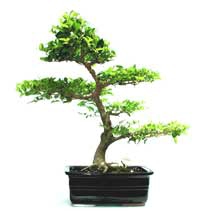
Bonsai
pots are containers, normally a ceramic pot glazed on the outside,
which makes these pots different from any other pots.
Bonsai pots has a very distinct features, essential for a tree to
survive in such small pot:
1) A bonsai pot must have feet or legs to stand on. The purposes of
these legs are for air to circulate underneath the pot and for
excess water to drain away from the pot. Water accumulating
underneath the pot will cause a bad smell and attract insects.
2) The second feature is a drainage hole - approximately 10mm in
diameter in the bottom of the container, which allows the air to
enter the soil from beneath and through which excess water drains,
that can cause root rot. When repotting your tree you can push the
tree out of the pot by pressing your finger through the drainage
hole.
3) A bonsai pot should not have any indentations or hollows on the
inside of the pot. Water accumulating in the hollow will cause roots
to rot. For training pots or trees requiring large amounts of water
it will be fine, but for precious show trees please steer away from
these pots.
4) However we have planted in some before, your pots should not be
glazed in side. Your tree will be fine, but the roots van grip onto
the inside of the pot, due to the smooth glazed surface. This will
cause your tree to be a bit loose in the pot and a loose tree is an
unhappy tree. Sometimes we tend to pick our trees up by grabbing it
at the trunk and "hopefully" the pot will come along. Be
careful with your fully glazed pot, otherwise it might and up in
pieces.
5) Bonsai pots come in all shapes and sizes, but be aware! Your tree
might not be suitable for odd shaped containers. The most popular
containers for bonsai trees are:
a)Rectangular pots with dimensions 3x4
b)Square pots with dimensions 3x3
c)Round pots
d)Oval pots
e)Oval-shallow pots for Saikei
f)Rectangular shallow pots
g)Cascade pots
h)Although hexagons are not very popular, it will compliment any
flowering bonsai tree.
Here follows a guideline on how to choose a suitable container for
your tree.
1)Always remember to have your tree with you when buying a pot.
2)The branches of your tree should not be longer than the pot.
3)The thickness of the trunk dictates the depth of the pot.
4)The colour of the tree must compliment your tree.
5)Literati design will always be planted in a round container.
6)Saikei will always be in a shallow-oval or shallow-rectangular
container.
AZALEAS: love
deep containers, especially blue ones.
PINES: can
be planted in a 'white' pot, indicating snow, where pines normally
grow in nature.
OLIVES: also
prefer a slightly deeper container.
ROCK-PLANTINGS: will
be best planted in a shallow pot where you can tie, glue or wire the
rock down in the pot.
In general a natural colour, brown, grey, or deep green will suit
most trees. Stay away from terra cotta coloured pots for shows.
"Beauty is in the eye of the beholder."
"Don't disgrace your tree by being stingy with cost, rather be
proud while your tree is envied by other."
Last but not least …
When spending time on a container for your favourite tree, keep in
mind that this is not where it ends. Your tree still needs a display
stand, for future shows. This is your tree and you should display it
as best as you can.
|