
| Home |
| Communicating in the IT Industry |
| Working in the IT Industry |
| Computer Systems |
| Database Systems |
| Website Development |
| Event Driven Programming |
| Spreadhseet Modelling |
What is a database? A database is a collection of data that has been organised. An example of a database is the one for Argos. It can be found in two different formats; a hard copy (the catalogue) and computerised (the website). Both formats of the database have been organised by being sorted into different categories of which the products will be used, for example 'Camping and Outdoors' and 'Electricals'. |
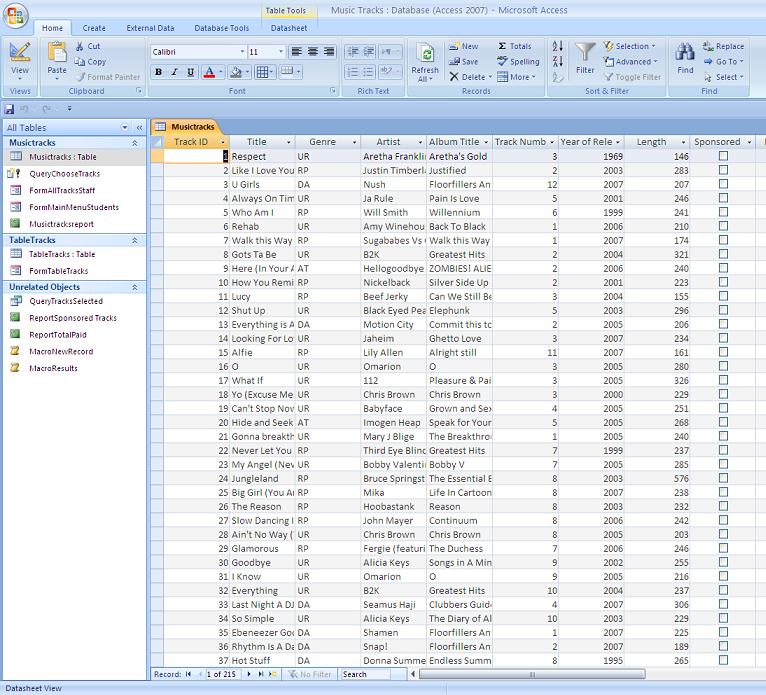 |
This is a screenshot of the database that I created in class. It contains a list of music tracks that were provided as the foundation of the databsae which I then sorted and categorised. I then created different items within the database such as forms, queries ad reports. These are used to make it easier to carry out different functions within the database. Please click on the screenshot to be take to the database. |
| VALIDATION | VERIFICATION |
| Click on the words to find out the definition! |
 |
What is the unit about? The Database Systems unit involved learning about how different databases work and the different functions that you can carry out within a database. You learn about different terms that are used when working with databases such as 'validation', 'verification' and 'data integrity'. You learn about the different items that you can create in databases and how these help you to carry out actions. My review of the unit I found the Database Systems unit very intersting. I enjoyed learning about how a database is usedm how it is organised and all of the different functions that can be carried out within one. I particularly enjoyed learning about the extra items that can be added such as queries, forms and reports, and how these can then be presented in different formats, for example exporting them to Microsoft Word to make it easier for the information to be interpreted. |