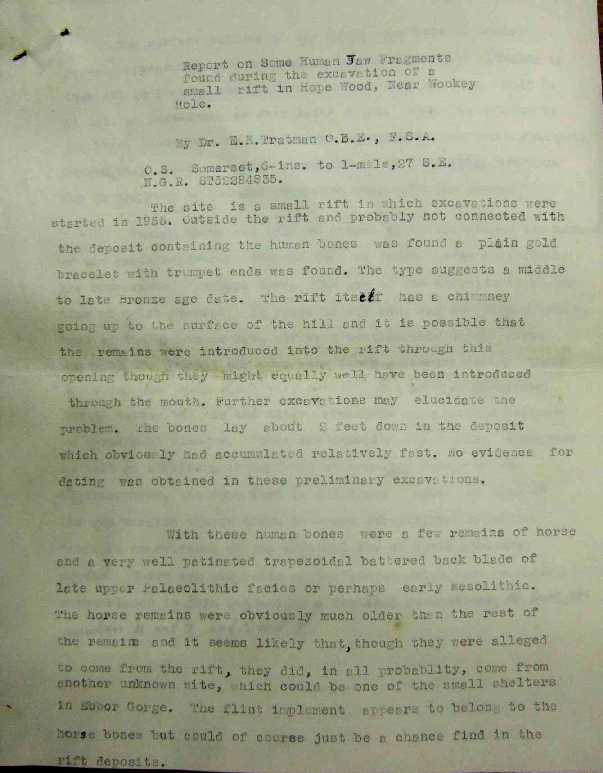
In the early 1950s, an Ebbor Research Group was in existence and the member E. C. Harris found a gold bracelet at Bracelet Cave on 3rd December 1955. This find became the subject of an inquest, held at Wells on 23rd July 1957; the jury determined it was not treasure trove and thus it remained in the possession of the Hodgkinson family. The bracelet was dated to the Late Bronze Age (Haldane 1969). E. Mason continued digging at Bracelet Cave in the following years (Mason 1972). He found Romano-British pottery and the remains of at least nine individuals. E. K. Tratman was involved in a preliminary study of the human remains (Tratman 1958). Mason also dug, on behalf of Wookey Hole Caves, a trench in the entrance of Primrose Shelter in 1959. He found a small number of flints.
The Prehistoric Society, and in particular C. McBurney, took an interest in the possible Palaeolithic sites at Ebbor. During 1958 they conducted a dig at Bridged Pot Shelter and also excavated at Lion Shelter and Savory�s Hole. In the end, the only evidence of human occupation that they found came down to a fragment of a flint blade and pieces of burnt bone and charcoal, within the Pleistocene deposit at Bridged Pot (McBurney 1959).
No more excavations appear to have been carried out at Ebbor for nearly fifty years. During that time, the most significant developments were a series of radiocarbon dates, such as the one from Bridged Pot reported by Burleigh, Ambers & Matthews (1984) and the two publications listing the cave sites in the gorge (Barrington & Stanton 1977 and Hendy 2005). However, in 2006 a team led by Dr Danielle Schreve began an excavation at Gully Cave. Their main aim is apparently to "ascertain the nature and extent (if any) of Palaeolithic occupation in Gully Cave". After two seasons, they had found some fauna, probably of late glacial age, but not a single archaeological object (Schreve 2007).