| Gully Cave
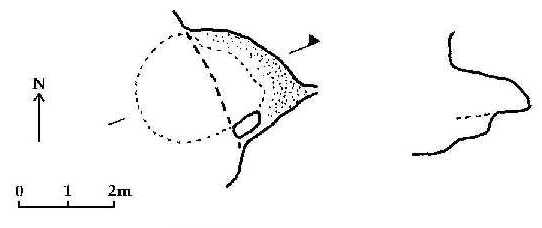
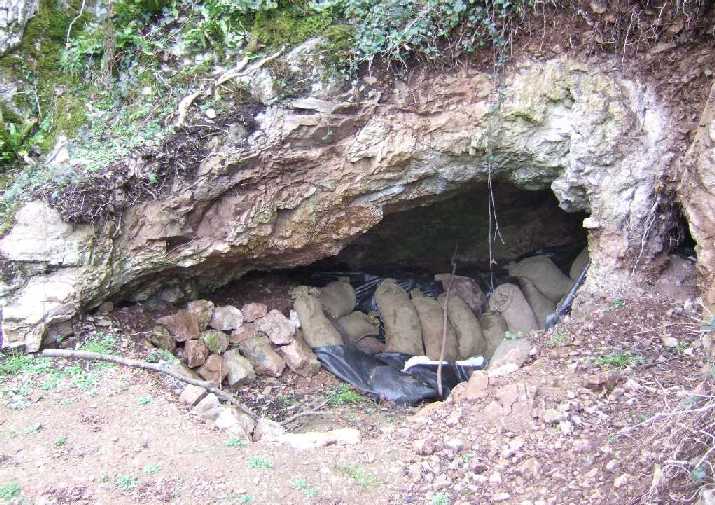
Located high on the east side of the gorge, the entrance offers a good view of Tower Rock on the opposite side. Originally a �wide choked archway� (Hendy 2005), the cave has been dug by a team of archaeologists in 2006 and 2007. It is now a shelter, about 3m wide and 2m deep. The archaeologists own account of their research can be found here. Extracts from two short articles about the excavations are given below. |
 |
 |
| Plan and elevation of Gully Cave |
 |
| Return to Ebbor Home page |
| The cave excavation in 2006 and 2007 |
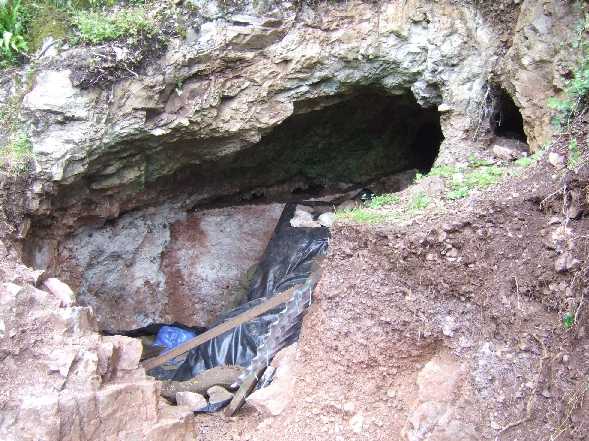 |
| The objectives of the excavation: A major research question within Palaeolithic studies concerns repopulation at the end of the Middle Palaeolithic and the transition to the Early Upper Palaeolithic�It seemed likely that the Ebbor Gorge area might prove a fruitful one in which to explore this theme. The specific aims of the project were to: 1. Ascertain the nature and extent (if any) of Palaeolithic occupation in Gully Cave, with particular reference to local settlement patterns, cultural histories, adaptation to environmental change and interactions with the landscape and fauna. 2. Establish the timing of any such occupation through the application of geochronology and biostratigraphy 3. 3. Reconstruct the palaeoenvironmental context of any such occupation through palaeoecological and sedeimentological analyses. The sediments were formed of a red, limestone-rich breccia�the breccia was capped by a densely cemented carbonate flowstone, in turn overlain by an organic-rich sediment containing numerous fragments of modern wood and recent mammal bone. (Schreve 2007) Yes, we are interested in exploring the potential for Middle or Upper Palaeolithic occupation of Gully Cave, but this is only one of several equally weighted scientific goals. �It is therefore essential to recover comprehensive multiproxy palaeoenvironmental information from well-stratified and well-dated contexts (with or without the presence of archaeology) in order to understand past climatic change. (Schreve et al., 2007) Note: While we wish the researchers success in finding a Palaeolithic occupation at Gully Cave, the previous evidence for any Pleistocene human use of the sites in Ebbor Gorge is very flimsy, even for the Late Upper Palaeolithic, and non-existent for the Middle to Upper transition. So the "potential" is probably very low. Methodology: Since we have no running water available, we carry in, by hand, dozens of five-gallon water containers to undertake as much wet-sieving on site as possible, thereby avoiding unnecessary transportation of sediment back to the laboratory. Nevertheless�in 2007 over 250kg were taken to the laboratory for subsequent processing� the number of small vertebrate fragments recovered is already in excess of one thousand elements. (Schreve et al., 2007) The spoil heap: Even if there were vehicular access to remove spoil, this would not be desirable since it is a local material and an excellent substrate for vegetation growth. Our experience this year, when we returned to the site and began our excavation preparations, was that the slope had revegetated in the preceding twelve months, and was heavily covered in nettles, brambles, ivy and seedling trees such as hazel. Natural England is fully satisfied that once the dig is finished, the slope will rapidly weather and return to a fully vegetated state. (Schreve et al., 2007) The finds: The sediments were formed of a red, limestone-rich breccia�the breccia was capped by a densely cemented carbonate flowstone, in turn overlain by an organic-rich sediment containing numerous fragments of modern wood and recent mammal bone. Within the red breccia, bones of wild horse, arctic hare, birds and numerous rodent jaws, including the water vole and the narrow-skulled vole (the latter known only from the Pleistocene in Britain)�the working hypothesis is that these remains are of probable late glacial age (about 12,500 years ago). (Schreve 2007) The rodent material from Bridged Pot, collected by McBurney in the 1950s is dominated by species that are characteristic of a tundra environment. It is clear, even from the preliminary stage of our analysis, that the levels we have explored in Gully Cave represent a completely different time period with a more temperate suite of small mammals preserved . (Schreve et al., 2007) |
| EXTRACTS FROM DESCENT MAGAZINE (Schreve 2007 and Schreve et al., 2007) |
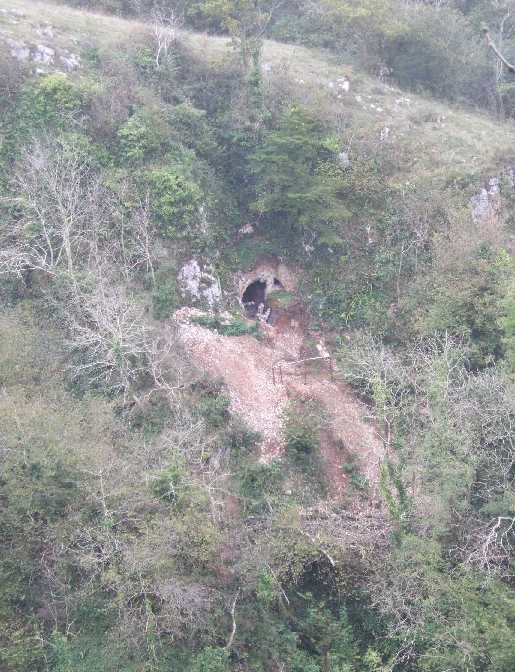 |
| Gully Cave and the spoil heap (Oct. 2007) |