Upper Palaeolithic
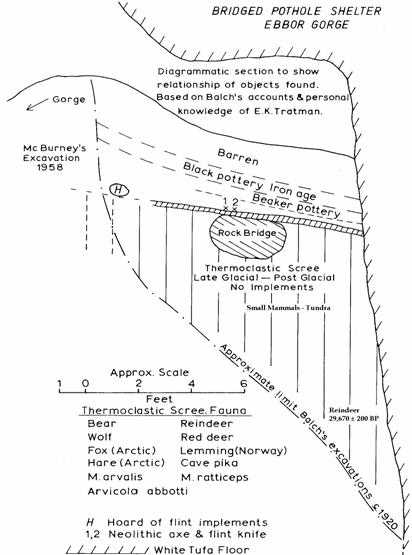
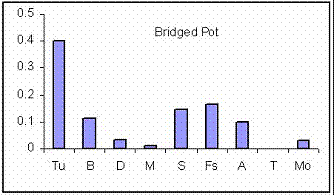
The archaeological evidence found at Ebbor that can be dated in the Upper Palaeolithic consists almost exclusively of faunal remains. Very little exists belonging to this period that can be attributed to an anthropic origin. By far the richest deposit is at Bridged Pot Shelter, where a reindeer scapula fragment has been dated to 29,670 � 200 BP. It was found at a depth of 12 feet. According to Balch (1947), the Neolithic axe and knife were found above the rock bridge at about 3 feet beneath the surface. Below that depth, the only remains found were animal bones. These included at between 6 and 8 feet an assemblage of small mammals. A study made by Andrews (2004) using data provided by Price (2003) has shown that these belong to a tundra environment. It is therefore probable that from at least 6 feet to the base of the excavation, at 15-17 feet, the deposit is of Pleistocene age. As well as the small mammals (with the notable presence of the pika) and birds like grouse and ptarmigan, the fauna included above all red deer and reindeer, fox, wolf and bear.
This Pleistocene layer was excavated in two trenches in the outer portion of the shelter by McBurney (1959), who called this layer B. He found some fish vertebrae among the small mammals and birds, and he explained that all these remains could come from the pellets of a Snowy Owl. Also in Layer B, he found scattered fragments of burnt bones and charcoal, and a fragment of a struck flint blade. He considered that this could be evidence of an Upper Palaeolithic human occupation.
However, when a limb bone from this level was radiocarbon-dated, the result was 8890 � 340 BP (Burleigh, Ambers & Matthews 1984).
Although, at first, Balch described the eleven blades found in the hoard at Bridged Pot Shelter as Mousterian or proto-Solutrean, in fact the hoard was probably located at a similar depth to the axe and knife and is therefore almost certainly of Neolithic age too.
A reference to Primrose Shelter states that a late Pleistocene deposit with flints was found in 1959 (Barrington and Stanton 1977). The evidence appears to be rather flimsy and, for example, R. Jacobi has expressed his doubts about the Palaeolithic attribution of the flints in a personal comment reported on the Somerset HER web-site. We have seen one flint at Wells Museum identified as coming from Pulpit Shelter (Primrose Shelter) and its appearance is not Palaeolithic. Another bag at the Museum is labelled �Flints from area of Pulpit Cave, Ebbor�; it contains a number of blades, but also two fragments of pottery.
Similarly, the two chert implements found at Bracelet Cave (Mason 1972) are poor evidence of a Palaeolithic occupation and soon after their discovery Tratman already cast some doubts as to their real provenance (Tratman 1958).
Fauna that is probably of Pleistocene chronology has been found at Savory�s Hole (reindeer), and above all the solitary lion bone recovered from Lion Cave. From Outlook Cave a proximal phalange of reindeer has been dated to 10,375 � 55 BP, within the cold Younger Dryas period at the end of the Pleistocene. Bear, and possibly wolf found in the same cave could be of a similar age. Interestingly, Balch believed that some reindeer remains at this site had been gnawed by hyena, and even human bones had been gnawed too. This seems unlikely, unless the bones are much older than we imagine, as it is now generally accepted that hyena did not return to the British Isles after the Late Glacial Maximum. A different animal was probably responsible. |