Neolithic - Beaker Culture
The Neolithic is the start of a sequence of use of the sites at Ebbor that may have continued through to the Romano-British period. This use is apparently funerary rather than occupational. The evidence is quite clear, although somewhat fragmentary. It is also interesting that Mendip in general has many outstanding monuments belonging to the Neolithic in the form of the numerous barrows. If this was the customary method of burial, why were a small number of individuals buried in the caves and shelters at Ebbor? The Megalithic monuments are often said to create a ritual landscape, where the burial places of the ancestors of the community stood in view of those people working the same land as their forbearers had done. If that is the case, then the individuals buried in hidden rock-shelters, separated from the community in their death, may also have been apart from the community in their lives: social outcasts, the insane, etc. This does not mean that they were necessarily poor, in fact quite spectacular artefacts, presumably grave goods, accompany some of the human remains
Some of the oldest evidence of human remains, together with what we suppose were grave goods, were found at Savory�s Hole (bones from several individuals, flints and a hammer-stone), and Kid�s Hole (bones of a child with a large number of goat bones).
For the latter site there is one reference to a barbed flint arrowhead (Savory 1989, p.48).
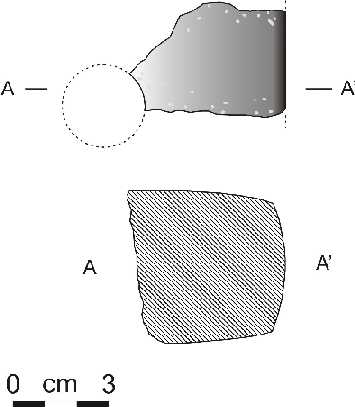
At Little Shelter (where flints and a fragment of a sandstone axe were found) the human remains included part of the skull of a man over 45 years of age, a right humerus probably of a woman about 5 feet 4 inches in stature, and the right half of an upper jaw of a person suffering from pyorrhoea, probably a middle-aged woman (Keith 1922) � therefore of at least 2 individuals. The axe was perforated and is therefore relatively recent in age, probably early Bronze Age.
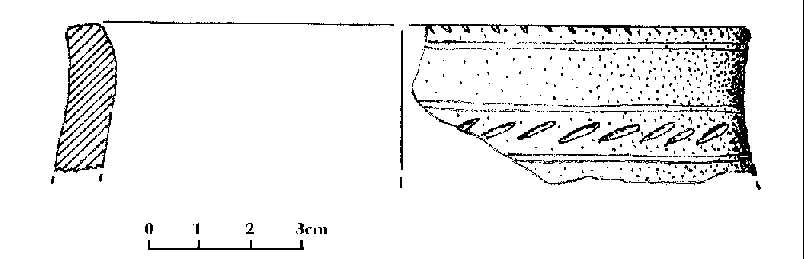
In the case of Outlook Cave, the human remains were accompanied by a flint arrow head, a broken axe, flints, and pottery. The surviving sherds appear to have beaker-like decoration. In contrast, the arrow (or javelin) head with a very small tang and no barbs would be older, Neolithic in age. The axe could be of the same age.
At Beaker Shelter, at least three individuals were buried, and a large beaker fragment was found with the human remains.
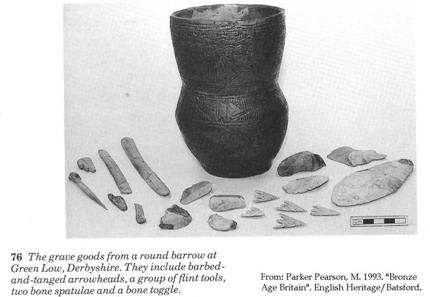
Nonetheless, the finest collection of artefacts belonging to this period comes from Bridged Pot Shelter, where, unfortunately, no human remains have been recorded. The objects were found at depths of between two and three feet. It is not known whether there is any significance in this vertical range, taking into account the limited control over the stratigraphy that was probably taken in the excavation, and the sloping beds suggested by the only known diagram of the deposit. However, appropriately, the oldest element could be the deepest: the superb greenstone axe. The hoard of eleven large flint implements was found at a similar depth (about three feet) and can be considered as an exceptional deposit belonging to the same period (despite Balch�s attribution for it, as stated above). The other implement, not with the hoard, was a flint knife. Intriguing parallels can be found for some of the flint artefacts at different Beaker deposits. For example, a flint knife comparable with the one from Bridged Pot Shelter was found in the grave of the Amesbury archer. This burial has been dated to between 2400 and 2200 BC. A blade resembling the large blade in the hoard formed part of the grave goods at a round barrow at Green Low, Derbyshire. These parallels suggest that the Beaker pottery found at Bridged Pot Shelter, although it appeared at a slightly shallower depth, may in fact be part of the same deposit as the hoard, or of another deposit of a similar age..
As no human remains have been found at Bridged Pot Shelter, this may have been a ritual deposit, a form of offering, possibly in relation with burials at the nearby Beaker Shelter. Or perhaps the human bones had disappeared through post-depositional processes before the cave was excavated. |