Bamboo flute
Three Stringed guitar - shamisen
Historical Context
Performance
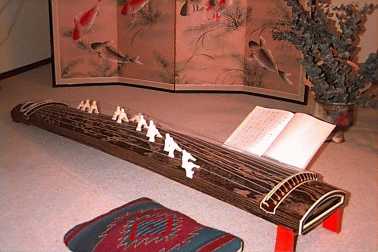
The Koto
Past and Present Orchestration
Stylistic Appeal of Genji Monogatari Emaki
My Personal Experience

The aesthetics of Japanese traditional music, like its theory and style, must be understood in the context of Japan's historical periods. The Japanese emphasis on monophonic or non-harmonized music has produced other specific characteristics: the delicate use of microtones, the importance of timbre and the refinement of free rhythm. Musical aesthetics have varied from period to period, although in later times the aesthetics of earlier periods lingered and often mingled with one another. If representative ideas are chosen from each period, they may be summarized as follows: purity (kiyosa) from early antiquity; refined and courtly taste (miyabi) from late antiquity; symbolism and sober poverty (wabi, sabi, yugen, hana) from early Middle Ages; and smartness and elegance (iki and sui) from the later Middle Ages. The philosophies of Shinto and Buddhism, especially Zen Buddhism, provide the aesthetic bases of the Japanese approach to most arts and, together with Confucianism, form the moral framework within which the different arts exist. Multiplicity, rather than symmetry and unity, might be regarded as the basic feature of the style and form of Japanese music. Japan has a rich variety of seasons and climates; its people have thought that human beings must be in harmony with nature, rather than resistant to it. Such thinking has been reflected in Japanese music throughout the ages.
"Harmony has the power to draw Heaven downwards to the Earth. It inspires men to love the good, and to do their duty. If one should desire to know whether a kingdom is well governed, if its morals are good or bad, the quality of its Music shall furnish forth the answers" Confucius
The nature of Japanese music is in close symbiosis with its mode of transmissions. For many genres, the right to perform was severely restricted. For example, court performers' roles were hereditary, with transmission from father to son; moreover, each instrument or skill was passed on in a separate lineage. Professional performance of certain traditions, such as biwa, koto and, jiuta shamisen was for several centuries legally restricted to blind performers' gilds, principally the Todo-az or Todo shoku-yashiki. Shakuhachi performance was also legally restricted to members of the Fuke sect of Zen for two centuries. Such restrictions were often violated, but in any case they were lifted in 1871 as part of modernization. Women were also excluded from various genres; even now, most Japanese consider it inappropriate for a woman to perform shakuhachi or 'official' forms of the theater genres no and kabuki.
Modernization did not lead to total liberalization. Most genres of traditional classical music and dance and even folksong are now taught within the iemoto (household) system, hierarchically structured 'schools' or 'lineage' with an autocratic iemoto at the head, who makes decisions about repertory, performance style, and licensing of teachers. Such institutional transmission is much debated. On the one hand, it tends to restrict creativity and access and can be economically exploitative. ON the other, it is considered responsible for the survival of many traditions that might otherwise have died or altered beyond recognition. Many aspects of teaching methods can be related to such restrictive transmission. Thus musical notation is often comparatively vague, partly as a way to limit access. The emphasis is on exact imitation of one's teacher; deviation can best be achieved by starting one's own 'school.'
Westernization brought threats to the survival of traditional genres. The national education system, created along Western lines in the 1870s, has tended until recently to overlook traditional music. One 20th century response was the emergence of Preservation Societies (hozonkai), especially in the folk world, where the iemoto system was absent. A hozonkai is usually an organization under local control devoted to 'preserving' a local song or dance, often a single item. Hozonkai have the same virtues and drawbacks as the iemoto system.
Beginning in the mid-20th century, survival of certain traditions has been helped by government intervention. To encourage young performers of the music theater genres, there are now government training schools based in national theaters. More important is the Ministry of Education's elaborate system of National Culture Properties, which designates particular traditions as 'important intangible cultural properties (juyo mukei bunkazai) and certain artists as "living National Treasures' (ningen kokuho) and provides some financial support.
There is a great diversity among these genres; despite or because of this, researchers have been keen to establish a modal theory that could encompass many or all types of traditional Japanese music. Prior to the late 19th century the only extensive modal theory was that for gagaku (court music); early theorizing did not extend to detailed analysis of tonal function or melodic patterns, and the focus was mainly on scales (tonal material), tunings and modal classification of pieces. It was recognized, that court music modes fell into two groups, ritsu and ryo, each with an anhemitonic pentatonic core with two 'exchange tones' that could replace two of the core degrees. The modal terminology of gagaku was sometimes applied to other genres but rarely provided insight.