Development of the independent solo koto and chamber music genres is more evident in the Muromachi period. The earliest surviving school of solo koto music is Tsukushi-goto. It was first established by court refugees and exiles that gathered away from the court in Kyoto, in the late 16th century on the island of Kyushu. Tsukushi-goto repertoire has a connection to variations of imayo court songs. These songs were accompanied by the koto and the three-stringed plucked samisen (shamisen in Tokyo area). The sets were called Kumiuta, a term applied to chamber music. The 16th century priest Kenjun is credited with the creation of the school and its first compositions. The tradition became more secular when it appeared in Edo. There, a 17th century blind musician named Johide, aclaimed as a student of Hosui, a student of Kenjun, developed his own version of the music. He added compositions in more popular technique and scale, and named himself Yatsuhashi Kengyo, and founded the Yatsuhashi school of koto. The title Yatsuhashi was adopted later by anotehr apparently unrelated school to the far south in the Ryukyu islands.
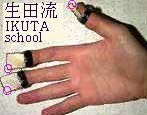
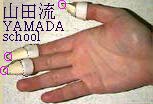
Schools of popular or "vulgar" koto (zokuso) reflected the mercantile life of the new Tokugawa (Edo) period (1603-1867). In 1695 another third generation extension of the Kenjun's koto tradition was Ikuta Kengyo, who began the Ikuta school. The term Kengyo has been one of the basic ranks of musicians under the guild system and frequently found in professional names, but the name Ikuta remained as a primary source of koto music until the creation of another school by Yamada Kengyo (1757-1817). Ikuta and Yamada schools remain popular but the Ikuta koto produces a tone easily distinguishable from the Yamada school.
Koto music is known as sokyoku. Koto music is divided into two classes, dan and kumi; dan-mono are written in parts "steps" or "grades" with connecting motives but without voice part. The grades are called respectively ichidan, nidan, sandan�. The piece is called "Godan," "Rokudan," Shichidan," "Hachidan," "Kudan" the pieces with 5,6,7,8,9 steps. Teach dan is composed of 52 hyoshi or bars. Danmono instrument compostions consists of a number of movement each dan except the 1st consists of 104 beats; arranged in 26, 4/4 measures; 1st dan is 4 or 8 beats long, slow beginning tempo, speed increases from each dan, near end of last dan, tempo slows to beginning tempo, few additional beats in 1st dan result in kando. Short introudction consisting of opening formulat with cadential characters.
Kumi are lighter in style, like dan-mono, written in several parts, accompanied by voice, parts correspond with verses of song, called hito-uta, futa-uta, "first verse" and "second verse" each verse diveided into 8 sections, each section of 8 hyoshi, the verse is 12 bars longers than the dan. In solo koto instrumental music (shirabemono), the most important type is the danmono, a variation piece in several sections (dan), each normally of 104-beat length. The term for koto chamber music, sankyoku, means music for three. The standard instrumentation consists of a koto player who sings, along with performers on a three-stringed samisen lute and an end-blown shakuhachi flute. The basic genre of chamber music is called jiuta and combines the earlier kumiuta tradtion of accompanied song with instrumental music by alternating section with singing (uta) and instrumental interludes (tegoto). After the 19th century a second embellishing koto part (danawase) was added to instrumental interludes.
Japanese melodies are referred to two types of scale structure of a five note octave; filling in minor and major third gaps, to become six or seven note scales. One type is described as Sino-Japanese, found over the far east and particularly in Mongolia, China and Indochina, and Japan; this is represented by the series; CDEGAC', each note serves as starting point for a different five-note mode; CDEGAC', DEGAC'D', etc. In Japan, the mode CDEGAC' is relatively uncommon; the more favored mode is represented by GAC'D'E'G'. of the six mode keys used in the ancient music of the imperial court, for example, three are of the first kind -ryo modes in different keys; three, of the second kind -ritsu modes in different keys.
The second type of scale structure occurs not only in Japan, but conspicuously in Indonesia and the coastal areas of the Indian archipelago, with traces elsewhere on the Asian mainland. It may be represented by the series BCEFAB'. Each note may serve as starting point for a different five-note mode; but in Japan only three of the possible modes are exploited, those on A, B and E. These are sometimes described as "national" modes.
| 1. Mae-uta | Mae-biki | Short koto introductory passage |
| Mae-uta | ||
| Tsunagi | Koto conclusion of uta section | |
| 2. Tegoto | Tegoto | |
| Naka-jirashi | mid-tegoto climax | |
| Tegoto | ||
| Hon-jirashi | Final climax or �true climax� | |
| 3. Ato-uta | Ato-uta | |
| Ato-biki | Short closing koto passage |
Melodies based on either of these note series tend, like Chinese and Mongolian melodies, to make use of the interval of a fourth as a constructional unit; chains of thirds, so common in western European folk song, are infrequent. It is rare to find purely syllabic, one note to one syllable, tunes in Japanese folk song; for the most part, songs tend to be partly syllabic and partly melismatic, with several notes sung to one syllable of the text. The simple, square-cut, symmetrical dance structures, so common in western folk and popular music, are less common in Japan, where folk song displays a great variety of asymmetrical and often quite complex structures. ON the whole, binary or quaternary (2/4 or 4/4) rhythms predominate; and though irregularities occur, there is no extended use of ternary or irregular rhythms.