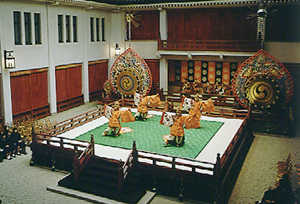
The introduction of continental East Asian music and dance first from Korea and then from China, greatly changed character of Japanese music. The introduction of Buddhism through Korea in the 6th century also had considerable influence. Importation of Buddhism to Japan was 538 or 552. The new religion welcomed by the ruling class opened new reforms. Prince Shotoku played an important role in promoting Chinese influence by writing the Constitution of Seventeen Articles about moral and political principles. The first Chinese performing art to reach Japan was gigaku (masked dance and pageants), which was imported by Koreans during the Asuka period (552-645). Gigaku was followed by gagaku, which consisted of various kinds of Korean and Chinese court music and dance. These were organized, together with indigenous music, under a governement music department called the Gagaku-ryo. Important governemental musical event as part of the celebration in 749 of the completion of a colossal bronze statue of Buddha for the Todaiji monastary in Nara, the capital. The Shosoin, the imperial treasury of the Emperor Shomu in Nara, contains 75 musical instruments of 18 kinds that were used in these cermonies. Other instruments came from the Tang dynasty China or Korea. The international features of gagaku were modified to Japanese taste and style when the aristocrasy replaced the governemtn as the major sponsor of such music early in the Heian period (749-1185). Buddhist chant, shomyo, which had its origins in India, was introduced into Japan, though China.
Buddhism gained a huge number of followers among the members of the upper class and became the state religion. However, its difficult theories were not comprehended by the average farmer. Some minor struggles took place when Shinto was confronted with Buddhism, but soon the two religions began to coexist harmonically.
In 645 Nakatomi no Kamatari started the era of the Fijiwara clan that was to last until the rise of the military class (samurai) in the 11th century. In the same year, the Taika reforms were realized: A new government and administrative system were copied from the Chinese system; all land was bought by the state and redistributed equally among the farmers in a large land reform in order to introduce the new tax system that was also adopted from China. With the immense influence from the mainland came also the theories of Confucianism and Taoism, as well as the Chinese writing system, the kanji into Japan.
This was one of the great periods of artistic development in Japan. Contacts with China were interrupted toward the end of the ninth century, and Japan's civilization began to take on its own special characteristics and forms. This was a process of assimliation and adaption by which things introduced from outsdied gradually assumed an essentially Japnaese style. The most typical instance of this process was the development during the Heian period of a Japanese script. The complexity of Chinese writing led writers and priests to work out two sets of syllabic systems based upon Chinese forms.
The Nara period (710-784) demonstrates how active music was in the newly established capital of Nara. The general term for court orchestra music, gagaku, is a Japanese pronunciation for the same characters used in Chinese for ya-yueh and in Korea for a-ak. As Japan absorebed more and more of the outside world, the music of the court, like that of T'ang dynasty China during the same centuries, received an increasing variety of styles. In 702 these styles were organized under a music bureau (gagakuryo), and by the early 9th cetnury an additional Outadokoro (Imperial Poetry Bureau) was created for handling Japanese-composed additions to the repertoire. Among foreign genres, the musical sytles of the nearby Three Kingdoms of Korea have already been shown to be some of the first imports, Silla music being called in Japanese shiragigaku, Paekche music, kudaragaku, and Koguryo music, kokurigaku. Music from the Three Kingdoms was sometimes called collectively sankangaku. Under these terms were found still other Chinese and northern Asian traditions, in addition to music purported to have come from India as early as 736. Evidence of such a distant import can be found in a surviving court dance (bugaku) called "Genjoraku," whose story about the exorcising of the snake can be traced to an ancient Indian Vedic tale. The date of 736 is also assumed for the entrance of music from Indochina, which survived for several centuries in a form of music called rinyugaku. Although this tradition is now lost, there are extant detailed pictures of the ensemble along with other ancient instruments and a variety of dances in sources such as the 14th century copy of the 12th century Shinzeigakuzu scroll.
The dominant musical style of early gagku was from China and was called the T'ang music (togaku). In Japan, as in Korea, the establishment and maintenance of such a music has made it possible for modern listeners to hear foreign versions of famous pieces long forgotten in the country of their origin. For example, there are names of pieces played and dances performed in Japan that are also found in T'ang Chinese lists. Unlike in China, many of these works are still played in Japan, and a few of the original costumes and masks used at that time are preserved. Perhaps the most valuable treasure in Japan for such materials from the ancient traditions of all East Asia is the Shoso-in, a storehouse built for the household goods of the emperor Shomu after his death in 756. In this collection on can find 21 percussion instruments, 12 strings, and 12 winds, in addition to dance masks, notation, and drawings. Some of the materials are Chinese and Korean imports, while other are Japanese-made. The Chinese variant of the arched harp of the ancient Middle East (in Japanese the kugo) is best preserved here. The very decoration of certain instruments can also be historical gold mines. For example, the protective cover across the face of one plucked lute (biwa) contains the picture of a performer riding a camel near a palm-treed oasis. Another such cover depicts a group of foreign musicians accompanying an energetic dancer, all on the back of an elephant. Etchings along a hunting bow show scenes of dancing and music performance connected with a popular imported art of acrobatics and juggling called sagaku.
Further images of Japanese musical life can be captured from the Heian period (794-1185). In the very first chapter of the 10th century Ochikubo monogatari, one of Japan's earliest novels, the sad fate of the heroine is noted by the fact that she was never able to learn how to play the Chinese seven-stringed ch'in zither, although she did have some training in Japanese koto music. The famous 11th century literary works, such as Murasaki Shikibu's Genji Monogatari (The Tale of Genji), are filled with romantic koto, biwa, and flutes, as well as gagaku and bugaku perfomances and the singing of many songs. Diaries also show that the courtiers, now moved to Kyoto, found music to be a useful and frequent adjunct to their insular courtly life. It was in this period that the many forms of official court music were organized into two basic categories. The music to the left was called togaku and contained the Chinese and Indian derived pieces. The music of the right was called komagaku and contained all Korean and Manchurian examples. In both categories there were pieces that by this time may have been Japanese arrangements or original compositions. The term left and right were derived from the Confucian-based administration system of the new capital, which divided the entire government into such categories. In bugaku they controlled the costumes of the dancers, left dances emphasizing red, right dances, green. In gagku these two major divisions standardized the instrumentation of the ensebles. When playing dance accmopaniments, stringed instruments were deleted, but eh two orchestras for purely instruemtal performances were complete. Each used plucked 12-stringed zithers with movealbe bridges called gaku-so or by the generic term koto. The string section was completed by a four-stringed plucked lute, the gaku biwa. A small hanging gong (shoko) and a large hanging drum (tsuri daiko) were found in both. The leader of a togaku piece would use a barrel drum (kakko) with two lashed heads struck with sticks, while a komagaku piece would be led by an hourglass san no tsuzumi drum similar to the Korean changgo. The standard melodic instrument for both was the double-reed hichiriki, with a komabue flute beign added in komagaku and a ryuteki flute in togaku. The Japanese sho mouth organ appears in both.
By the middle of the Heian period, these phonetic alphabets, or kana as they are called, had been improved and brought into fairly wide use, opening the way for a literature of a pure Japanese style, which was to flourish in place of that in the imported Chinese idiom. Life in the capital was marked by great elegance and refinement. While the court gave itself up to the pursuit of the arts and social pleasures, its authority over the martial clans in the provices became increasingly uncertain.
Effective control of the realm gradually passed out of its hands and became the prize for which two rival military families, the Minamotos and the Tairas, both of which traced their descent from previous Emperors, engaged in one of the most celebrated and hard-fought struggles in Japan's turbulent Middle Ages. The Minamotos finally prevailed, annihilating the rival Taira clan in the epic Battle of Dannoura on the Inland Sean in 1185.
The main events during this period may be summarized as follows, each numeral covering about a century: (I) The king of Shiragi (Silla), Korea, sent 80 musicians to attend the funeral of the emperor Inkyo in 453, thus marking the first importation of foreign music into Japan. (II) The king of Kudra, Korea, in the middle of the 7th century dispatched a number of musicians to remain in the Japanese court; about the same time music came also from Koma, Korea. At this time kure-gaku (gaguku), which played an important part in Buddhist ceremonial, was also introduced. (III) Indian, as well as Chinese, music had already found its way to Japan through Korea. But the influence of T'ang music, coming direct from china, became irresistible and played an important part in the grand inauguration ceremony of the Great Buddha of Todaiji, Nara, in 752. The music of European Turkey and of Arabia also found its way to Japan before the establishment (in 702) of the imperial bureau of music (Uta-ryo) which consisted of more than 500 singers, musicians, etc. (IV) The biwa (bass lute) and the koto (zither) were brought from China. There was a revival of T'ang and Korean music, and this foreign music so dominated the Uta-ryo that O-uta-dokoro was created for the development of native music to be used on certain ceremonial occasions. (V) The contact between foreign and native music gave rise to new instruments. (VI) there was a further development of gagaku for the court use. (VII) there arose the class of shirabyoshi (white measure markers) whose semipoetical chants were accompanied by drum and flute. It was during this time that a separation of popular from aristocratic music took place.
The first significant development in the history of Japanese music took place in the Heian Period (794-1192 A.D), While Japanese music which had been popular among common people was being sophisticated, all kinds of music from various Asian countries In the previous two centuries were being assimilated and modified, acquiring distinct Japanese characteristics. Gagaku is the music which was performed mainly at Court among the powerful nobility and upper classes. Gagaku is classified into three categories: original foreign music, pure Japanese music, and music composed in Japan using influences from other countries. The representative genre of Gagaku has its origin in China, Korea, and other countries in Southeast Asia or South Asia, and is divided into two types such as To-gaku or music of Chinese origin, and Komagaku or music of Korean origin. It is orchestral music without any vocal part. The music is known as Kangen and when accompanied by dancing is called Bugaku.
Pure Japanese music, called Kokufu kabu or Japanese Song Dance, is vocal music with instrumental accompaniment. It is based on very ancient music performed at shrine rites as well as Court ceremonies. The last category includes Saibara with its origin in folk songs and Roei for chanting Chinese poems. They are accompanied with instrumental music.
Instruments used in Gagaku are mouth organs, flageolite-type instruments, flutes, drums, and zither. Arrangements of these instruments differ depending on the genre of music. Gagaku is performed at Court, shrines, and some temples. Recently it has attracted young people's attention and is sometimes used in contemporary music.
In addition to Gagaku, another important music style, Shomyo, was formed during the Heian Period. It is vocal music used in Buddhist services and became a very significant source of Japanese vocal music which developed later.