
Japanese flute, Yamato-fuye, lacquered red inside and closely bound outside between holes with string laid on with paste, and afterwards fixed with lacquer. Strings made from strips of cherry-tree bark, called kaba (Chinese trees) the top plugged with lead wrapped in rolls of paper fastened with wax, and finished at the end with wood decorated either witih brocade or a highly finished metal ornament. Seldom clean notes, Seiteki primitive Chinese flute used with Gekkin, Teikin, and Keikin; made of plain bamboo unlacquered inside, 21 inches long, 6 finger holes.
The Shakuhachi made of thick bamboo and lacquered inside, measuring 20 inches long, measurements from joint to joint (6 �, 5 �, 4, 3 �) internal measures 1 inch at top, 1 �inches at base, external diameter 1 � inches at top, 2 inches at base.
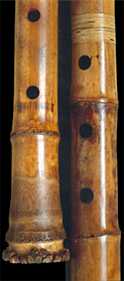
Well played as mellowest instrument of wind section. Traditional secrets were handed down from Omori Toku, a hermit of Yedo, from generation to generation. Lower lip of player covers upper cavity and takes place of 'language' of pipe, breath entering between edge of lower lip as 'voicing' it has 4 upper holes, center of 1st is 9 � inches from lip, thumb hold underneath 8 � inches from lip.
The shakuhachi end-blown flute is a variant of the Chinese hsiao, and examples of it can be found in the famous 8th century Shoso-in treasure house. During the Muromachi period (1338-1573) a smaller Japanese version called the hitoyogiri became popular as a solo instrument, but the best-known form of the shakuhachi is the one developed in the Tokugawa period. The instrument was used by komuso, Zen Buddhist priests who begged or something spied while wandering through the streets playing the flute incognito, their heads covered by a special wicker basket hat. With the changes in contemporary Japanese society, many former warriors no longer carried their swords, whereas young merchants carried more money. One curious side effect of such change was the occasional appearance of a shakuhachi tucked in the back of one's belt for use as a musical device or as a clube.
The major schools of shakuhachi music today come from guilds, the Meian and Kinko, whose origins derive from two sects of an earlier Fukeshu guild of komuso priests. In the Meiji era (1868-1912) the monopoly rights of the various music guilds of the previous period were abolished; and a Tozan school was founded for teaching the music to amateur musicians, a custom soon adopted by the other guilds.
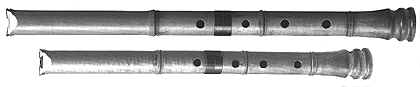
The instruments of all schools may vary in size and the number of finger holds for the purpose of pitch as well as difference in timbre ideals. The standard shakuhachi has four finger holes along the front and one thumb hold behind. A bell is formed by the bamboo root stems at the end of the flute. The mouthpiece is cut obliquely outward, and a small piece of bond or ivory is inserted at the blowing edge in order to help produce the great subtle variety of tones typical of shakuhachi music. The basic repertoires of the music are divided into three general types. Original pieces (honkyoku) are those claimed to be composed by the founders or early teachers of a given school, whereas outside pieces (gaikyoku) are taken from other genres or other schools of shakuhachi music. New pieces (shinkyoku) continually appear and are kept in that category. Shakuhachi notation varries with each school, all are based on mnemonics with which the music is taught. Given the exceptional sublety of tone changes and ornamentation in all traditional shakuhachi music, such a notation system seems quite logical. The beautiful introverted sounds of shakuhachi music seem closer to Buddhist change than to other instrumental forms and are best learned by the ear and heart rather than by the eye and brain.
The Shakuhachi is a traditional Japanese vertical bamboo flute played like a recorder blowing at one end. It has unique tonal characteristics and a profound historical connection to Zen Buddhism. It was once played only by a particular sect of wandering monks known as Komuso as an instrument of devotion but, in modern times, has become a musical instrument available to all.
The Shakuhachi repertory comes out of an oral traditional based on learning by example and imitation. In addition, it was originally a type of Buddhist devotional music practiced soley by monks belonging to the Fuke sect who were called Komuso, or 'Monks of Emptyness'. Their religious practice was based on the belief that ordinary reality was false in nature and that by emptying themselves of their preconceived notions and preconditioned perceptions they could directly connect into the innate nature of reality. Their primary tool for this was the shakuhachi.
The standard length is 1.8 Japanese feet, the meaning "shaku"-foot and "hachi"-eight. The shakuachi is made from the lowest section of the bamboo. The average diameter of the pipe is 4-5cm and the inside is almost cylindrical. There are four holes in the front and one in the back, its sometimes called a "five-holed bamboo flute" in English. These five holes are enough to produce a complete range of sounds giving it 12 distinctively poignant chromatic tones.