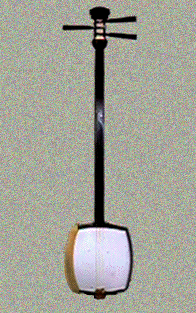
The jamisen is the Chinese instrument equivalent to the samisen. Front and back covered in snake-skin, with oval block of hard wood body, measuring 6 inches in length 5 in breadth, and 3 � in thickness, 2 inch holes in diameter are cut. 3 strings pass from the tuning pegs though a small ivory notch on the neck, and over a small ivory bridge on the face, fastened to an ivory knob at the base of belly; jamisen played with small tortoise-shell plectrum, long silk cord and tassel attached. Neck is 2 inches shorter than samisen, pegs are larger. Strings tuned to Honchoshi.
The shamisen is one of Japan's most popular classical musical instruments. Another Chinese import, it came to Japan by way of Okinawa in the middle of the sixteenth-century. The shamisen arrived to Japan through Liu Chiu in 1560. There are three tunings, adopted to Hirajoshi; Honchoshi, Ni-agari, San-sagari The word 'agari' means raising, 'sagari' is lowering, 'choshi' is normal, 'joshi' is tuning, ni-agari is second string raised, san-sagari is third string lowered. The shamisen resembles the banjo, it has a long, thick neck and a small, rectangular body covered with skin. The instrument is made of four boards of Chinese quinced or oak, through which a stick made of red sandalwood or Indian redwood is inserted. The skin covering both sides of the body is usually cat skin, but dog skin is used as well. Three strings of different thicknesses are plucked and the pitch is adjusted using the tuning pegs on the head, just like a guitar or violin. The strings are not plucked with the fingers, a large triangular plectrum is used to strike the strings. Generally the plectrum is made of ivory or tortoise shell, and in the shape of a Ginko tree leaf. The shamisen is frequently used as an accompaniment to songs of various types.
Samisen is played with bachi of wood, ivory, and tortoise-shell, which strikes the string just below where the neck joins the body. Measurements, 7 � inches long by 7 inches broad, by 3 � inches deep, the neck 2 feet 5 � inches long, tapering from 1 inch broad to 7/10 inch, the pegs 3 inches long, the bachi 8 � inches long, rather less than an inch square at the top, and 3 � inches long at the striking edge.
The shamisen is three-stringed instrument that developed from the classical Japanese stringed instrument, the biwa. The predominant genre of music played by the shamisen players was nagauta, or long song. This genre of music dates from the later seventeenth century, and was very simple, lyrical style up until the nineteenth century but grew into a more ornate lyrical style in the late nineteenth century. But the shamisen players also play a genre of music called joruri, after a singing style in the puppet plays, also called joruri. Such music was meant to accompany the narrator (tayu) as he sung the story of the play. In the joruri theater, all the action is sung by a narrator, but kabuki theater alternates narrative with spoken dialogue. The central genre of narrative music is called gidayu, since it was invented by a puppet theater shamisen performer named Takemoto Gidayu (1651-1714). When a shamisen player in kabuki theater plays in both nagauta and joruri styles, this mixture of genres is called kake ai performance.
The three-stringed plucked lute of Japan is known as the shamisen in the Tokyo area or as the samisen in the Kansai district around Kyoto. It seems to have arrived in Japan as an import of the sanshin, or jamisen, from the Ryukyu Islands in the mid-16th century. Thy Ryukyu form of the instrument, with its oval body and snakeskin, is obviously derived in turn from the Chinese San-Hsien. Such an origin is reinforced by collections of early Ryukyu music, which use a kukunshi notation similar to Chinese symbols. The Japanese shamisen underwent considerable physical change, its body being rectangular and the skins coming from a cat or dog. Apparently under the influence of contemporary biwa lute traditions, the plectrum of the instrument was changed from the talonlike pick of the Ryukyus to a wooden or ivory bachi with a thin striking edge. In addition, the lowest string was kept off the small metal upper bridge near the pegbox so that it produced a buzzing sound (sawari) distinctly reminiscent of the tone of the biwa. The three basic tunings of the Japanese instrument are Hon-Choshi (b-e'-b'; b represents the B below the middle C, b' the B above); Ni Agari (b-f'-b'); San Sagari (b-e'-a'). These tunings have remained standard to the present day.
Greater variety is found in the many genres of samisen music. The earliest types seem to have been played by old biwa entertainers around Saka, a city then called Naniwa; hence the name of the new genre was Naniwa-Bushi. Samisen was used for folk music and party songs, but in keeping with the biwa origin of the first performers, narrative music was of prime importance. Such music became known as joruri, the term being derived from the title of the famous story of the princess Lapis Lazuli (Jorurihime Monogatari). As different guilds of samisen evolved, it was possible in modern times to divide them into two basic styles: narrative traditions (Katarimono) and basically lyrical musics (Utaimono). Sekkyo was an earlier form of Buddhist ballad drama for the general populace and thus is placed at the beginning of the narrative style, for Sekkyo-Bushi was eventually done with samisen accompaniment. The term jiuta has already been mentioned as one of the early chamber music forms and thus starts the lyrical list.
Turning to the narrative list first, one finds a mass of names, most of which after Naniwa and Joruri are derived from the professional name of the musician who began the style. Except for the terms Ogie and Utazawa, the names for the lyrical styles are more descriptive. It has already been noted that kumiuta mean a set of songs. The terms hauta and kouta stand for short lyrical pieces such as would be heard in the teahouse or at a banquet. Nagauta means a long song and represents the major genre in this category. Each of the styles uses a samisen of different size with different weight bridges and design of plectrums. The voice quality of the singers is quite different as well. A professional shinnai singer would find the performance of gidayu as difficult as would a French opera specialist attempting to sing Wagner.
The most famous and perhaps most demanding of the narrative styles is gidayu, named after Takemoto Gidayu (1651-1714), who worked with Chikamatsu Monaemon in the founding of the most popular puppet-theater tradition (known as bunraku) of Osaka. The gidayu samisen and its plectrum are the largest of the samisen family, and the singer-narrator is required to speak the roles of the play, as well as to sing all the meditations and commentaries on the action. The part is so melodramatic and vocally taxing that the performers are often changed halfway through a scene. There is little notated in the books (maruhon) of the tradition except the words and the names of certain appropriate stereotyped samisen responses. The samisen player must know the entire drama by heart in order to respond correctly to the interpretations of the text by the singer. The two musicians sit on a platform to the stage left of the theater and through the intensity and skill of their performance help bring life and pathos into the wooden characters who move with frighteningly realistic gestures in the hands of the puppeteers. The power of gidayu is such that it can be heard in concert versions as well. In the 19th century a school of female performers (Onna-joruir) carried on the concert tradition with equal ability.
Kabuki theater is a musical theater; it is filled with dance, instrumental music and percussion. There are two instrumental performance groups on the kabuki stage. To the left of the stage is a small room with a narrow window (kuromisu); inside this room sit the geza, or "background music" players. But on the right side of the stage is a raised platform, the choba yuka on which the narrator (tayu) and the onstage music ensemble (debayashi). This ensemble consisted of singers, hand drums (ko tsuzumi and o tsuzumi), a stick drum (taiko), a Noh flute (nokan) or bamboo flute (takebue, and the principle instrument, the shamisen. On-stage shamisen music became a constant feature of the kabuki stage from the middle of the seventeenth century.