Rommel's Last Battle

While Rommel was recovering his health, the Afrika Korps
collapsed, just as Rommel said it would, with a loss of 130,000 of Germany's
best warriors. Hitler summoned Rommel to the Fuhrer Headquarters and said "You
were right, I should have listened to you." Rommel was allowed out of
semi-retirement and put in charge of Army Group B, whose Headquarters was in
Munich. He was in charge of the German forces in Northern Italy. Rommel's
strategy on defense conflicted with Kesselring's, who was in command of German
forces in Southern Italy.
Hitler pulled Rommel out of Italy and, while deciding
on the Desert Fox's future, sent him on inspection of the Atlantic Wall. The
Atlantic Wall was a line of coastal fortifications from Denmark in the North to
the Franco-Spanish border in the South. This area was the responsibility of
Rundstedt, the C-in-C of Oberkommado West or OKW.
FALLING OUT WITH RUNDSTEDT
Rommel realized that
Anglo-American air support would make the Allies too strong for a battle in
France. He, of all the German commanders in North-West Europe, had experienced
the power of Allied air attacks. He also knew that if the Allies were allowed a
beach head, the Germans would never be able to dislodge them and the fall of the
Third Reich would only be a matter of time. Therefore, Germany's only chance
would be to attack the Allies while they were establishing their beachhead. He
was unable to convince any German of his view, which in the event to out to be
correct.
Hitler should have chosen between these two views.
However he decided on a compromise. He allocated three divisons to Rommel, three
more to Army Group G in Southern France and left four divisions in Ob West's
reserve.
This arrangement meant no-one was happy since Rommel
did not have enough armor to carry out his plans and Runstedt lost six out of
his ten mobile divisions. In other words, Hitler had ruined both commanders
plans.
INVASION: NORMANDY
He also asked Rundstedt to reposition the Panzer
Lehr division, 3rd Flak Corps, 12th SS Panzer Division and a rocket
launching brigade to more strategic positions in Normandy. These appeals were
rejected by Rundstedt and subsequently the High Command. "They would have been
in exactly the right place to counter the invasion," Admiral Ruge moaned
later.
PREPARING FOR THE INVASION
The inspections, arguments and other work had taken
its toll on Rommel and he needed a rest. Checking the weather forecasts on June
4 for the next few days and discovering the weather wasn't favorable for an
invasion, he left his HQ for Germany. He planned to have a few days rest at home
and then visit Hitler to personally ask for more reinforcements. It was a
mistake which cost him and Germany dearly.
D-DAY
Rommel arrived back in France that night and tried
for the next three days to restore the front. Two days too late, on June 9,
Rommel managed to launch a counterattack with the 21st Panzer, 12th SS Panzer
and the Panzer Lehr divisions. The attack came within three miles of the coast
but was halted by overwhelming air and naval support. The Panzer Group was all
but wiped out. Rommel went on the defensive all along the front, and no major
counter attacks occurred until August.
FIGHTING IN THE HEDGEROWS
Hitler expected the invasion in Normandy to be a
feint, he thought the real invasion would come from the Pas de Calais. Rommel
couldn't convince Hitler to release the troops stationed there for the Normandy
battle. Meanwhile the 7th Army and Panzer Group West were bleeding to death in
the deadly bocage country of Normandy.
PLOT TO KILL HITLER
Rommel was deeply involved in this conspiracy.
Although he opposed killing Hitler, he did want to arrest the dictator and put
him on trial for his crimes. He was the only active field marshal ready to play
a part in the coup against the Nazi regime. He succeeded in getting the
SS General Sepp Dietrich, commander of the II Panzer Corps, to agree to follow
only Rommel's orders in case of an anti-Nazi coup.
ROMMEL WOUNDED
Meanwhile the conspirators had placed a bomb in
Hitler's conference room at the Wolf's Lair in Prussia. Hitler survived the
explosion and set about hunting down members of the conspiracy. The Gestapo, the
Nazi secret police. learned of Rommel's involvement in the conspiracy while he
was recovering in Swabia. On October 14, Army Personnel Chief Lieutenant-General
Wilhelm Burgdorf and his deputy surrounded Rommel's home with SS men and offered
him a choice: suicide, or trial before the People's Court. Rommel originally
chose the trial, but after being told the consequences for his family he changed
his mind. The Army Officers told him they had a poison capsule, and that his
family would remain safe. They also promised a state funeral with full military
honors.
SUICIDE
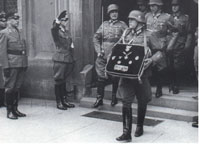
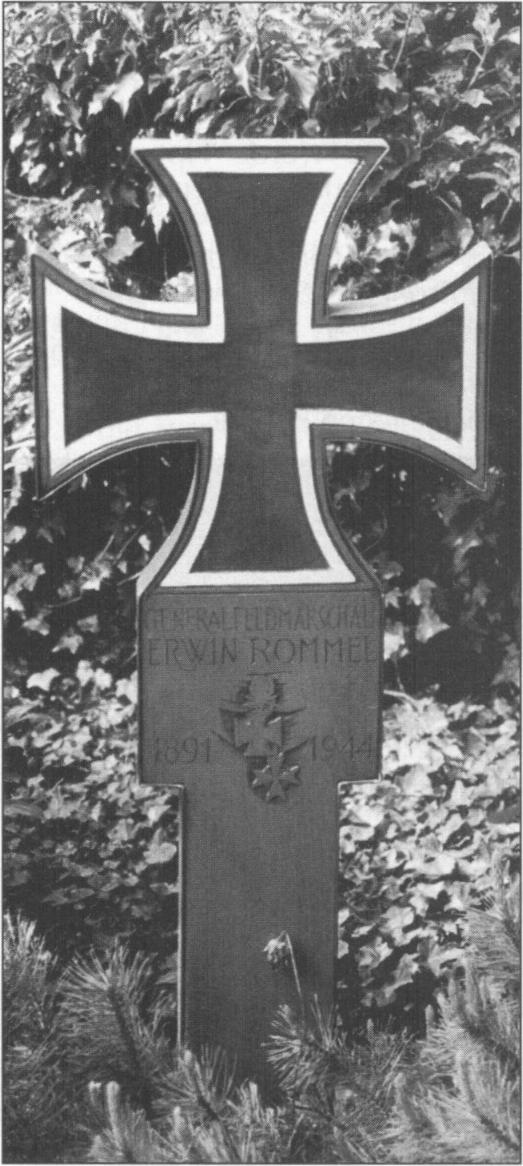
The Nazis kept their end of the bargain. Rommel's
family wasn't harassed and he received his state funeral. His body was cremated
to remove all traces of the suicide. His ashes were buried in the graveyard of
the Herrlingen village church.
He was fifty two
years old at the time of his death.
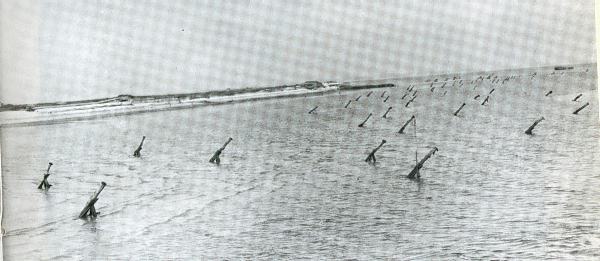
Rommel was satisfied with the coastal defenses. He
was convinced that unless the Allies were stopped on the beaches the fall of
Germany would be inevitable. The first twenty-four hours of the invasion would
be the most important and he wanted to command.
However Rundstedt was convinced that Rommel had been
sent to France to replace him. Rommel and Rundstedt met in December 1943
and agreed that Army Group B placed under OB West. Rommel was given command of
the new army group, which consisted of twenty-four infantry and five Luftwaffe
divisions, extending from the Netherlands to Brittany. The Army Group, though,
had no Panzer divisions. This led to the major strategic debate between Rommel
and Rundstedt: where to position the ten Panzer and Panzer Grenadier
divisions which were in OB West's reserve at the turn of 1943. Rommel wanted
to position them near the coast, where they would be able to launch immediate
counterattacks against the Allied landing forces. Rundstedt wanted to keep the
divisions where they were, since he wanted to save them for a decisive battle in
Central France.
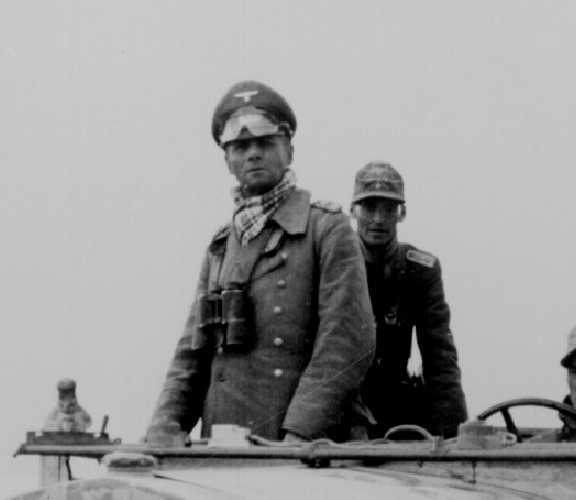
Rommel came around to the conclusion that Normandy
was the location of the Allies' invasion due to scientific reasons: he realised
that the Allies were deliberately bombing the railways into Normandy and trying
to isolate it. In May, 1944 he reinforced Normandy with the 91st Divison, the
6th Parachute Regiment, the 101st Rocket Launching Regiment and the 206th
Panzer, 100th Panzer, 17th Machine Gun and 7th Army Sturm Battalions.
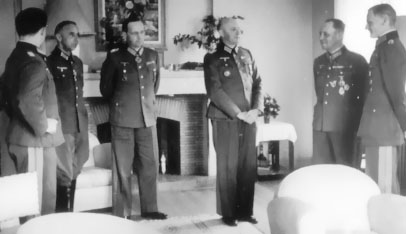
Rommel's men laid over four million mines in the five
months leading up to the invasion, trying to make the coastal defenses as
impenetrable as possible. This huge number of mines was more than the entire
number that OB West had laid in the previous three years. He had also set up
over 500 000 off-shore obstacles, thousands of anti-glider obstacles and
anti-tank traps, dummy positions and strong points with machine gun
nests.
On June 6, 1944, the Allies landed in Normandy on
five beaches. They came up against two under strength German infantry divisions.
The Germans fought fiercely but by the end of the day they were all but
destroyed. Rommel didn't hear of the invasion until three hours and forty-five
minutes after it. His only comment was "How stupid of me, how stupid of me." He
had missed the most important battle of his career.
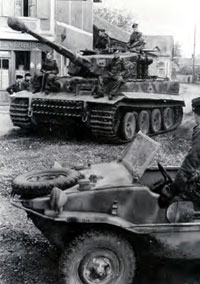
For six weeks Rommel had his hands full just
containing the Allies in the dense hedgerow country of Normandy. Major General
Barton of the US army commented that Rommel's men were outnumbered by the Allies
"ten to one in infantry, fifty to one in artillery and by an infinite number in
the air." Just as in North Africa, Rommel was getting the maximum effort from
his men, but it was not enough.
On July 15, he sent Hitler an "ultimatum" implying
that the war was lost and calling upon the Fuhrer to end the war. "I have given
him his last chance. If he doesn't take it, we will act!" Rommel said to his
fellow conspirators plotting to eliminate Hitler and sue the Western Allies for
peace.
Fate took Army Group B out of Rommel's hands. On July
17 he was hit in the head by shells from an enemy fighter-bomber. He wasn't
expected to live through the night but he survived and returned home to
Herrlingen in Swabia where he had moved his family in late 1943.
After bidding farewell to his family, Rommel left
with the Generals. He was found Dead on Arrival at the Wagnerschule Reserve
Hospital in Ulm. Brain seizure was officially recorded as the cause of his
death.