North Africa

Rommel flew to Rome on 11 February, 1941
and immediately began giving orders. He would need air support, he was nowhere
near the front line and he uncharacteristically began taking over command. Next
morning he arrived at Tripoli airfield.
The Germans perceived Operation Sonnenblume a rescue operation
intended to save their ally while the Italians were still being effective tying
down British troops.
Rommel had unclear information on the position of the British forces. He
assumed that he would be dealing with an overwhelming British offensive against
the demoralized Italians. He believed the salvation of the Italians would lie
with the Luftwaffe, since he had few troops of his own- most of his forces
during the entire African campaign were Italian. He was given Luftwaffe sorties
which bombarded British armored columns.
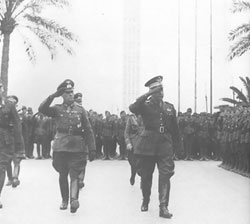
When the first German troops arrived in Tripoli they were paraded before the
general population. They made a great impression before they were sent to the
front. However their equipment was unsuitable to the desert climate, the men
found the conditions very unusual. The German soldier learnt very fast and
adaptation began immediately.
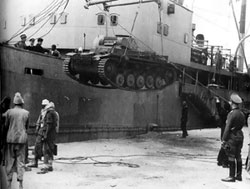
Rommel ensured over the next weeks that there were no delays unloading the
German armor in Tripoli harbor. He also ordered that dummy tanks be set up in
order to confuse the enemy as to the strength of the German/Italian army. On 19
February the name Afrika Korps was coined to indicate the German troops.
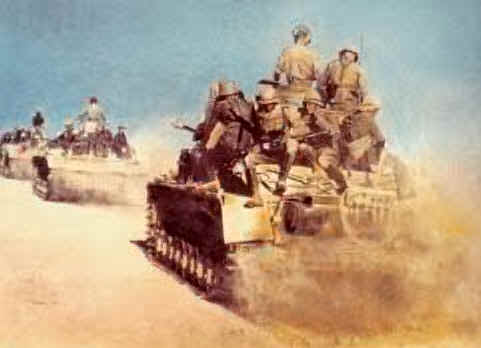
His armor arrived on March 11. Half of them were the excellent Mark III and
IVs and the other half were light tanks. Rommel moved his headquarters close to
the front. However his superiors were restricting the amount of German troops
being sent to Africa.
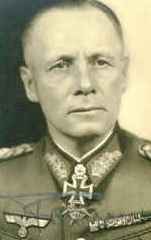
On his return to Berlin in March, 1941, Rommel was rewarded with the Knight's
Cross with Oak Leaves. By the time Rommel flew back he was rewarded with the
news that the 5th Light Division had won the first victory of the North African
campaign.
Rommel decided to attack Mersa El Braga, but he had received orders to wait
for the 15th Panzer division. This he found impossible to do. If he delayed the
British could mine the area. Under the false name of a probe he attacked. He
outflanked the British and won the battle. What had started with a probe had
turned into a major pre-emptive strike. It was an act of disobedience that
Rommel hoped to justify by its success.
His next goal was the capture of Cyrenaica. On 2 April the operation began.
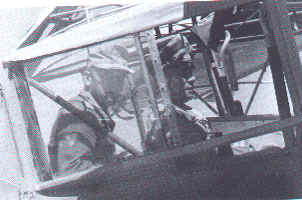
Flying over his disorganized columns in his Storch light monoplane he redirected
formations like he did in France. Once he nearly landed in a British column and
narrowly escaped capture. Rommel won the battle, the British had evacuated
Cyrenaica and were retreating as fast as they could to Tobruk.
SIEGE OF TOBRUK
He surrounded Tobruk and on 14 April attacked. It failed
miserably. Rommel was furious. He thought the coordination between the infantry
and the armor was defective and air bombardment had gotten the edge over the
Afrika Korps. He described the Italian soldiers: "They did not come forward at
all, or they ran at the first shot."
Rommel made another attempt two weeks later and took the
commanding position that the Anzacs were using to harass Axis supplies after a
fierce battle.
On 27 April General Paulus arrived to assess the situation. He sanctioned a
further attempt on Tobruk which (Paulus present) failed. After seeing Rommel
first hand in battle he reported back to Berlin, describing Rommel as "a
head-strong, tempestuous commander of the Afrika Korps." Paulus also thought
that Rommel should withdraw to Benghazi and shorten his supply line. Rommel
thought differently. However Paulus didn't see Rommel at his best.
Rommel now thought Tobruk should only be taken by siege. He now planned to
hold the front, which was by now the Egyptian border. The redeployments of his
non-motorized infantry took time and the British appreciated this. They prepared
an attack which began on 15 May, 1941. They planned to preempt the arrival of 15
Panzer, which was en route to the front, and knock Rommel off balance. Small
actions characterized the battle which Rommel won.
BRITISH COUNTERATTACK
OPERATION BATTLEAXE
The next day, 16 June, was when Rommel countered. After a hard fight which
lasted throughout the day the British withdrew with a loss of 29 tanks.
Battleaxe had ended in a complete victory for Rommel. He hoped this triumph
would result in more supplies being sent to his front. He did not know that most
of the available material was being saved for the German invasion of Russia.
Rommel was lucky not to be on the Eastern Front. Many shady military reputations
were made there. Rommel didn't know of the atrocities being committed in Russia.
After Battleaxe Rommel had under his command 10 divisions and three
Corps commands and he was now 'General of Panzer Troops'
OPERATION CRUSADER
Rommel came to the conclusion that the British operation was in fact a major
offensive. He was forced to postpone the attack on Tobruk and divert his armored
forces to destroy the mobile British forces. He missed the entire British 7th
Armored Division and its commander was told to press on to Tobruk. Rommel
expected an attack from Tobruk itself to meet with the 7th Armored. He had to
stop these forces from linking up.
In one of the most confusing battles of World War Two, the British relieved
Tobruk, albeit tenuously. Rommel had lost all but 26 of his tanks and on
December 8 Rommel withdrew from Cyrenaica.
The British, thinking Rommel was finished began building up for the final
attack on Tripoli. However the Desert Fox, as Rommel had come to be known, had a
surprise waiting for them.
ROMMEL COUNTERATTACKS
After this attack, there was the usual lull on the battlefield, as both sides
built up supplies for the next attack. When Rommel struck, first as usual, he
was outnumbered three to one in tanks, ten to one in armored cars, eight to five
in artillery and six to five and a half in aircraft. Despite this
disproportionment of strength, Rommel broke through the heavily mined Gazala
Line, outfought and outmaneuvered the British, and nearly destroyed the British
8th Army.
He pursued his routed enemy to Tobruk, without giving his men time to rest,
and captured Tobruk on June 21, 1942. The next day, Hitler promoted Rommel to
Field Marshal. He was the youngest German Marshal in the Wehrmacht. This was the
apex of his military career. His promotion was not the award he hoped to
achieve. He wrote to Lucy that night: "Hitler has made me a field marshal. I
would have much rather he had given me one more division."
After the capture of Tobruk, Rommel only had 44 operational Panzers left.
Despite this weakness he invaded Egypt. He hoped to capture Alexandria and Cairo
before the battered 8th Army could recover. He nearly pulled this bold plan off.
However he was halted at El Alamein.
BATTLE OF EL ALAMEIN
In the battles of July 1942, the Afrika Korps were fighting almost only with
captured British guns and ammunition. Rommel repelled ten attacks in July,
but by the 26th his artillery fired its last shot. He was prepared to retreat if
the British attacked again, but they had suffered heavy losses and had to
rebuild their forces.
By now, the Allies were unloading 38 times more supplies than the Germans.
The RAF had swept the Luftwaffe from the sky, and Rommel's worn Panzers, which
were in bad need of overhauls, were outnumbered nearly 3 to 1. The Allies had
won the war of attrition. Rommel decided to attack one last time before the
British became too strong for him to attack at all.
General Montgomery (the fifth 8th Army commanders in less than a year) was
ready for such an attack. During the Battle of Alam Halfa ridge, he destroyed 49
Panzers and turned back Rommel's last attempt to breach the El Alamein line.
On September 23, he left on sick leave, before he was to travel to Russia for
a new command. However when Montgomery began his offensive on October 23, Hitler
telephoned Rommel and told him to report back to North Africa. Rommel was
severely outnumbered and ordered a general retreat. To Rommel's surprise, Hitler
told him to "Stand fast, yield not a yard of ground, and throw every gun and man
into battle."
As a soldier, Rommel obeyed the Fuhrer's order, a decision which cost him
half his Panzers and most of the Italian tanks. On November 3 Rommel ordered a
retreat without the Fuhrer's permission the next afternoon. From the retreat on,
the Desert Fox's relationship with the Fuhrer deteriorated steadily. At the
Fuhrer Headquarters, Rommel was treated to scenes of the Fuhrer's rage: Temper
tantrums, charges of defeatism and screaming fits. Hitler even questioned the
courage of Afrika Korps, upon which comment Rommel left the room. When Hitler
insisted that Rommel's men stand fast and die in battle, Rommel asked why the
Fuhrer didn't come to the front and show them how to do it.
Rommel conducted a brilliant one thousand mile retreat and got the remnants
of Afrika Korps to Tunisia in early 1943. After the Americans landed in Morocco
in 1943, cutting off Rommel's rear, he wanted to abandon Africa and use his
tanks to defend Sicily and Italy. Instead Hitler sent an entire army to Africa,
even though he couldn't supply it properly. Rommel turned on the Allies and
defeated the inexperienced Americans terribly at the battle of Kasserine Pass in
late February, 1943. In March 6 he lost fifty Panzers without inflicting a
single casualty on the 8th Army - his worst tactical defeat ever. Hitler
decorated him with the Knight's Cross with Oak Leaves, Swords and Diamonds and
sent him off in unofficial disgrace.
He left North Africa for the last time in March, 1943.
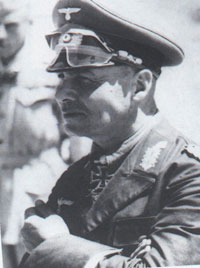

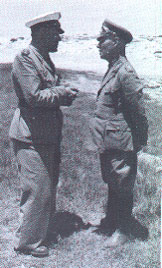
On 10 April Rommel announced "Objective: Suez Canal". For the mean time his
immediate goal was the Libyan port of Tobruk. To an extent Rommel was obsessed
with Tobruk. He knew it would be a tough nut to crack; it was held by the
Australian 9th Division who had prepared the position. He described the
Australian prisoners as "big and powerful men, without question...an elite
formation of the British empire..." Tobruk could only be taken by siege.
Rommel's intelligence had informed him of this attack in advance. Rommel had
three sources of intelligence. The first was the patrols and recons made by the
Luftwaffe and his troops. The second was captured documents and the third was
the interrogation of prisoners. Rommel treated his prisoners with respect, and
admired the British order that if captured only name and rank can be given to
the enemy. An example of respect given to the enemy is his encounter with
Brigadier Stirling. He assured Stirling that his captivity would not be harsh,
and with a handshake and a smile remarked "that there must surely be enough room
in the world for both British and Germans without need for fighting." Stirling
heartily agreed.
These three sources were valuable but by far the most useful was the
interception of British signal traffic. His excellent intercept documents
prompted Rommel to boast the he knew more about where the enemy formations were
than the opposing commander. The attack on 15 May began with a British signal
"Fritz". On 14 June Rommel's forces again picked up the code word "Fritz"
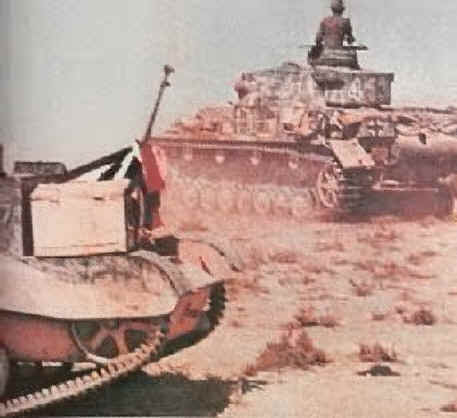
and troops on the front were alerted. This was the beginning of Operation
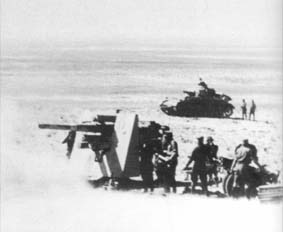
Battleaxe. The British attack was a two pronged attack. The defensive battle
went well, with the excellent 88mm anti-tank knocking out large numbers of
British armor. The British started 'Battleaxe' with 200 tanks. After the first
attack, they were down to 39.
He embarked on Operation Sommernachtstraum ,a raid which told Rommel
the British were not ready for any kind of an offensive. During this lull on the
front Rommel was to organize an assault on Tobruk. It began on 14 November, 1941
and coincided with the British offensive dubbed 'Crusader'. The British plan
involved an incursion in the German lines after which the German forces would
retaliate and run straight into a British line of anti-tank guns and tanks.
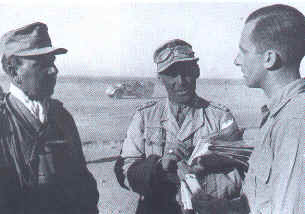
In January, 1942, a naval convoy carrying 55 Panzers and tons of
supplies got by the Malta blockade. Rommel immediately threw these newly arrived
forces in a preemptive strike on the British before they could finish their
buildup. He overran the assembling grounds and pressed all the way to the Gazala
Line, where he halted due to shortage of supplies. After this brilliant success,
Rommel was promoted to Colonel-General.
There were two battles of El Alamein. In the first, Rommel tried to reach the
Nile at full throttle, but failed. In the second, General Auchinleck, the new
8th Army commander changed the Allied tactics. Instead of attacking the Germans,
they concentrated solely on the Italians. Mussolini's Roman legions broke every
time. Rommel was forced to use the Afrika Korps as a fire brigade, rushing
around to restore the front. Supplies were used up and the supply lines almost
collapsed completely.