
France-1940

Rommel was given command of the 7th Panzer (tank) division in February 1940. Hitler had planned Operation Gelb: The invasion of France. Rommel's division was part of Army Group A, the spearhead of the invasion .It was to advance across the Meuse, past the Ardennes and the Somme, all the way to the English channel.
The 7th Panzer division consisted of the 25th Panzer regiment of three battalions - 218 tanks - and a reconnaissance battalion; two rifle regiments, each of three battalions; a motorcycle battalion and an engineer battalion and artillery with one field regiment (9 batteries, 36 guns) and an anti-tank battalion of 75 anti-tank guns. Rommel's tanks were made up of Panzer III and IVs.
Operation Gelb was underway on 10th May, 1940. For Rommel the Second World War was underway.
The advance across France was
extraordinarily fast. During the initial stages of the advance roadblocks were
common and the incredible efforts of the traffic police kept up the swift pace
of the advance. The Luftwaffe (German air force) also gave remarkable service
harassing the Allies when the advance halted. As of 11 May, Rommel was well
ahead of his right hand neighbor, 5 Panzer, in the race to the Channel. Hoth,
Rommel's immediate superior, reinforced 7 Panzer and told Rommel to reach and
cross the Meuse.
On the 12th of May, Rommel's armored cars
reached the Meuse only to find the bridges blown. This was a disappointment for
Rommel who wanted to 'bounce' the bridge before demolition. The French had the high ground on the
other bank of the Meuse and was raining down terrific fire on the Germans.
Rommel personally directed artillery fire on the houses the French occupied.
Several shells landed near Rommel himself. On the Northern end of the Meuse the 6th
Rifle Regiment had crossed the Meuse and was beginning to bridge the river.
Rommel allegedly jumped into the water to help with the construction. During
these days Rommel appeared to be everywhere at once 'like a whirlwind'. On 14 May Rommel had thirty tanks across
the Meuse. He climbed aboard one of them and lead the advance himself towards
the position Rommel wanted to assemble his tanks. Rommel's tank was hit twice
and slithered down a steep slope. Rommel abandoned the tank, his face pouring
with blood from a splinter, taking the crew with him. When he made it back to
his command vehicle bridging over the Meuse had been completed. For this Rommel was awarded a clasp to his
Iron Cross (1st Class) and for his Iron Cross (2nd class). Rommel gave orders the following day to
advance west, engaging the enemy only when necessary; the speed of the advance
must be kept up. It actually gathered pace, as the withdrawal order was given to
the French troops. Large numbers of French vehicles (including tanks) were
overrun. Everywhere the enemy was shattered. Stories were told of French traffic
control directing German columns. BREACHING OF THE MAGINOT LINE
He deployed his artillery which laid
covering fire while the rifle regiments advanced under the cover of Panzer and
artillery fire. The Panzer troops took the lead in the advance through the Maginot Line and
motored through. Engineers blew up bunkers while Panzer guns sprayed areas
thought to conceal French troops. They broke through the line and past French villages. Resistance crumbled.
'Every road out of Avesnes was crowded with refugees, carts, cars mingled
together with the fleeing forces of the French army. The chaos was
indescribable." Rommel wrote. His total prisoner count now totaled two
divisions. By now his supplies and communications line had been greatly extended and
Rommel's superiors were out of touch with him. He had seized his objective and
since he was out of touch with Army Group A's Headquarters he was unable to
receive new orders. Therefore he took the initative and decided to press on to
Landrecies and seize a crossing over the Sambre river. Meanwhile a French tank battalion was moving into Avesnes, temporarily
cutting 7th Panzer division's supply line. Rommel sent his Nazi adjutant, Hanke,
to clear up the situation. Just when Rommel set off for Landrecies he learned that Hanke had dealt with
the French tanks. When Rommel arrived at Landrecies he found the bridge unblown
and large numbers of French anxious to surrender. Rommel ordered Hanke to gather
the Frenchmen and return to the east. Rommel continued his advance, thinking the
7 Panzer was invincible. Rommel was like a racehorse that needs a challenge to
set any real pace. When he arrived at le Cateau he realized he only had the leading
Panzer battalion with him, so he must bring up more of his force, or at least find where
they were! Ordering the leading battalion to stand fast, he headed back towards
Avesnes. He directed the laggers like a traffic policeman and at 4 o'clock the
rest of the division arrived at Landrecies He continued to advance towards Cambrai. On 17 May Rommel won the Knights
Cross of the Iron Cross. Rommel had a reputation for chivalry, for treating prisoners with respect and
decency, and also for feeling decency towards them. Prisoners were killed by
armies on the Eastern Front, but Rommel felt such things were repugnant. Since crossing the German Frontier on May 10, eight days before, Rommel's
forces had advanced an incredible 175 miles and captured over 10,000 French
prisoners. It had destroyed over 300 tanks, 30 armored cars and 20 guns, all for
the low cost of only 35 men killed and 59 wounded. Hoth thought that 7 Panzer needed more time for rest, but Rommel objected,
thinking it wrong that the enemy should not have remission. "Pursuit should be
to the last breath of man and beast", ran the old Prussian maxim. One hour after midnight on May 19-20 May, Rommel set off by moonlight to
Arras.
BATTLE OF ARRAS
On 24 May Hitler gave the order to halt. The counter-attack at Arras had made
Hitler nervous and he switched to the defensive. Rommel showed no disappointed
with the 'Halt' order, and was glad to give his division two days rest. On the
26th May, Lieutenant Hanke awarded Rommel the Knight's Cross of the Iron Cross,
on behalf of the Fuhrer. On the evening of 26 May, Rommel set off for the next phase of the campaign;
A northward attack across the la Bassee canal to complete the encirclement of
Lille. Rommel again took personal command when he found British snipers active as
the crossing point of the Canal. He directed fire from a tank and anti-aircraft
guns from a railway embankment, in open view of the enemy, careless of danger.
He directed fire at every house on the other side of the canal, silencing the
snipers. He had the 5th Panzer brigade transferred to his command and completed the
crossing of the canal. Thereafter Rommel's advance met a great deal of
opposition and he was unable to give personal orders to regiments because of the
terrain. The 25th Panzer had been surrounded and cut off from supplies and Rommel
resupplied the regiment. On 28 May Rommel organized a siege of Lille. The French defenders finally
surrendered on June 1 with honors of war. In the campaign so far Rommel had captured over 7000 POWS, had captured a
considerable number of tanks and had knocked out over 300, including 18
'heavies'. A copy of 7 Panzer's report was sent to Hitler and during the
Fuhrer's visit to the troops on June 3, Rommel was asked to personally accompany
Hitler for the rest of the day, the only divisional commander to do so.
'We were all very worried about you!' Hitler remarked on his visit, referring
the exploits of the 7 Gespensterdivision (Ghost) Division. England
withdrew its forces on June 3. Rommel thought that it was necessary for a
friendly peace between Germany and France.
Rommel felt no hatred towards the French and even less towards the British.
After the great campaign against France, for Rommel and most patriotic
Germans the sun was shining over Germany.
On 5 June, 1940, Rommel crossed the Somme. The second phase of the campaign,
the mopping up of French forces, showed Rommel at his more cautious side. The
French fought fiercely, although Rommel wrote that many of the prisoners taken
were drunk.
On 6 June Rommel implemented an Flachenmarcsh -area march. The
division would form up in a rectangular box and move across country, bypassing
villages and main roads; firing on woods or other places which might be
harboring the enemy. This advance was more slow but the enemy was well
entrenched.
General Hoth's eyes were on the Seine Estuary. There were villages near the
Seine, clearly not an area for an Flachenmarcsh. There Rommel ran into parties
of British. The French inhabitants of Elbuef , a village on the Seine, were
confused and terrified. An elderly woman grabbed Rommel's arm and asked if he
was British. She was shaken by his reply. There was complete confusion, the
streets were crowded with men and machines. The motorcycle battalion that Rommel
asked to take the two bridges over the Seine had not shown sufficient energy to
take the bridges. Rommel furiously ordered them to attack the bridges. He was
rewarded by the blowing of both the bridges by the enemy. In Rommel's sector, at
least, the Germans were halted on the Seine.
On 10 June Rommel received orders to attack and hold le Havre to block the
allied retreat. He advanced joyously. His men were extremely elated at finally
being on the rim of Europe. Since forcing the Somme canals, Rommel drove himself
ruthlessly, always being on the move, day and night. Rommel knew his men were
tired after the last month's advance and that they were starting to slacken off.
An example of this was when he was with three Panzers. A lone French
anti-tank gun opened fire and hit the leading tank. The tank commander abandoned
the tank, while the two others drove off the road, leaving Rommel's command car
in the line of fire. Rommel directed fire from the two undamaged tanks and
silenced the French gun. Rommel then told the tank commander what he thought of
his performance and told him to straighten up his effort.
ST VALERY
Rommel's next task was to take Cherbourg. He organized a heavy bombardment
and on 5 pm 19 June the garrison at Cherbourg surrendered.
Rommel won a great name for himself, as well the Gespensterdivision .
His exploits were the material of publicity. He kept a photographic record of
his campaign. Rommel's methods raised the eyebrows of the high command on two
counts:
1) He ignored regulations and irritated his superiors. Some people say he was
an individualist, others say an egomaniac and ungenerous about others.
2) He believed that a commander needed to be at the tip of the spear, so to
speak. His critics blamed him for failure to utilize the chain of command, of
failure to be in the headquarters, overlooking his whole command.
Rommel was a difficult man to serve, he could only command in the way he knew
how.
On the award of the Knight's Cross Rommel expressed his thanks and reminded
his men of their achievements "Dinant-Avesnes-Le
Cateau-Cambrai-Arras-Lille-Somme-Rouen-Fecamp-St Valery: will remain proud
memories for all the soldiers of the division throughout their lives."
Rommel's name was now known. Joseph Goebel's diaries revealed that he had
made a hero out of him:- "A soldiers' soldier."
NORTH AFRICA
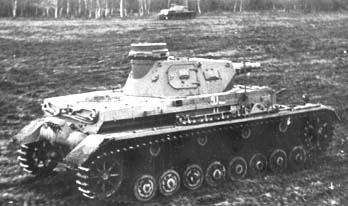
On 16 May Rommel advanced across the
French frontier and through a thin extension of the Maginot Line. He thought the
Maginot Line would be a tough nut to crack.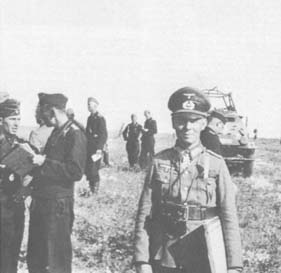
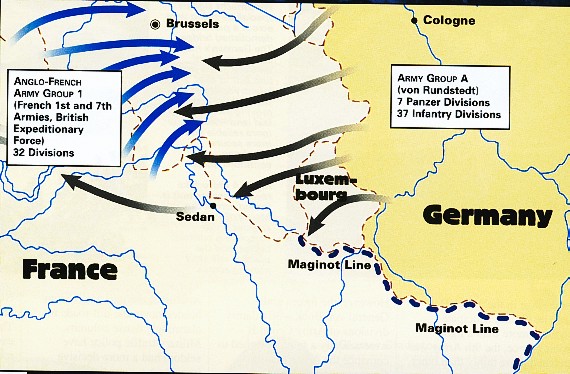
Rommel was leading the advance of the 25th Panzer Regiment towards the small
British garrison at Arras. Irritated by the often sluggish movement of his rifle
regiments he drove back many times and sped up their advance. When he was
reunited with the 25th Panzer in the afternoon of 21 May he found it was under
heavy fire from British heavy Matilda tanks. In tank-to-tank combat, the British
lost seven Matilda's in comparison to the 9 Mark III and IVs. During that battle
Rommel lost his aide-de-camp, killed at his side, as well as over 400
men, more than in the entire advance across Northern France. However the British
counterattack had been spent and Rommel wrote home that the war in France would
be over in a fortnight.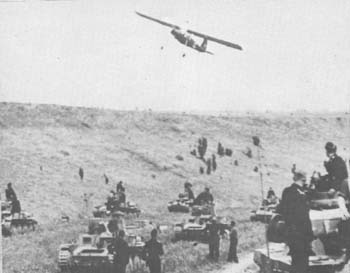
The British and French defensive position at St Valery received heavy fire
from Rommel's forces. The city was in flames but the enemy refused to surrender.
Rommel sighted a transport trying to evacuate men. Rommel directed fire on the
ship and sank it. With their only option being surrender, French and British
prisoners came from everywhere. North and East of the Seine, the war was over.
Rommel's men gave a concert on the promenade of Fecamp.
While Rommel was pressing across Northern France Germany's ally, Italy, had
invaded North Africa. Landing through Libya, the Italian army pressed east
towards Egypt. They advanced 50 miles into Egypt before they were stopped and
forced back by the Imperial Western Desert Force under General O'Connor. Hitler
became surprised and disturbed, this interfered with his Plan Orient:- One army
would invade north into Russia from the Middle East, while another army would
invade south through the Caucasus. He therefore proposed to reinforce the routed
Italian army with one Panzer division and one light division. The leader
of these forces would be one Erwin Rommel. No decision would have such a
profound effect on Rommel's destiny.
