WORLD POPULATION
The world population is the total number of living humans on Earth. As of today, it is estimated to number 7.13 billion by the United States Census Bureau (USCB). The USCB estimates that the world population exceeded 7 billion on March 12, 2012. According to a separate estimate by the United Nations Population Fund, it reached this milestone on October 31, 2011. The median age was 30.4 years in 2012 and is expected to rise to 37.9 years by 2050.
The world population has experienced continuous growth since the end of the Great Famine and the Black Death in 1350, when it stood at around 370 million. The highest rates of growth global population increases above 1.8% per year were seen briefly during the 1950s, and for a longer period during the 1960s and 1970s. The growth rate peaked at 2.2% in 1963, then declined to below 1.1% by 2012. Total annual births were highest in the late 1980s at about 138 million, and are now expected to remain essentially constant at their 2011 level of 134 million, while deaths number 56 million per year, and are expected to increase to 80 million per year by 2040.
POPULATION BY REGION
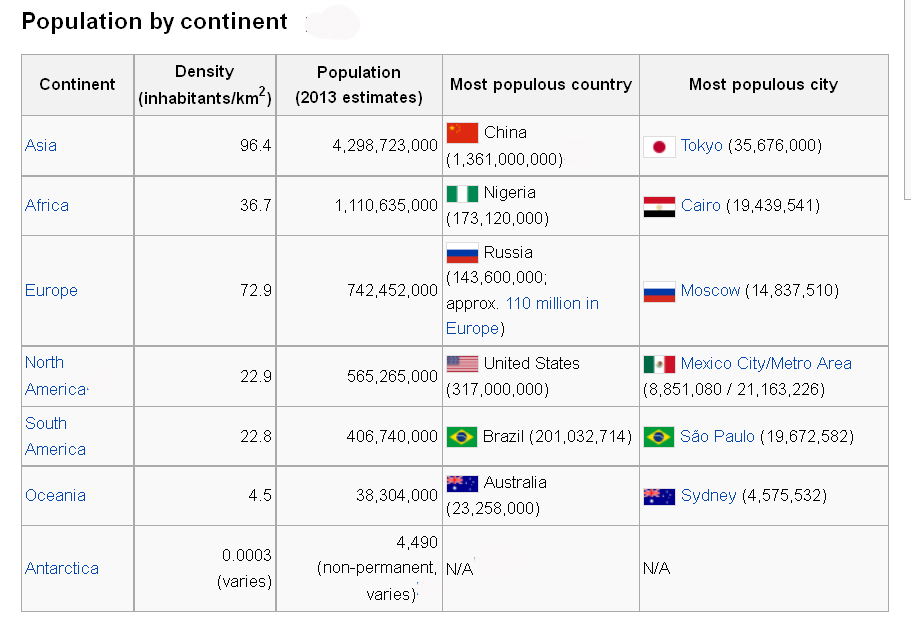
Six of Earth's seven continents are permanently inhabited on a large scale. Asia is the most populous continent, with its 4.3 billion inhabitants accounting for 60.31% of the world population. The world's two most-populated countries alone, China and India, together constitute about 37% of the world's population. Africa is the second-most-populated continent, with around 1 billion people, or 15% of the world's population. Europe's 733 million people make up 11% of the world's population, while the Latin American and Caribbean regions are home to around 600 million (9%). Northern America, primarily consisting of the United States and Canada, has a population of around 352 million (5%), and Oceania, the least-populated region, has about 35 million inhabitants (0.5%). Though it is not permanently inhabited by any fixed population, Antarctica has a small, fluctuating international population, based mainly in polar science stations. This population tends to rise in the summer months and decrease significantly in winter, as visiting researchers return to their home countries.

GLOBAL DEMOGRAPHICS
As of 2012, the global sex ratio is approximately 1.01 males to 1 female – the greater number of men is possibly due to the significant gender imbalances evident in the Indian and Chinese populations. Approximately 26.3% of the global population is aged under 15, while 65.9% is aged 15–64 and 7.9% is aged 65 or over.
The global average life expectancy is 67.07 years,[72] with women living an average of 69 years and men approximately 65 years. In 2010, the global fertility rate was estimated at 2.52 children per woman. In June 2012, British researchers calculated the total weight of Earth's human population as 287 million tonnes, with the average person weighing 62 kilograms (137 lb).
The nominal 2012 gross world product was estimated at US$71.83 trillion by the CIA, giving an annual global per capita figure of around US$10,000. Around 1.29 billion people (18.4% of the world population) live in extreme poverty, subsisting on less than US$1.25 per day; approximately 925 million people (13.2%) are malnourished. 83% of the world's over-15s are considered literate. In June 2012, there were around 2.4 billion global Internet users, constituting 34.2% of the world population.