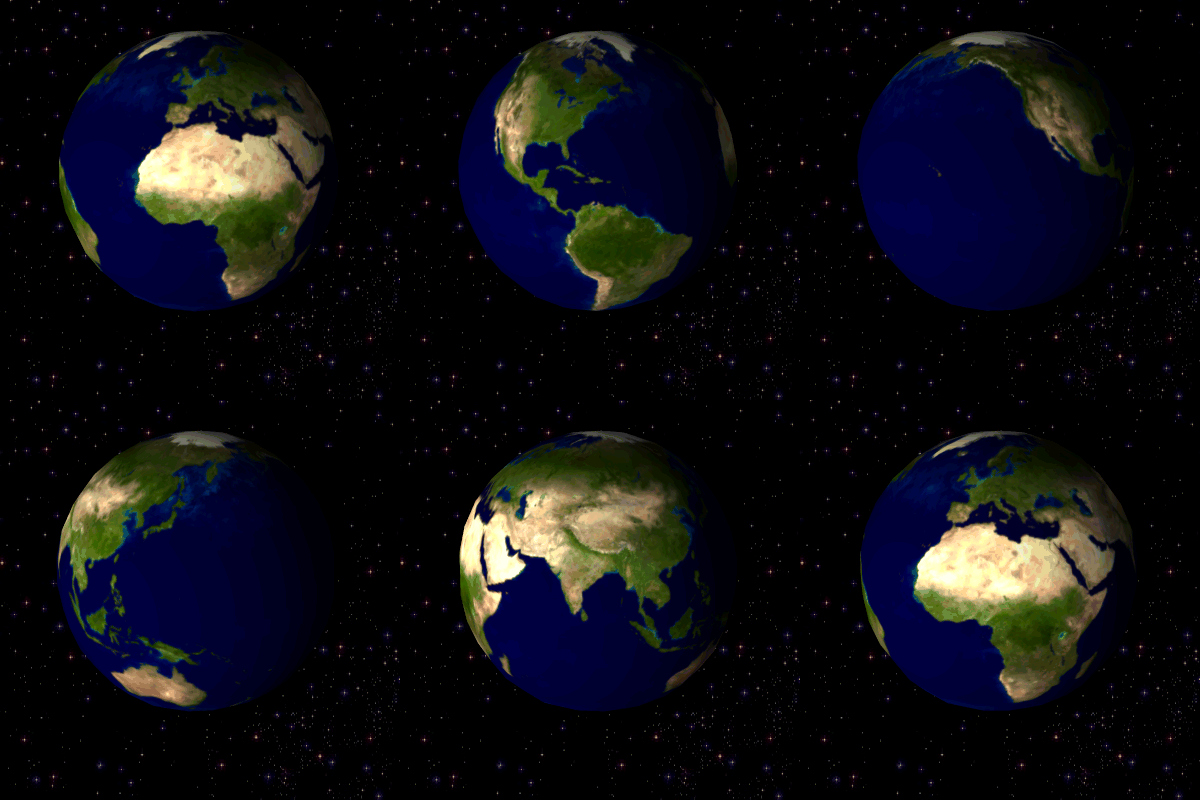
Earth is the third planet from the Sun, it is the densest and fifth-largest of the eight planets in the Solar System. It is also the largest of the Solar System's four terrestrial planets. It is sometimes referred to as the world or the Blue Planet.
Earth formed approximately 4.54 billion years ago, and life appeared on its surface within its first billion years. Earth's biosphere then significantly altered the atmospheric and other basic physical conditions, which enabled the proliferation of organisms as well as the formation of the ozone layer, which together with Earth's magnetic field blocked harmful solar radiation, and permitted formerly ocean-confined life to move safely to land. The physical properties of the Earth, as well as its geological history and orbit, have allowed life to persist. Estimates on how much longer the planet will be able to continue to support life range from 500 million years (myr), to as long as 2.3 billion years (byr).
Earth's lithosphere is divided into several rigid segments, or tectonic plates, that migrate across the surface over periods of many millions of years. About 71% of the surface is covered by salt water oceans, with the remainder consisting of continents and islands which together have many lakes and other sources of water that contribute to the hydrosphere. Earth's poles are mostly covered with ice that is the solid ice of the Antarctic ice sheet and the sea ice that is the polar ice packs. The planet's interior remains active, with a solid iron inner core, a liquid outer core that generates the magnetic field, and a thick layer of relatively solid mantle.
ECOSYSTEM
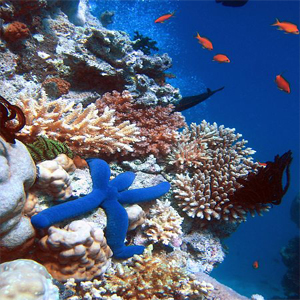
An ecosystem is a community of living organisms (plants, animals and microbes) in conjunction with the nonliving components of their environment (things like air, water and mineral soil), interacting as a system. These biotic and abiotic components are regarded as linked together through nutrient cycles and energy flows. As ecosystems are defined by the network of interactions among organisms, and between organisms and their environment, they can be of any size but usually encompass specific, limited spaces(although some scientists say that the entire planet is an ecosystem)
Energy, water, nitrogen and soil minerals are other essential abiotic components of an ecosystem. The energy that flows through ecosystems is obtained primarily from the sun. It generally enters the system through photosynthesis, a process that also captures carbon from the atmosphere. By feeding on plants and on one another, animals play an important role in the movement of matter and energy through the system. They also influence the quantity of plant and microbial biomass present. By breaking down dead organic matter, decomposers release carbon back to the atmosphere and facilitate nutrient cycling by converting nutrients stored in dead biomass back to a form that can be readily used by plants and other microbes.
AGRICULTURE
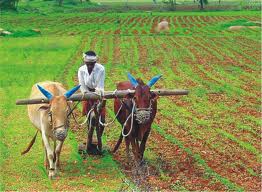
Agriculture, also called farming or husbandry, is the cultivation of animals, plants, fungi, and other life forms for food, fiber, biofuel, drugs and other products used to sustain and enhance human life. Agriculture was the key development in the rise of sedentary human civilization, whereby farming of domesticated species created food surpluses that nurtured the development of civilization. The study of agriculture is known as agricultural science.
The history of agriculture dates back thousands of years, and its development has been driven and defined by greatly different climates, cultures, and technologies. However, all farming generally relies on techniques to expand and maintain the lands that are suitable for raising domesticated species. For plants, this usually requires some form of irrigation, although there are methods of dryland farming. Livestock is raised in a combination of grassland-based and landless systems, in an industry that covers almost one-third of the world's ice- and water-free area. In the developed world, industrial agriculture based on large-scale monoculture has become the dominant system of modern farming, although there is growing support for sustainable agriculture, including permaculture and organic agriculture.
NATURAL PHENOMENON
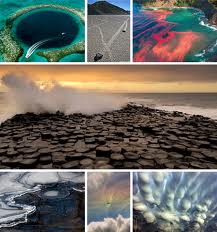
A natural phenomenon is not a man-made event. Examples include sunrise, weather (fog, hurricanes, tornadoes), biological processes (decomposition, germination), physical processes (wave propagation, conservation of energy, erosion), tidal flow, and include natural disasters such as electromagnetic pulses, volcanic eruptions, earthquakes.
Various types of natural phenomena occur, including (but not limited to) the following:
- Geological phenomena (volcanic activity and earthquakes)
- Meteorological phenomena (hurricanes, thunderstorms, and tornadoes)
- Oceanographic phenomena (tsunamis, ocean currents and breaking waves)