
Catalytic Converters
There are millions of cars on the roads in the world, and each one is potentially a source of air pollution. Especially in large cities, the amount of pollution that all the cars produce together can create big problems.
To solve those problems, cities, states and the federal government create clean-air laws, and many laws have been enacted that restrict the amount of pollution that cars can produce. To keep up with these laws, automakers have made many refinements to car engines and fuel systems. To help reduce the emissions further, they have developed an interesting device called a catalytic converter, which treats the exhaust before it leaves the car and removes a lot of the pollution, hence inhibiting the accumulation of greenhouse gases.
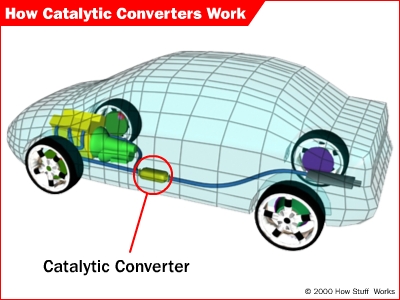 |
| Location of catalytic converter in car |
Back to top
Pollutants Produced
by a Car Engine
Modern car engines carefully control the amount of fuel they burn in order to minimize emissions. This is done by trying to keep the air-to-fuel ratio very close to the stoichiometric point (the calculated ideal ratio of air to fuel). Theoretically all of the fuel will be burned using all of the oxygen in the air at this ratio. For petrol , the stoichiometric ratio is about 14.7:1, meaning that for each kilogram of petrol burned, 14.7 kilograms of air will be burned. However, there is variation in this fuel mixture varies from the ideal ratio during driving. Sometimes the mixture can be lean (an air-to-fuel ratio higher than 14.7), and at other times the it can be rich (an air-to-fuel ratio lower than 14.7).
There are many harmful gases in car exhaust, but in this case we shall talk about those which contribute to the greenhouse effect. They are:
- Carbon dioxide (CO 2 ) - This is one product of combustion. The carbon in the fuel bonds with the oxygen in the air in the ratio 1:2
- Water vapor (H 2 O) - This is another product of combustion. The hydrogen in the fuel bonds with the oxygen in the air in the ratio 2:1
- Hydrocarbons or volatile organic compounds (VOCs) - produced mostly from unburned fuel which evaporates into the atmosphere
- Nitrogen oxides (NO and NO 2 , together called NO x) - contributes to smog and acid rain, and also causes irritation to human mucus membranes
How Catalytic Converters
Reduce Pollution
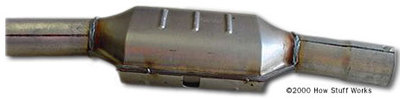
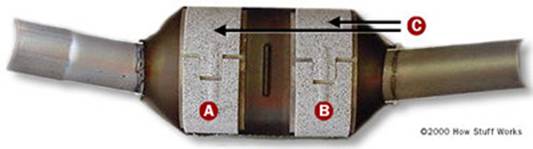
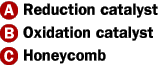
Most modern cars are equipped with three-way catalytic converters, the "three-way" referring to the three regulated emissions these converters help to reduce -- carbon monoxide, VOCs and NO x molecules. These converters use two different types of catalysts, a reduction catalyst and an oxidation catalyst. Both types consist a ceramic structure coated with a metal catalyst, usually platinum, rhodium and/or palladium. The structure of the ceramic structures are such that they expose the maximum surface area of catalyst to the exhaust stream while minimizing the amount of catalyst used (catalysts are very expensive).
 |
 |
 |
There are two main types of structures used in catalytic converters -- honeycomb and ceramic beads, though most cars use the honeycomb structure.
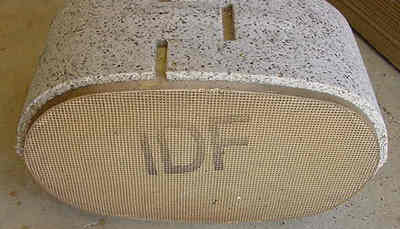 |
| Ceramic honeycomb catalyst structure |
The Reduction Catalyst
The reduction catalyst is the first reaction stage in the catalytic converter. It uses platinum and rhodium to help reduce the NO x emissions. When an NO or NO 2 molecule contacts the catalyst, the catalyst breaks the Nitrogen-Oxygen bond(s), freeing the oxygen in the form of O 2 . The nitrogen atoms bond with other ‘freed’ nitrogen atoms in the catalyst, forming N 2 . For example:
2NO => N 2 + O 2 or 2NO 2 => N 2 + 2O 2
The Oxidization Catalyst
The oxidation catalyst is the second reaction stage in the catalytic converter. It reduces the unburned hydrocarbons and carbon monoxide by burning (oxidizing) them over the platinum and palladium catalyst. This catalyst aids the reaction of the CO and hydrocarbons with the remaining oxygen in the exhaust gas by lowering the activation energies of reaction. For example:
2CO + O 2 => 2CO 2
The Control System
The third stage is a control system which monitors the exhaust stream and uses this information to control the fuel injection system. There is an oxygen sensor mounted upstream of the catalytic converter which tells the engine computer how much oxygen is available in the exhaust. The engine computer then adjusts the air-to-fuel ratio accordingly. This control system allows the engine computer to ensure that the engine is running as close to the stoichiometric point as possible, yet at the same time ensuring sufficient oxygen for the oxidizing and reducing reactions to occur.
Other Ways to Reduce Pollution
Preheating the catalytic converter is a good way to reduce exhaust emissions, the easiest way being to preheat the converter using electric resistance heaters. However,lack of sufficient electrical energy and the waiting time required makes this idea non-feasible in gasoline cars. Hybrid cars that have big, high-voltage battery packs, on the other hand, can provide enough power to heat up the catalytic converter very quickly, hence reducing exhaust emissions by speeding up the catalytic reactions.
Back to top