
Hybrid Cars
Have you pulled your car up to the gas pump lately and been shocked by the high price of gasoline? As the pump clicked past $20 or $30, maybe you thought about trading in your car for something that gets better mileage. Or maybe you're worried that your car is contributing to the greenhouse effect.
|
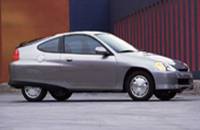
The auto industry has the technology to address these concerns. It's the hybrid car. You're probably aware of hybrid cars because they've been in the news a lot. Most automobile manufacturers have announced plans to manufacture their own versions.
How does a hybrid automobile work? What goes on under the hood to give you 20 or 30 more miles per gallon than the standard automobile? And does it pollute less just because it gets better gas mileage? In this article, we'll help you understand how this amazing technology works, and we'll even give you some tips on how to drive a hybrid car for maximum efficiency.
Back to top
What Makes it a Hybrid
Any vehicle is a hybrid when it combines two or more sources of power. In fact, many people have probably owned a hybrid vehicle at some point. For example, a mo-ped (a motorized pedal bike) is a type of hybrid because it combines the power of a gasoline engine with the pedal power of its rider.
Hybrid vehicles are all around us. Most of the locomotives we see pulling trains are diesel-electric hybrids. Cities like Seattle have diesel-electric buses -- these can draw electric power from overhead wires or run on diesel when they are away from the wires. Giant mining trucks are often diesel-electric hybrids. Submarines are also hybrid vehicles -- some are nuclear-electric and some are diesel-electric. Any vehicle that combines two or more sources of power that can directly or indirectly provide propulsion power is a hybrid.
The gasoline-electric hybrid car is just that -- a cross between a gasoline-powered car and an electric car.
It has a fuel tank, which supplies gasoline to the engine. The engine then turns a transmission, which turns the wheels.
Electric car
It has a set of batteries that provides electricity to an electric motor. The motor turns a transmission, and the transmission turns the wheels.
Back to top
Hybrid Structure
You can combine the two power sources found in a hybrid car in different ways. One way, known as a parallel hybrid, has a fuel tank, which supplies gasoline to the engine. But it also has a set of batteries that supplies power to an electric motor. Both the engine and the electric motor can turn the transmission at the same time, and the transmission then turns the wheels.
You'll notice that the fuel tank and gas engine connect to the transmission. The batteries and electric motor also connect to the transmission independently. As a result, in a parallel hybrid, both the electric motor and the gas engine can provide propulsion power.
Series hybrid
The gasoline engine turns a generator, and the generator can either charge the batteries or power an electric motor that drives the transmission. Thus, the gasoline engine never directly powers the vehicle. All of the components form a line that eventually connects with the transmission.
Back to top
Hybrid Components
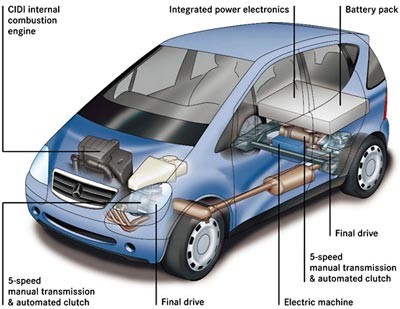
Hybrid cars contain the following parts:• Gasoline engine - The hybrid car has a gasoline engine much like the one you will find on most cars. However, the engine on a hybrid is smaller and uses advanced technologies to reduce emissions and increase efficiency.
• Fuel tank - The fuel tank in a hybrid is the energy storage device for the gasoline engine. Gasoline has a much higher energy density than batteries do. For example, it takes about 1,000 pounds of batteries to store as much energy as 1 gallon (7 pounds) of gasoline.
• Electric motor - The electric motor on a hybrid car is very sophisticated. Advanced electronics allow it to act as a motor as well as a generator. For example, when it needs to, it can draw energy from the batteries to accelerate the car. But acting as a generator, it can slow the car down and return energy to the batteries.
• Generator - The generator is similar to an electric motor, but it acts only to produce electrical power. It is used mostly on series hybrids.
• Batteries - The batteries in a hybrid car are the energy storage device for the electric motor. Unlike the gasoline in the fuel tank, which can only power the gasoline engine, the electric motor on a hybrid car can put energy into the batteries as well as draw energy from them.
• Transmission - The transmission on a hybrid car performs the same basic function as the transmission on a conventional car. Some hybrids, like the Honda Insight, have conventional transmissions. Others, like the Toyota Prius, have radically different ones, which we'll talk about later.
|
Back to top
Why Build Such a Complex Car?
You might wonder why anyone would build such a complicated machine when most people are perfectly happy with their gasoline-powered cars. The reason is twofold: to reduce tailpipe emissions and to improve mileage. These goals are actually tightly interwoven.California emissions standards dictate how much of each type of pollution a car is allowed to emit in California. The amount is usually specified in grams per mile (g/mi). For example, the low emissions vehicle (LEV) standard allows 3.4 g/mi of carbon monoxide.
The key thing here is that the amount of pollution allowed does not depend on the mileage your car gets. But a car that burns twice as much gas to go a mile will generate approximately twice as much pollution. That pollution will have to be removed by the emissions control equipment on the car. So decreasing the fuel consumption of the car is one of the surest ways to decrease emissions.
Carbon dioxide (CO2) is another type of pollution a car produces. The U.S. government does not regulate it, but scientists suspect that it contributes to global warming. Since it is not regulated, a car has no devices for removing CO2 from the exhaust, so a car that burns twice as much gas adds twice as much CO2 to the atmosphere.
Automakers in the U.S. have another strong incentive to improve mileage. They are required by law to meet Corporate Average Fuel Economy (CAFE) standards. The current standards require that the average mileage of all the new cars sold by an automaker should be 27.5 mpg (8.55 liters per 100 km). This means that if an automaker sells one hybrid car that gets 60 mpg (3.92 liters per 100 km), it can then sell four big, expensive luxury cars that only get 20 mpg (11.76 liters per 100 km)!
Back to top
Evolution of the Hybrid
The hybrid is a compromise. It attempts to significantly increase the mileage and reduce the emissions of a gas-powered car while overcoming the shortcomings of an electric car.Back to top
The Problem with Gas-powered Cars
To be useful to you or me, a car must meet certain minimum requirements. The car should be able to:• Drive at least 300 miles (482 km) between re-fueling
• Be refueled quickly and easily
• Keep up with the other traffic on the road
A gasoline car meets these requirements but produces a relatively large amount of pollution and generally gets poor gas mileage. An electric car, on the other hand, produces almost no pollution, but it can only go 50 to 100 miles (80 to 161 km) between charges. And the problem has been that it is very slow and inconvenient to recharge.
A driver's desire for quick acceleration causes our cars to be much less efficient than they could be. You may have noticed that a car with a less powerful engine gets better gas mileage than an identical car with a more powerful engine. Just look at the window stickers on new cars at a dealership for a city and highway mpg comparison.
The amazing thing is that most of what we require a car to do uses only a small percentage of its horsepower! When you are driving along the freeway at 60 mph (96.6 kph), your car engine has to provide the power to do three things:
• Overcome the aerodynamic drag caused by pushing the car through the air
• Overcome all of the friction in the car's components such as the tires, transmission, axles and brakes
• Provide power for accessories like air conditioning, power steering and headlights
For most cars, doing all this requires less than 20 horsepower! So, why do you need a car with 200 horsepower? So you can "floor it," which is the only time you use all that power. The rest of the time, you use considerably less power than you have available.
Back to top
Smaller Engines are More Efficient
Most cars require a relatively big engine to produce enough power to accelerate the car quickly. In a small engine, however, the efficiency can be improved by using smaller, lighter parts, by reducing the number of cylinders and by operating the engine closer to its maximum load.There are several reasons why smaller engines are more efficient than big ones:
• The big engine is heavier than the small engine, so the car uses extra energy every time it accelerates or drives up a hill.
• The pistons and other internal components are heavier, requiring more energy each time they go up and down in the cylinder.
• The displacement of the cylinders is larger, so more fuel is required by each cylinder.
• Bigger engines usually have more cylinders, and each cylinder uses fuel every time the engine fires, even if the car isn't moving.
This explains why two of the same model cars with different engines can get different mileage. If both cars are driving along the freeway at the same speed, the one with the smaller engine uses less energy. Both engines have to output the same amount of power to drive the car, but the small engine uses less power to drive itself.
Back to top
Hybrid Performance
The key to a hybrid car is that the gasoline engine can be much smaller than the one in a conventional car and therefore more efficient. But how can this smaller engine provide the power your car needs to keep up with the more powerful cars on the road?Let's compare a car like the Chevy Camaro, with its big V-8 engine, to our hybrid car with its small gas engine and electric motor. The engine in the Camaro has more than enough power to handle any driving situation. The engine in the hybrid car is powerful enough to move the car along on the freeway, but when it needs to get the car moving in a hurry, or go up a steep hill, it needs help. That "help" comes from the electric motor and battery -- this system steps in to provide the necessary extra power.
The gas engine on a conventional car is sized for the peak power requirement (those few times when you floor the accelerator pedal). In fact, most drivers use the peak power of their engines less than one percent of the time. The hybrid car uses a much smaller engine, one that is sized closer to the average power requirement than to the peak power.
Back to top
Hybrid Efficiency
Besides a smaller, more efficient engine, today's hybrids use many other tricks to increase fuel efficiency. Some of those tricks will help any type of car get better mileage, and some only apply to a hybrid. To squeeze every last mile out of a gallon of gasoline, a hybrid car can:• Recover energy and store it in the battery - Whenever you step on the brake pedal in your car, you are removing energy from the car. The faster a car is going, the more kinetic energy it has. The brakes of a car remove this energy and dissipate it in the form of heat. A hybrid car can capture some of this energy and store it in the battery to use later. It does this by using "regenerative braking." That is, instead of just using the brakes to stop the car, the electric motor that drives the hybrid can also slow the car. In this mode, the electric motor acts as a generator and charges the batteries while the car is slowing down.
• Sometimes shut off the engine - A hybrid car does not need to rely on the gasoline engine all of the time because it has an alternate power source -- the electric motor and batteries. So the hybrid car can sometimes turn off the gasoline engine, for example when the vehicle is stopped at a red light.
|
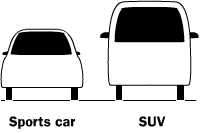
• Use advanced aerodynamics to reduce drag - When you are driving on the freeway, most of the work your engine does goes into pushing the car through the air. This force is known as aerodynamic drag. This drag force can be reduced in a variety of ways. One sure way is to reduce the frontal area of the car (Figure 5). Think of how a big SUV has to push a much greater area through the air than a tiny sports car.
Reducing disturbances around objects that stick out from the car or eliminating them altogether can also help to improve the aerodynamics. For example, covers over the wheel housings smooth the airflow and reduce drag. And sometimes, mirrors are replaced with small cameras.
• Use low-rolling resistance tires - The tires on most cars are optimized to give a smooth ride, minimize noise, and provide good traction in a variety of weather conditions. But they are rarely optimized for efficiency. In fact, the tires cause a surprising amount of drag while you are driving. Hybrid cars use special tires that are both stiffer and inflated to a higher pressure than conventional tires. The result is that they cause about half the drag of regular tires.
• Use lightweight materials - Reducing the overall weight of a car is one easy way to increase the mileage. A lighter vehicle uses less energy each time you accelerate or drive up a hill. Composite materials like carbon fiber or lightweight metals like aluminum and magnesium can be used to reduce weight. Back to top
What's Available Now?
Three hybrid cars are now available in the United States -- the Honda Civic Hybrid, the Honda Insight and the Toyota Prius. We will be discussing the latter two, and although both of these cars are hybrids, they are actually quite different in character.
|
|
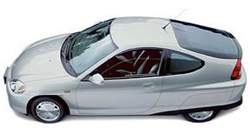

The Honda Insight price starts around $19,570, and the Toyota Prius starts around $20,510. Both cars have a gasoline engine, an electric motor and batteries, but that is where the similarities end.
The Honda Insight, which was introduced in early 2000 in the United States, is designed to get the best possible mileage. Honda used every trick in the book to make the car as efficient as it can be. The Insight is a small, lightweight two-seater with a tiny, high-efficiency gas engine.
The Toyota Prius, which came out in Japan at the end of 1997, is designed to reduce emissions in urban areas. It meets California's super ultra low emissions vehicle (SULEV) standard. It is a four-door sedan that seats five, and the powertrain is capable of accelerating the vehicle to speeds up to 15 mph (24 kph) on electric power alone. The Prius was honored as the 2004 North American Car of the Year. Back to top