
Solar Power
How Solar Power Works
There are many different types of solar power applications ranging from a few cells powering a calculator to large utility-grade plants generating megawatts of electricity to power hundreds of homes. Photovoltaic (PV) systems can be configured to suit a wide range of applications. A typical home installation works as follows:
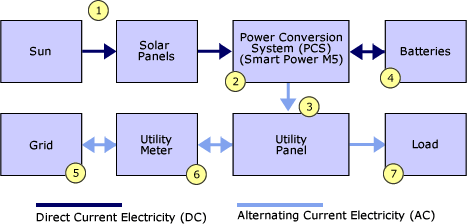
- Rays of light from the sun strike the solar panels and are absorbed. The panels are made from a special type of silicon that converts solar energy into DC electricity.
- The DC electricity from the solar panels enters the inverter. The inverter converts it into AC electricity, which is the type used in a typical home.
- The utility panel in the house receives the AC power from the inverter and distributes it to the loads (e.g., lights, appliances, etc.). If the solar panels are not generating enough electricity to satisfy the house loads (for instance at night), the utility panel will draw additional electricity from the grid.
- If the solar panels are generating more electricity than is being used in the house, the inverter will convert some of the DC electricity from the panels to the appropriate DC voltage required to charge the batteries.
- If the batteries are fully charged and the solar panels continue to generate more electricity than is required by the house, the excess is exported to the utility grid.
- The utility meter measures the electricity flowing in and out, spinning forward and backward as appropriate. You only pay for the difference between the amount of energy used and the amount of energy exported. This is called “net-metering.”
- If power from the grid is not available (such as during a blackout), a battery backup inverter switches over to battery power. Critical loads in the house will continue to have power supplied to them from the batteries, for as long as they are sized to provide it.
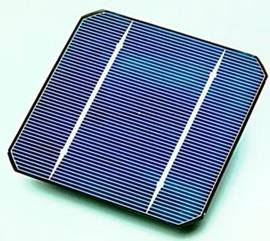 |
| A photovoltaic cell produces electricity directly from solar energy |
A solar cell, or photovoltaic cell, is a semiconductor device consisting of a large-area p-n junction diode, which in the presence of sunlight is capable of generating usable electrical energy. This conversion is called the photovoltaic effect. The photovoltaic effect was discovered in 1839 by French experimental physicist Alexandre-Edmond Becquerel, who observed that certain materials would produce a small current when exposed to light.
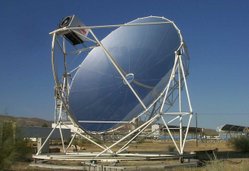 |
| Point focus parabolic dish with Stirling System |
Effective use of solar radiation often requires the radiation (light) to be focused to give a higher intensity beam. A parabolic dish or concentrating lens, possibly combined with a heliostat are used to concentrate light at a point (the focus). At the focus there might be placed a high-concentration of photovoltaic cells (solar cells) or a thermal energy 'receiver', such as those used in Stirling Engines.
Back to topHydro Electricity
Hydroelectric power: How it works
So just how do we get electricity from water? Actually, hydroelectric and coal-fired power plants produce electricity in a similar way. In both cases a power source is used to turn a propeller-like piece called a turbine, which then turns a metal shaft in an electric generator, which is the motor that produces electricity. A coal-fired power plant uses steam to turn the turbine blades; whereas a hydroelectric plant uses falling water to turn the turbine. The results are the same.
Take a look at this of a hydroelectric power plant to see the details:
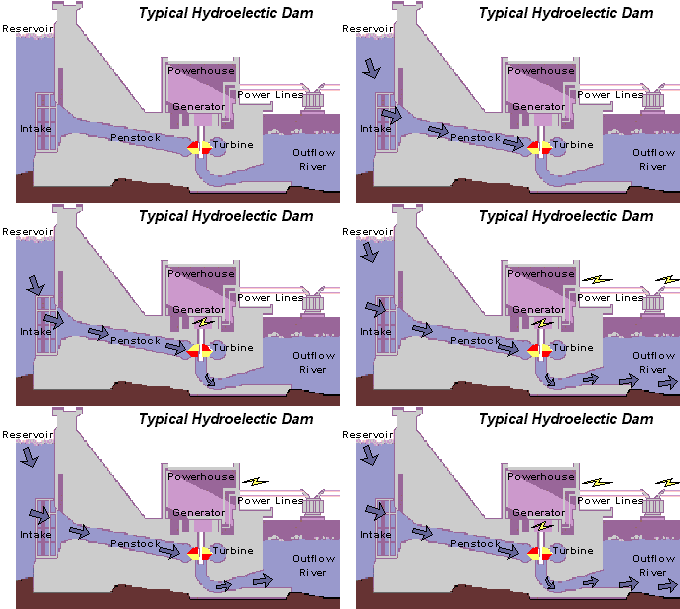
The theory is to build a dam on a large river that has a large drop in elevation (there are not many hydroelectric plants in Kansas or Florida). The dam stores lots of water behind it in the reservoir. Near the bottom of the dam wall there is the water intake. Gravity causes it to fall through the penstock inside the dam. At the end of the penstock there is a turbine propeller, which is turned by the moving water. The shaft from the turbine goes up into the generator, which produces the power. Power lines are connected to the generator that carries electricity to your home and mine. The water continues past the propeller through the tailrace into the river past the dam.
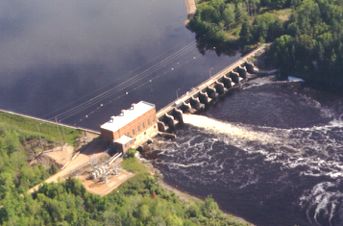 |
| The photo below shows the Alexander Hydroelectric Plant on the Wisconsin River, a medium-sized plant that produces enough electricity to serve about 8,000 people. |
- Dam. Raises the water level of the river to create falling water. Also controls the flow of water. The reservoir that is formed is, in effect, stored energy.
- Turbine. The force of falling water pushing against the turbine's blades causes the turbine to spin. A water turbine is much like a windmill, except the energy is provided by falling water instead of wind. The turbine converts the kinetic energy of falling water into mechanical energy.
- Generator. Connected to the turbine by shafts and possibly gears so when the turbine spins it causes the generator to spin also. Converts the mechanical energy from the turbine into electric energy. Generators in hydropower plants work just like the generators in other types of power plants.
- Transmission lines. Conduct electricity from the hydropower plant to homes and business.
Wind
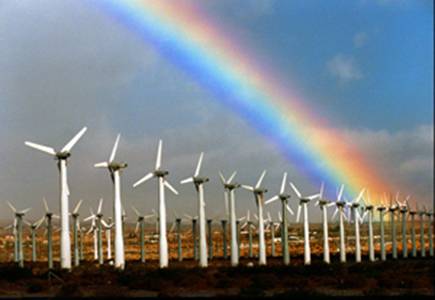 |
| A wind farm |
A wind turbine is a machine for converting the mechanical energy in wind into electrical energy. If the mechanical energy is used directly by machinery, such as a pump or grinding stones, the machine is usually called a windmill. If the mechanical energy is then converted to electricity, the machine is called a wind generator.
Common modern wind turbines
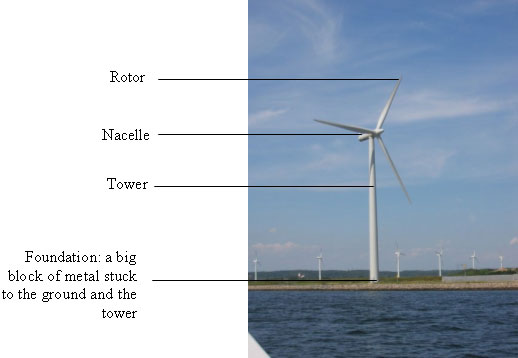
Horizontal axis
Usually 3-bladed, sometimes 2-bladed or even 1-bladed (and counterbalanced), and pointed into the wind by computer-controlled motors. The rugged three-bladed turbine type has been championed by Danish turbine manufacturers. These have high tip speeds of up to 6x wind speed, high efficiency, and low torque ripple which contributes to good reliability. This is the type of turbine that is used commercially to produce electricity.
Vertical axis wind turbines
Vertical axis turbines (or VAWTs) have the main rotor shaft running vertically. The advantages of this arrangement are that the generator and/or gearbox can be placed at the bottom, near the ground, so the tower doesn't need to support it, and that the turbine doesn't need to be pointed into the wind. Drawbacks are usually the pulsating torque produced during each revolution; and the difficulty of mounting vertical axis turbines on towers, meaning they must operate in the slower, more turbulent air flow near the ground, with lower energy extraction efficiency.
 |
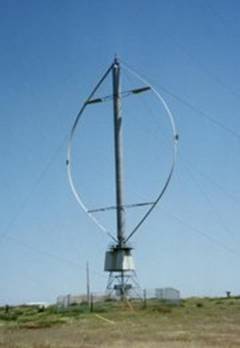 |
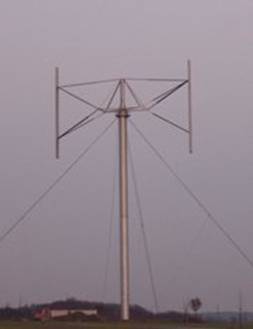
| H-Darrieus-turbine | Darrieus wind turbine |
Darrieus wind turbine
These are the "eggbeater" turbines. They have good efficiency, but produce large torque ripple and cyclic stress on the tower, which contributes to poor reliability. Also, they generally require some external power source, or an additional Savonius rotor, to start turning.
Giromill
These lift-type devices have vertical blades. The cycloturbine variety has variable pitch, to reduce the torque pulsation and self-start. The helical type has smooth torque, and can also use the vertical air flow component in turbulent or rising winds above buildings or cliffs.