
Fuel Cell: Introduction
A fuel cell is an electrochemical energy conversion device which converts the chemicals hydrogen and oxygen into water, producing electricity in the process.
Another electrochemical energy conversion we are familiar with would be the battery, which converts chemicals within it into electrical energy. However once the chemicals are used up, the battery goes ‘dead’ and has to either be recharged or thrown. But in the case of the fuel cell, chemicals constantly flow into the cell so it never goes dead and keeps on supplying electricity, as long as there is an undisrupted flow of chemicals into the cell. Most fuel cells in use today use hydrogen and oxygen as their reactants.
|
The fuel cell competes with many other types of energy conversion devices, including s in power plant, gasoline engines in cars and batteries in laptops. Combustion engines like the turbine and the gasoline engine burn fuels and make use of the pressure created by the expansion of the gases to do mechanical work; batteries converted chemical energy into electrical energy when needed. Fuel cells do both tasks more efficiently.
Fuel cells provide a DC (direct current) voltage that can be used to power electrical appliances.
There are several different types of fuel cells, each using a different set of chemical reactions. Fuel cells are usually classified by the type of electrolyte they use, with some types of fuel cells working well for use in stationary power generation plants and others being useful for small portable applications or for powering cars.
The proton exchange membrane fuel cell (PEMFC) is currently one of the more promising technologies. It will be the type of fuel cell which will end up powering cars, buses and maybe even households. We shall use it as a case study.
Proton Exchange Membrane
The proton exchange membrane fuel cell (PEMFC) uses one of the simplest reactions of any fuel cell. Below is the structure of the PEMFC:
|
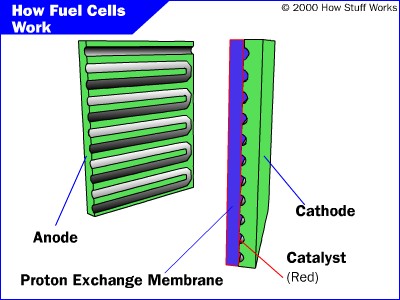
In Figure 1 you can see there are four basic elements of a PEMFC:
• The anode, the negative post of the fuel cell, has several jobs. It conducts the electrons that are freed from the hydrogen molecules so that they can be used in an external circuit. It has channels etched into it that disperse the hydrogen gas equally over the surface of the catalyst.
• The cathode, the positive post of the fuel cell, has channels etched into it that distribute the oxygen to the surface of the catalyst. It also conducts the electrons back from the external circuit to the catalyst, where they can recombine with the hydrogen ions and oxygen to form water.
• The electrolyte is the proton exchange membrane. This specially treated material, which looks something like ordinary kitchen plastic wrap, only conducts positively charged ions. The membrane blocks electrons.
• The catalyst is a special material that facilitates the reaction of oxygen and hydrogen. It is usually made of platinum powder very thinly coated onto carbon paper or cloth. The catalyst is rough and porous so that the maximum surface area of the platinum can be exposed to the hydrogen or oxygen. The platinum-coated side of the catalyst faces the PEM.
|
Chemistry of a Fuel Cell Anode side: 2H2 => 4H+ + 4e- Cathode side: O2 + 4H+ + 4e- => 2H2O Net reaction: 2H2 + O2 => 2H2O |
This shows the pressurized hydrogen gas (H2) entering the fuel cell on the anode side. This gas is forced through the catalyst by the pressure. When an H2 molecule comes in contact with the platinum on the catalyst, it splits into two H+ ions and two electrons (e-). The electrons are conducted through the anode, where they make their way through the external circuit (doing useful work such as turning a motor) and return to the cathode side of the fuel cell.
Meanwhile, on the cathode side of the fuel cell, oxygen gas (O2) is being forced through the catalyst, where it forms two oxygen atoms. Each of these atoms has a strong negative charge. This negative charge attracts the two H+ ions through the membrane, where they combine with an oxygen atom and two of the electrons from the external circuit to form a water molecule (H2O).
This reaction in a single fuel cell produces only about 0.7 volts. To get this voltage up to a reasonable level, many separate fuel cells must be combined to form a fuel-cell stack.
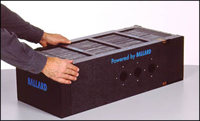
PEMFCs operate at a fairly low temperature (about 176 degrees Fahrenheit, 80 degrees Celsius), which means they warm up quickly and don't require expensive containment structures. Constant improvements in the engineering and materials used in these cells have increased the power density to a level where a device about the size of a small piece of luggage can power a car.
Back to top
Problems with Fuel Cells
Though oxygen required for the PEM fuel cell is readily obtained from atmospheric air, hydrogen is not as readily available , making the PEM fuel cell impractical to use in most cases.Hydrogen is difficult to store and distribute, making to more practical for fuel cells to use more readily available fuel sources instead of hydrogen.
Fortunately, there is the invention of reformers, devices which convert hydrocarbons or alcohols into hydrogen.
But then again, these devices have not been perfected yet, generating heat and producing other unwanted gases besides hydrogen. Despite efforts to clean up hydrogen, the hydrogen produced is not pure, lowering efficiency of the fuel cell.
Promising alternatives to hydrogen and oxygen are natural gas, propane and methanol, which many people have readily available at home. Of the 3, methanol is a likely candidate as fuel for fuel-cell powered cars as it is liquid at room temperature, making it easy to transport and distribute. Back to top
Efficiency of Fuel Cells
Pollution reduction is one of the primary goals of the fuel cell. In comparison of fuel-cell-powered cars with gasoline-engine-powered and battery-powered cars, a great deal of improvement in efficiency can be seen.
Since all tree types of cars have the same basic infrastructure, the following comparisons shall compare only efficiency of the respective engines in generation of mechanical energies.
Fuel-Cell-Powered Electric Car
The efficiency of a hydrogen-powered fuel cell is about 80%, that’s is, 80% of the energy content of hydrogen is converted into electrical energy.
However, due to pure hydrogen being hard to obtain, a reformer fuelled with methanol is usually, nut, this reduces the overall efficiency to about 30-40%
We still need to convert the electrical energy into mechanical work. This is accomplished by the electric motor and inverter. A reasonable number for the efficiency of the motor/inverter is about 80 percent. So we have 30- to 40-percent efficiency at converting methanol to electricity, and 80-percent efficiency converting electricity to mechanical power. That gives an overall efficiency of about 24 to 32 percent.
Gasoline Vs Battery Power
Gasoline-Powered CarThe efficiency of a gasoline-powered car is surprisingly low. All of the heat that comes out as exhaust or goes into the radiator is wasted energy. The engine also uses a lot of energy turning the various pumps, fans and generators that keep it going. So the overall efficiency of an automotive gas engine is about 20 percent. That is, only about 20 percent of the thermal-energy content of the gasoline is converted into mechanical work.
Battery-Powered Electric Car
This type of car has a fairly high efficiency. The battery is about 90-percent efficient (most batteries generate some heat, or require heating), and the electric motor/inverter is about 80-percent efficient. This gives an overall efficiency of about 72 percent.
But that is not the whole story. The electricity used to power the car had to be generated somewhere. If it was generated at a power plant that used a combustion process (rather than nuclear, hydroelectric, solar or wind), then only about 40 percent of the fuel required by the power plant was converted into electricity. The process of charging the car requires the conversion of alternating current (AC) power to direct current (DC) power. This process has an efficiency of about 90 percent.
So, if we look at the whole cycle, the efficiency of an electric car is 72 percent for the car, 40 percent for the power plant and 90 percent for charging the car. That gives an overall efficiency of 26 percent. The overall efficiency varies considerably depending on what sort of power plant is used. If the electricity for the car is generated by a hydroelectric plant for instance, then it is basically free (we didn't burn any fuel to generate it), and the efficiency of the electric car is about 65 percent.
Surprised?
Maybe you are surprised by how close these three technologies are. This exercise points out the importance of considering the whole system, not just the car. We could even go a step further and ask what the efficiency of producing gasoline, methanol or coal is.
Efficiency is not the only consideration, however. People will not drive a car just because it is the most efficient if it makes them change their behavior. They are concerned about many other issues as well. They want to know:
• Is the car quick and easy to refuel?
• Can it travel a good distance before refueling?
• Is it as fast as the other cars on the road?
• How much pollution does it produce?
This list, of course, goes on and on. In the end, the technology that dominates will be a compromise between efficiency and practicality.
Other Types of Fuel Cells
There are several other types of fuel-cell technologies being developed for possible commercial uses:• Alkaline fuel cell (AFC): This is one of the oldest designs. It has been used in the U.S. space program since the 1960s. The AFC is very susceptible to contamination, so it requires pure hydrogen and oxygen. It is also very expensive, so this type of fuel cell is unlikely to be commercialized.
• Phosphoric-acid fuel cell (PAFC): The phosphoric-acid fuel cell has potential for use in small stationary power-generation systems. It operates at a higher temperature than PEM fuel cells, so it has a longer warm-up time. This makes it unsuitable for use in cars.
• Solid oxide fuel cell (SOFC): These fuel cells are best suited for large-scale stationary power generators that could provide electricity for factories or towns. This type of fuel cell operates at very high temperatures (around 1,832 F, 1,000 C). This high temperature makes reliability a problem, but it also has an advantage: The steam produced by the fuel cell can be channeled into turbines to generate more electricity. This improves the overall efficiency of the system.
• Molten carbonate fuel cell (MCFC): These fuel cells are also best suited for large stationary power generators. They operate at 1,112 F (600 C), so they also generate steam that can be used to generate more power. They have a lower operating temperature than the SOFC, which means they don't need such exotic materials. This makes the design a little less expensive.
Back to top
Applications
As we've discussed, fuel cells could be used in a number of applications. Each proposed use raises its own issues and challenges. Let's take a look at the various applications, starting with automobiles.Automobiles
Fuel-cell-powered cars should start to replace gas- and diesel-engine cars in the near future. A fuel-cell car will be very similar to an electric car but with a fuel cell and reformer instead of batteries. Most likely, you will fill your fuel-cell car up with methanol, but some companies are working on gasoline reformers. Other companies hope to do away with the reformer completely by designing advanced storage devices for hydrogen.
Portable Power
Fuel cells also make sense for portable electronics like laptop computers, cellular phones or even hearing aids. In these applications, the fuel cell will provide much longer life than a battery would, and you should be able to"recharge" it quickly with a liquid or gaseous fuel.
Buses
Fuel-cell-powered buses are already running in several cities. The bus was one of the first applications of the fuel cell because initially, fuel cells needed to be quite large to produce enough power to drive a vehicle. In the first fuel-cell bus, about one-third of the vehicle was filled with fuel cells and fuel-cell equipment. Now the power density has increased to the point that a bus can run on a much smaller fuel cell.
Home Power Generation
This is a promising application that is already available in some areas. General Electric offers a fuel-cell generator system made by Plug Power. This system uses a natural gas or propane reformer and produces up to seven kilowatts of power (which is enough for most houses). A system like this produces electricity and significant amounts of heat, so it is possible that the system could heat your water and help to heat your house without using any additional energy.
Large Power Generation
Some fuel-cell technologies have the potential to replace conventional combustion power plants. Large fuel cells will be able to generate electricity more efficiently than today's power plants. The fuel-cell technologies being developed for these power plants will generate electricity directly from hydrogen in the fuel cell, but will also use the heat and water produced in the cell to power steam turbines and generate even more electricity. There are already large portable fuel-cell systems available for providing backup power to hospitals and factories.