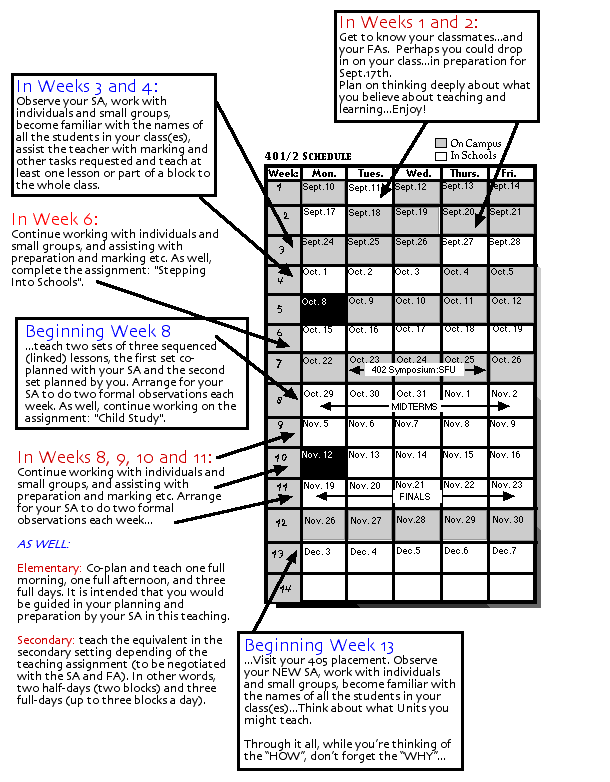
GENERIC Schedule of 401/2. Ray's Schedule of 401/2. Use this schedule if you want to know when Ray is coming to your school during 401/2. KATE'S Schedule of 401/2. Use this schedule if you want to know when KATE is coming to your school during 401/2. Click on the eye if you need a... Fax Form for Observation Times.
Click on the link below to move directly to the item.
The first semester of the Professional Development Program is Education 401/2 wherein you engage in the study of teaching through the integration of in-classroom practicum experiences combined with on-campus instructional seminars. This integrated experience makes it possible for you to grow in your understanding of the relationship between educational theory and classroom practice.
Education 401 (the weeks in your school placements):
A copy of the calendar outlining the rotation of weeks on campus (Education 402) and weeks in schools (Education 401) follows below. Here is an explanation of the two components of the semester:
In Education 401 you will be assigned to a classroom teacher (School Associate). You will work with single students, small groups, and finally whole classes.School placements will be finalized by Friday of Week 1. You will be given the name of your school associate, grade, and school, and will be asked to contact your school associate (SA) prior to arriving at the school on Monday of Week 2. During the weeks you are in your school placement you will work primarily with your SA, though your faculty associate (FA) will be in regular contact through phone calls, e-mail, informal visits to the school, and formal observation and follow-up seminar visits. Further information about formal observations and follow-up seminars will be given during the first week of the semester.
Education 402 (the weeks on campus):
In Education 402 you will study the literature of education and engage in seminars that examine educational issues and their relation to classroom practice, becoming familiar with a wide variety of educational resources. An important part of the Education 401/2 experience is for you to begin to make meaning of the vast and complex world of educational practice, and to have this meaning informed by extensive study of the literature, and by thoughtful, reflective discourse. For the most part, the work of Education 402 will take place on campus. However there will be some exceptions.
- 8:30 Coffee (Feel free to "drift in", but please be here by 9 AM.)
- 9:00 Gathering (stories and sharing)
- 9:15 Workshop A
- 10:30 Break
- 10:45 Workshop B
- 12:00 Lunch
- 1:00 Workshop C
- 3:00 Reflections, Planning for the next day,Time to go home!
While this is a typical shape of our day, the shape may vary, depending on specific seminar tasks and workshops. It is important, however, that everyone be on time in the morning, and that everyone pitch in to help in the setting up of the room, and in cleaning up and putting things away at the end of the day.
The following fees are due by Friday, September 15th.
A charge of $40 per pre-service teacher covers the cost of the photocopying of journal articles and other related materials, and the cost of supplies used for workshops.
Coffee Fund
Coffee, tea, juice, hot chocolate, and snacks will be available each day the module is on campus. Beginning teachers take turns setting up the beverages each morning and cleaning up each day. Snacks are brought on a rotating basis. All beginning teachers contribute $10 to the coffee fund. We'll discuss other expenditures if the need arises.
Developing Philosophy of the Fraser Valley Module
Community: We expect to learn how to build community and how to access our community for resources.Active: We expect to actively participate in our learning. Through our exchange of energy we construct knowledge.
Choice: We expect to make choices which allow us to live as autonomous teachers.
Survival: We expect to have strategies and skills to survive as competent novice professional teachers.
Growth: We expect to create new ways of being and doing based on our sensations, perceptions and reflections when problems arise.
By the end of Education 401/2 it is our intention that you will:have a beginning understanding of the political, social, and personal context of the work of teaching and being a professional teacher and demonstrate that understanding in your daily actions and in assignments that incorporate the theoretical learning and practical experiences of Education 401/2. experience and understand the importance that the learning community plays in students experiencing school success and be able to articulate that. be able to plan for learning in a lesson and a sequence of lessons in a way that is goal-oriented, coherent, organized, and developmentally appropriate to the learners. be able to teach a lesson, a sequence of lessons, and at least two days in sequence in a way that demonstrates an understanding of the teacher's responsibility for the personal safety of the students, the classroom climate, and the academic learning intended. demonstrate the ability and willingness to examine your work in both the campus and practicum context - to begin to demonstrate your ability to be a "reflective practitioner".
Throughout the Semester:
Arrive at campus or school early enough to ready yourself for the day. Be consistently punctual and reliable throughout the day whether on campus or at school.
When you are ill and will be absent from school or campus (even for a day), notify your faculty associate and, when appropriate, your school associate. When you are in school, it is also a professional courtesy to notify the principal (through the secretary) of your absence.For short absences not due to illness, obtain prior approval from your faculty associate (and school associate when applicable).
In the case of extended absence due to illness, the Coordinator may ask you to provide a medical certificate when you return to campus or school.Understand the BCTF Code of Ethics. Understand and demonstrate lawful, ethical and professional conduct in your interactions with students, parents, teachers and other student teachers. Click here for the Official BCTF Code of Ethics.
The Campus Component (Education 402):Show a high level of involvement in campus activities. Actively participate in and contribute to the learning and to the community.Consider the assignments and tasks to be opportunities for your professional growth. Complete and submit these as negotiated with your faculty associate.
Take responsibility for your own learning. (If you don't know, find out.)
Keep a separate binder for the on-campus component. Develop an organization system that works for you and facilitates easy access to the material of Education 402.
The School Component (Education 401):Become involved in the life of the school. Attend school functions such as staff and department meetings, professional development activities, and evening events. Participate with your SA in his/her supervision duty. Consider assisting your SA or other teachers with extracurricular activities.Before leaving school each day, ensure that all of your teaching responsibilities for the next day are organized. If you need to leave the school promptly, make arrangements with your SA well in advance.
Begin to develop an organization system (separate from your campus binder) that works for you and facilitates easy access. This system will include items such as lesson plans, anecdotal comments on students, handouts you've prepared, communications with your SA and FA, completed formal observation forms and post-conference summaries - everything that pertains to your classroom practice.
Write detailed lesson plans for all lessons taught. For lessons formally observed by either or both the SA or FA, a complete lesson plan must be available at the pre-conference. For the pre-conference, think about an observation focus for the lesson you are going to teach.
Give all white copies of the observation forms and post-conference summaries of lessons observed by your SA, to your FA when s/he visits.

The Goals of the PDP (found in the PDP Handbook) represent the criteria upon which your work will be evaluated. These statements represent the kinds of characteristics that we in this faculty consider to be hallmarks of the professional educator. We do not expect that you will have mastered these goals at the end of your professional year. Competence is not something that appears in a flash, like a thunderbolt, upon the program's completion. Rather, it occurs in gathering power that evolves steadily, over a professional lifetime.
That is why the goal statements are not phrased as final accomplishments - behaviours to be seen unequivocally in your performance. Instead, they are presented as professional pathways that allow for your growth to be assessed in relation to your progress on these pathways. What is considered "significant" growth in your professional development is, of course, determined by thoughtful and judicious evaluative procedures.The responsibility for assessment and evaluation is held by all three partners: beginning teacher, school associate, and faculty associate. Everyone in the triad partnership keeps data and contributes to the ongoing and final assessment of your work in Education 401/2. However, you, the beginning teacher, hold the primary responsibility for collecting and demonstrating evidence of your professional growth through the semester. It is expected that you will document both your growing understanding of educational theory and your growing competency as a practitioner.
- The Procedure:
To aid in the assessment of performance toward the goals of PDP, the Profiles of Teaching Competency will be used. The Profiles are an evaluative instrument that articulates standards of behaviour against which your performance will be evaluated.
On an ongoing basis, you will assess your performance, as you perceive it, providing specific examples of how your work is consonant with, or discrepant from the standards in a particular Profile.
As well, both school associate and faculty associate will observe and note, with specific examples, how your performance is consonant with or discrepant from the standards in a particular Profile.
ConclusionWe want you to know that we are here to support you in your growth toward professional competence in this year. Please see us as partners in this effort and know that we are available to you through the UCFV messaging system and through email.
Communication is an essential way of nurturing our learning community. There will be times when you will need to communicate with others because of events during your practice teaching. Please follow the "three before contacting me" rule. That is, contact three of your classmates before contacting Kate or Ray. That way, Ray and Kate will be free to deal with more pressing module matters, and you will become closer to your classmates as you negoitate matters with them. Each night we will monitor our voice mails and emails. We will contact you at our earliest convenience. In case of dire emergencies you may contact us directly at home, before 9 pm. The home numbers of Kate and Ray will be given out in the module, and will not be posted on the web. Please respect their quiet time as well after 9 pm.
- Email: Ray (Faculty Associate) - [email protected] Kate (Faculty Associate) - [email protected] Alan (Faculty) - [email protected] Phil (Coordinator) - [email protected]
Office Phone:
Ray and Kate (Faculty Associates) - 604-814-3101 Phil (Coordinator) - 604-291-4432 Alan (Faculty) - 604-291-3432Fax:
Kate and Ray - 604-814-3102 Phil (Coordinator) - 604-291-5691
Things to explore while you are in PDP 401/2...
What kind of a learner are you?