





|
|









| Background | |
| |
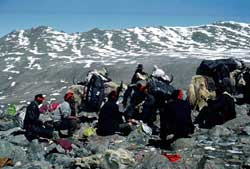
Photo: Tibetan Nomads © J El Nemr |
The reasons Tibetans leave their homeland are varied. It can be simply a desire to see the Dalai Lama, whose photographs are strictly forbidden inside Tibet. Others leave for rather more poignant reasons, life in contemporary Tibet, under Chinese occupation, can become unbearable with basic human rights denied or curtailed: Tibetans are becoming increasingly marginalized and overwhelmed by the influx of Chinese Han population. |
Enduring perilous conditions many Tibetans risk life and limb trying to cross the Himalayas to Nepal. It is in this process that they are frequently apprehended by Chinese border security forces and by the Nepalese border patrols. Incidents of extortion and beating and arrest by the Nepalese have been on the increase since the Chinese recently undertook to extend more economic aid to Nepal. | |
|
The UNHCR and the Nepalese government have had since 1989 an unwritten "gentleman's agreement" to allow Tibetan refugees to transit Nepal and move on to Dharamsala, India, where the Tibetan government in exile resides. Recent events suggest this agreement does not seem to be respected by the Nepalese and the apprehended Tibetans are now imprisoned or receive exorbitant fines. The Nepalese government routinely ignores international appeals for humanitarian release of imprisoned Tibetans. | |
|
The census taken by the Nepalese government in 1997 counted some 15,400 Tibetans living in Nepal (based on DANGEROUS CROSSING/ 2002 Update, by the International Campaign for Tibet1825, K Street, NW Suite 520 Washington DC20006, e-mail [email protected]). There are ethnic Tibeto-Burmese groups in Nepal, namely Thakalis, Tamangs and Sherpas of whom the last two remain Buddhist, but they have all been integrated into the Nepalese society for hundreds of years. | |
|
Those Tibetans that arrived in Nepal as a result of the Chinese invasion in 1950-59 fall into four categories: refugee identity card (RC) holders, illegal aliens, Nepalese citizens and Khatsar-wa (Tibetan-Nepali mixed). Their status and rights vary from illegal with no rights to RC-holders with limited rights: like the right to remain in Nepal but with limited freedom of movement and no right to obtain work permits, establish business or attend public higher education. The majority of Tibetans in Nepal cannot own property, including businesses or cars. The land on which most Tibetans settled is in trust of the Nepal Red Cross and those Tibetans wishing to conduct business in Nepal need to utilize a Nepalese "front" with substantial profits going to the Nepalese. | |
Nevertheless the Tibetan community has been a productive element in Nepal notwithstanding the fact that they remain isolated from Nepalese society. Tibetans have created a thriving, until recently, carpet industry and hugely enhanced tourist trade through their colourful presence in the country, reviving the sacred Buddhists sites of Swayambunath and Bouddhanath. But their economic success has created resentment mobilized by the Maoists insurgents leading to attacks on the Tibetan community. Tibetan schools are routinely targeted by armed gangs demanding regular pay-offs. Should the Maoists assume power in Nepal, the Tibetans may become far worse off. To find out how Sponsorship for Excellence can help Tibetan refugees in Nepal go to the How It Works section now! |
|
| Home Page | Contact Us | Site Map |
|