Bahasa Indonesia: tekan disini
Introduction
Plasma assisted processes have been widely used in the fabrication of semiconductor devices including deposition, etching and sputtering. The motivation to use plasma is that the substrate can be kept at low temperature, typically 300 oC or lower. Thus this technique is suitable to prepare device structures invoke temperature-sensitive materials such as polymer and low melting point metal films. This technique takes advantage of the high-energy electrons present in the plasma to generate chemically active radicals and ion. However, plasma processes are known to be a dirty process because of the tendency of the plasma to generate dust particles. Such dust particles can damage semiconductor devices on the wafer. A major problem is pattern defects, which represents the main cause of yield reduction. Particles deposited on the wafer may also initiate unwanted chemical reactions, cause improper film adhesion, and cause stress concentrations that result in film cracking. Figures below show the dust particles generated in the plasma reactor during silica thin film preparation using TEOS/oxygen plasma and the contaminated showerhead after the process.
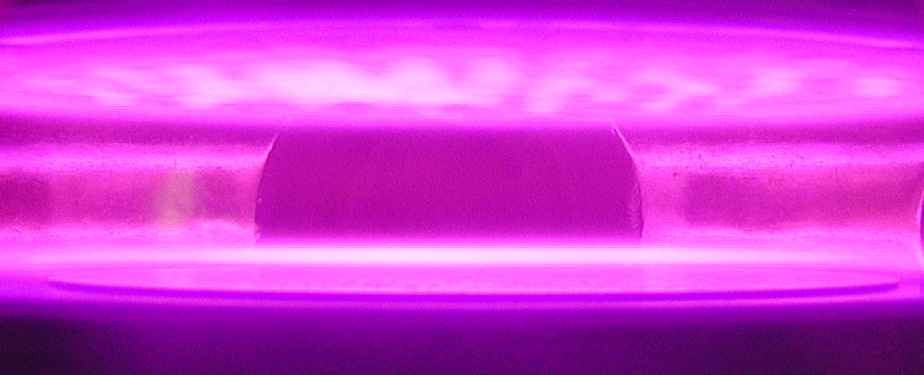

Dust particles trapped in the sheath region below the shower- Dirty showerhead after silica thin
head (powered electrode) and above the grounded electrode film preparation.
during silica thin film preparation using TEOS/Oxygen.
This site was last updated 07/30/03