Bahasa Indonesia: tekan disini
 Plasmas
are weakly ionized gases consisting a collection of electrons, ions, and neutral
atomic and molecular species in which the numbers of positive and negative
charge carriers are approximately equal. There are numerous types of plasmas,
natural or man-made, extending from stars, solar winds and coronas, and the
earth's ionosphere to the regime of high pressure arcs, shock tubes, and fusion
reactors. They primarily differ in the electron density and the average electron
energy. In the rarefied environments such as in the space, the electron density
is typically less than 107 cm-3, whereas
experimentally, densities approaching 1020 have been realized in the
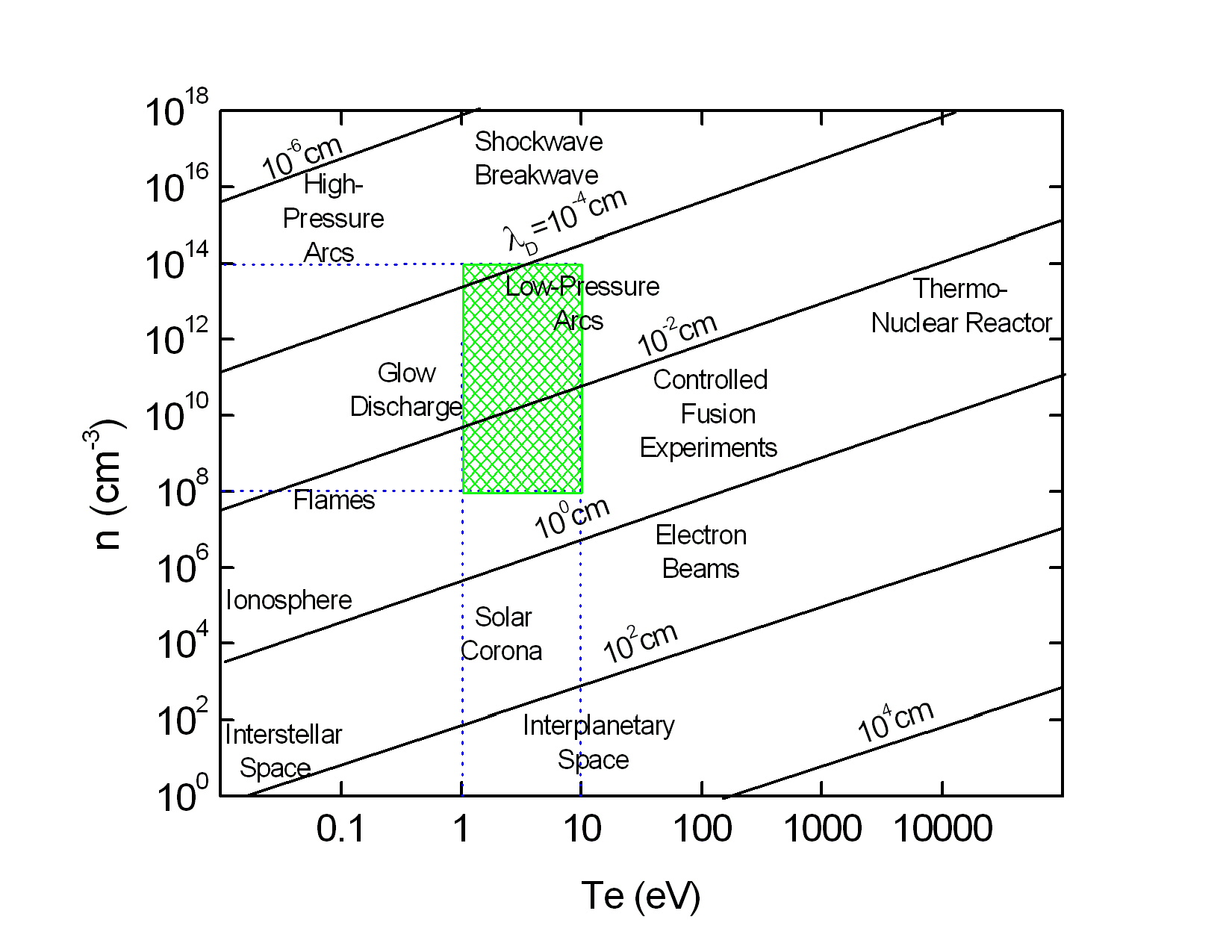
latter man-made high-pressure plasmas. Fig. 1 illustrates the characteristics of
man-made as well as naturally occurring plasma in terms of the electron
temperature and density. The two regions of greatest interest to plasma
application for industries are glow discharges and arcs shown by the shadow area
in the figure. The plasma produced in this area is characterized by the average
electron temperature of 1-10 eV (1 eV = 11604 K) and electron densities of 108
- 1014 cm-3. We see tthat electrons have an amazingly high
temperature. However, because there are so few of them, their heat content is
small and the chamber walls do not heat appreciably. The very high temperature
of electrons makes the plasmas useful in semiconductor processing to drive
chemical and other processes.
Plasmas
are weakly ionized gases consisting a collection of electrons, ions, and neutral
atomic and molecular species in which the numbers of positive and negative
charge carriers are approximately equal. There are numerous types of plasmas,
natural or man-made, extending from stars, solar winds and coronas, and the
earth's ionosphere to the regime of high pressure arcs, shock tubes, and fusion
reactors. They primarily differ in the electron density and the average electron
energy. In the rarefied environments such as in the space, the electron density
is typically less than 107 cm-3, whereas
experimentally, densities approaching 1020 have been realized in the
latter man-made high-pressure plasmas. Fig. 1 illustrates the characteristics of
man-made as well as naturally occurring plasma in terms of the electron
temperature and density. The two regions of greatest interest to plasma
application for industries are glow discharges and arcs shown by the shadow area
in the figure. The plasma produced in this area is characterized by the average
electron temperature of 1-10 eV (1 eV = 11604 K) and electron densities of 108
- 1014 cm-3. We see tthat electrons have an amazingly high
temperature. However, because there are so few of them, their heat content is
small and the chamber walls do not heat appreciably. The very high temperature
of electrons makes the plasmas useful in semiconductor processing to drive
chemical and other processes.
Plasma can be produced by supplying sufficient energy to strip electrons from atoms. The energy can be of various origins including thermal, electrical, or light (ultraviolet light or intense visible light from a laser). If the sustaining power is insufficient, plasmas recombine into neutral gas. In industrial applications, the most widely method to generate plasma is by applying an electric field. The methods of applying electric field can be classified as direct current (DC) discharge (0-100 Hz), high frequency discharge (100 Hz-1 GHz), and microwave discharge (> 1 GHz). Recently, radiofrequency (rf) plasmas 0f 13.56 MHz has been widely used in the fabrication of semiconductor devices for deposition, etching, sputtering of thin films with the pressure ranging from several mTorr to about 10 Torr. The rf plasmas are more efficient than their DC counterpart in promoting ionization. The rf power can be delivered to the reactor by means of either a coil or a set of capacitor plates. These two forms of coupling are referred to as inductive and capacitive coupling, respectively.