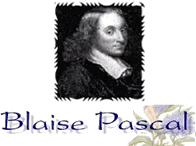
his wife Antoinette.
Due to the death of their mother, Pascal and his two sisters
were raised by their father (Young, 1998).
Pascal had gained
an abundant amount of knowledge in the field of mathematics
by the age of sixteen. He learned much of this mathematics
material by attending and listening to group discussions,
such as the Académie Parisienne, between various
scientists and mathematicians with his father. In 1640,
he wrote a pamphlet titled, Essai sur les coniques, which
discussed the foundations of what is known as projective
geometry. Writing a treatise to clarify one of Gérard
Desargues’ works, he further analyzed the work and
produced his own theorem which dealt with about 400 propositions
and corollaries.
In 1641, Pascal’s
health began to decline. He continued to work at home and
developed a calculator to help his father with his tax work.
This became the first manufactured calculator. It used cogged
wheels to perform the operations of addition and subtraction.
Around 1646, Pascal began work in physics, concentrating
on vacuums, atmospheric and barometric pressure. In relation
to this, he developed a principle (now called Pascal’s
principle) which says "that pressure will be transmitted
equally throughout a confined fluid at rest, regardless
of where the pressure is applied" (Young, 1998, p.
386).
Later in his life, Pascal and Fermat started corresponding
via letters concerning probability. Their solutions of probability
problems lead to the development of the probability theory
we know today. Although their early correspondence concerned
probability concepts, Pascal and Fermat began to lay the
foundations of calculus when Pascal used what we know as
Pascal’s triangle to solve problems involving mathematical
concepts, such as the curve cycloid. These results were
published in a 1658 work, Lettre circulaire relative a la
cycloïde (Young, 1998). This work established foundations
of both differential and integral calculus.
In 1658 Pascal’s health continued to decline. He died
on August 19, 1662 before his last project, the development
of a public transportation system of carriages in Paris.