After the
rebuilding of Schneidemühl in the wake of the Great Fire of 1834
and after the elimination of the
old ghetto, many Jewish families began to live on and around the town's
squares and its adjoining streets. An examination of the
Schneidemühl
City Directory of 1896 reveals how the new Jewish burghers clustered
there as a result of the commercial upswing brought about the
unification of
the German Reich in 1871.
Nearly one third of the houses on Neuer Markt, Mühlenstrasse, Friedrichstrasse, Posenerstrasse, Wilhelmstrasse were Jewish owned, while some had only Jewish tenants. This was Schneidemühl's Jewish heart. Of the seventy-three people listed as living on Wilhelmsplatz, fourteen belonged to the Jewish community who also owned the community centre, the Gemeindehaus, at No. 4, while No. 10 was the mikveh. Ironically, the occupations that had been forced upon Jews over the centuries now helped them to excel—often to become leaders in their field—and to climb the ladders of success in this era of industrial capitalism. Fin-de-siècle Schneidemühl could boast of a petit bourgeoisie that then included some of the wealthiest and best-known Jewish families. Julius Edel’s Likörfabrik, or liqueur manufacturing, was already established in 1870. There were no particularly ‘better addresses’ in the city. Siegmund Jacob who owned a house on Zeughausstrasse, was a wholesaler in grain, feeds and vegetables—a Jewish monopoly in Schneidemühl. He is said to have been one of the first in town to have acquired an automobile. Several of the wealthy Schweriners’ addresses were on Friedrichstrasse. Isidor Sommerfeld, owner of a mill, known to have made his fortunes in timber, lived on Hasselort. The popular Dr. Emil Mislowitzer’s mode of transport had advanced over a period of two decades from simple bicycle, then horse and buggy, to a double span of white horses with soft-wheeled carriage, and sleigh in winter. By 1904 — when there were a mere dozen automobiles in Schneidemühl — Dr. Emil Mislowitzer’s brand new two-cylinder Ford was widely admired. (Ironically, Henry Ford's anti-Semitism had not flowered yet until a few decades later) Among the numerous Jewish businesses in the area were the Konfektion, or clothing stores, that sold ready-made and tailor-made clothes. Practically ninety percent of tailoring stores were Jewish owned, together with furriers and the universal Kurz-und Weisswaren, the haberdasheries. A business innovator was Lesser Hirsch—one of the first merchants to apply such novel business management practices as set prices and no credit; he was not to be undersold and gave discounts for cash purchases. He had also bought Julius Engel’s store on Neuer Markt 26 and later owned the popular Hill’s Hotel. Some owners of tailoring stores — such as Schneidermeister Sally Eifert and Hugo Simonstein, or the master butchers Klein, Lippmann, Rosenthal, Rothschild and Jerochim, as well as master bakers and shoemakers — were accepted as proud members of the various guilds. Two of the town’s doctors belonged to the Jewish community; and so did four of the six horse traders, the town’s only pawnshop, not forgetting the ragman—the latter two finding themselves at the somewhat lower end of the cultural spectrum. Isidor Schweriner, who ‘was in grain,’ retired a millionaire to Berlin in 1905, where he was known to have financed the building of a private synagogue. These surviving
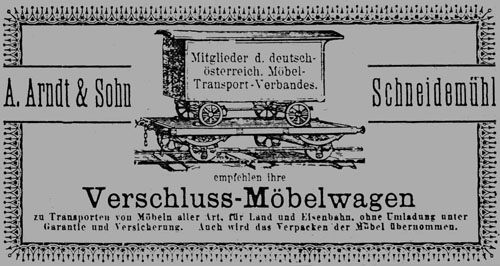
calling cards (below) from the last decades of the 19th
century make for interesting reading.
(Excerpted from the recently published
book
History of the Jewish Community of Schneidemühl: 1641 to the Holocaust) |
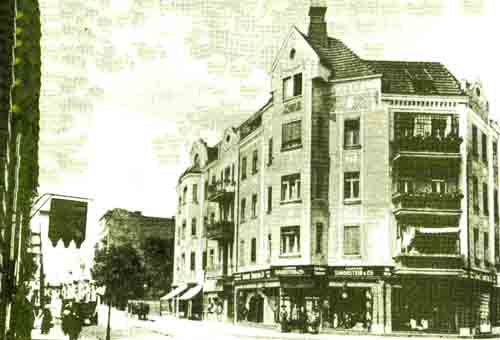
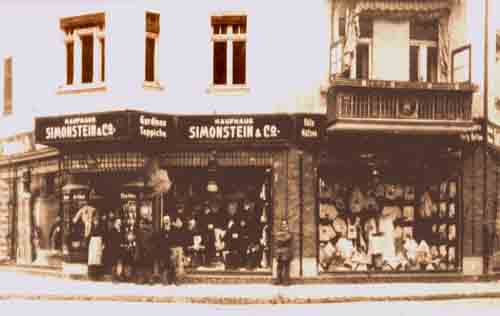
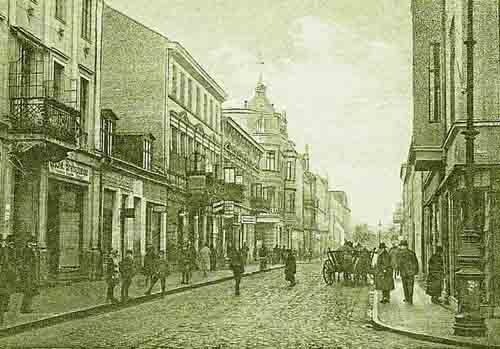
The stores on elegant Posener Strasse
[now known as ul. Srodmiejska]

.
(Photo courtesy of J. Rosenberg, Chile)
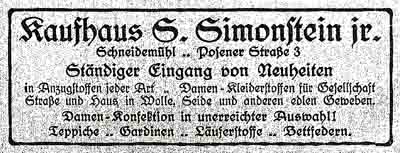
[Salomon Simonstein, owner of Posener Strasse 3]
Large collection of cloths, suits and dresses in exceptional variety,
carpets, curtains and goose feathers
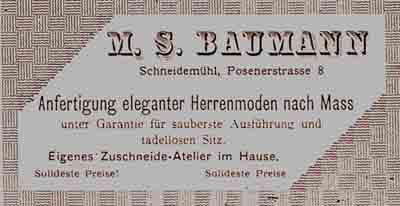
[Owner of the building, - one of his tenants was the well loved Rabbi S. Brann.]
Men's suits made to measure in-store, guaranteed workmanship
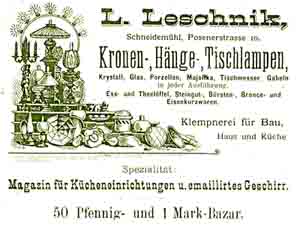
Lamps, Crystal, porcelain, brushes, cutlery, plumbing.
Specialty: new kitchens & enamelled dishes
[Building owned by Lesser Hirsch]
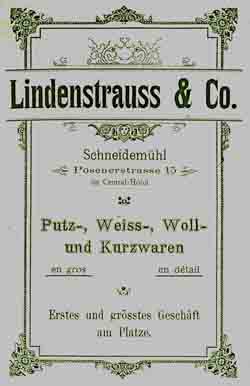
Store owner Julius Schmuel - later Julius Neumann.
Haberdashery, linen, wool, drapery, cotton, millinery
- largest and finest establishment -
- retail and wholesale -
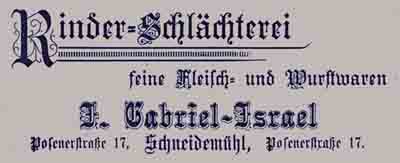
[Owner of the building]
Beef butchery - finest beef and saussages
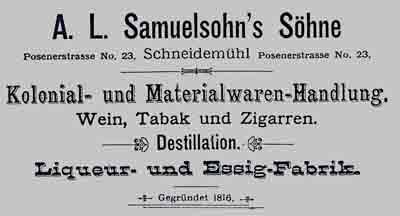
[Owner of the building]
Colonial produce, grocery, wine, tobacco and cigars
liqueur and vinegar factory
- the oldest family-owned company in Schneidemühl -
- established in 1816 -
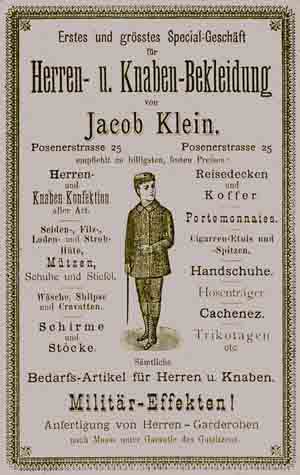
Men's and boys' clothing, hats, shoes, boots, gloves, suitcases, umbrellas,
- made-to-measure wardrobe for men, finest workmanship guaranteed -
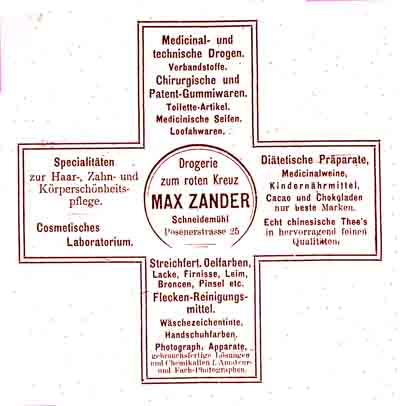
"Druggist at the Red Cross"
Photographic material, cosmetics, chocolade, Chinese tea, toiletries, soaps
ready oil paints and lacquer, brushes and spot removers
- specialties: hair, teeth and body cosmetics -
The stores on "fashionable" Friedrich Strasse
[now ul. Bohaterów Stalingradu]
.
(Photo
courtesy of J. Rosenberg, Chile)
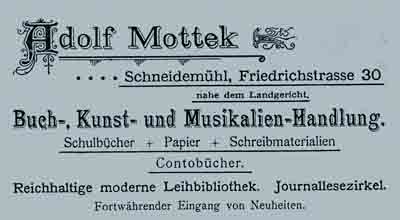
[Building owned by Benno Falk]
Books, art and music. Stationery and lending library.
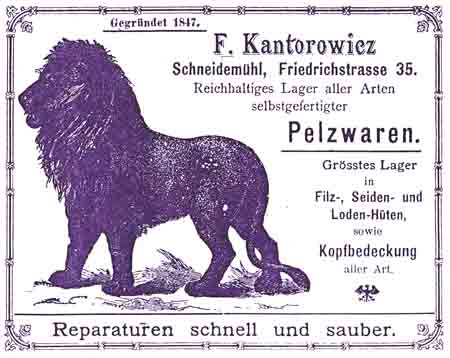
Largest collection and variety of hand-crafted furs, hats in felt and silk,
reliable and clean repairs.
- Established since 1847 -
[Building owned by Benno Falk]
Books, art and music. Stationery and lending library.
Largest collection and variety of hand-crafted furs, hats in felt and silk,
reliable and clean repairs.
- Established since 1847 -
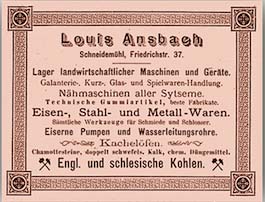
[Building owned by Isidor Schweriner]
Farm equipment, iron and steel wares, tools for smiths and locksmiths,
pumping and water equipment, sawing machines, English and Silesian coal,
glasswares, toys and fancy goods.
Stores on Zeughaus Strasse
[now ul. 1 Maja]
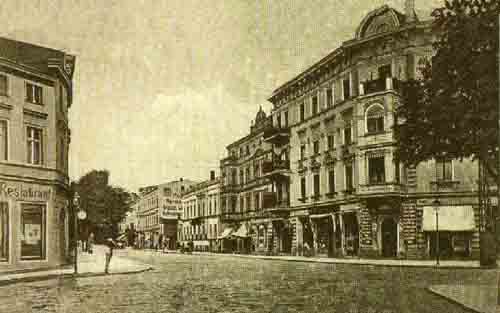
.
(Photo courtesy of J. Rosenberg, Chile)
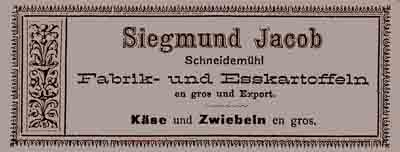
[Zeughaus Strasse No. 7]
Various types of potatoes, cheeses and onions
- wholesale and export -
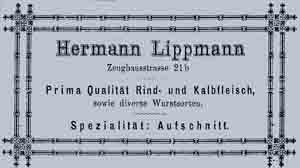
[Building owned by R. Lippmann]
Fine quality beef and veal, variety of saussages
- specialty: cold meats -
Hasselort
[now Ogińskiego Michaela]
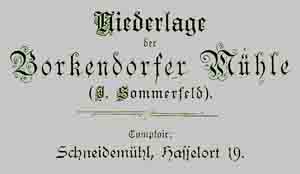
Branch of the Borkendorf Mill
- owned by Isidor Sommerfeld, one of Schneidemühl 's wealthiest businessmen -
Bromberger Strasse
[now Plac Powstancow W. Wy.]
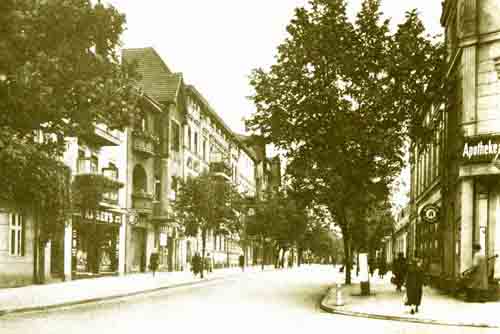
.
(Photo courtesy of J. Rosenberg, Chile)
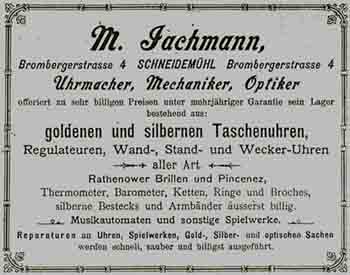
Watchmaker, mechanic, optician. Gold and silver pocket watches, eye glasses,
clocks of all varieties, barometers, thermometers, cutlery, rings, chains and brooches.
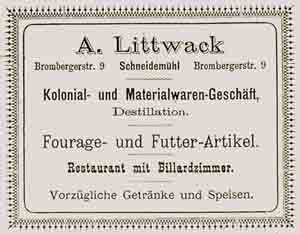
Colonial produce, groceries, destillery, animal feed, hay, straw and oats
- Restaurant and billiard room -
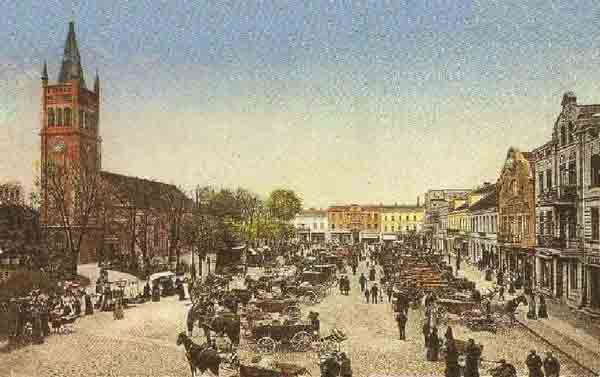
Neuer Markt
- the typical market day in much of eastern Europe -
[now Plac Zwyciestwa]
.
(Photo courtesy of Rudy Simonstein, New York)
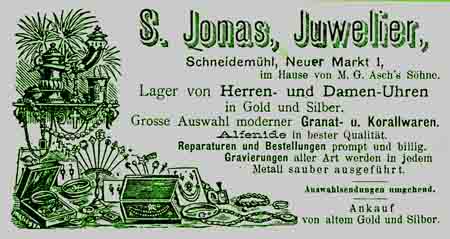
[Building owned by Isert Asch]
Jeweller and goldsmith. Large variety of modern garnet and coral jewellery, men's and
ladies' watches, engraving, repairs and special orders, buyers of gold and silver.
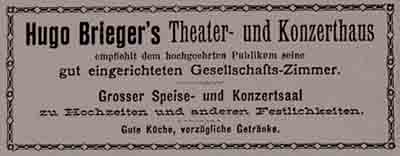
Neuer Markt 10.
Theater & concert house, large dining room suitable for weddings and other festivities.
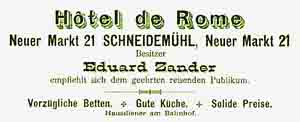
[Building owned by Eduard Zander]
Exceptional beds, fine cuisine, affordable prices for the travelling public.
Own coachman available at the railway station.
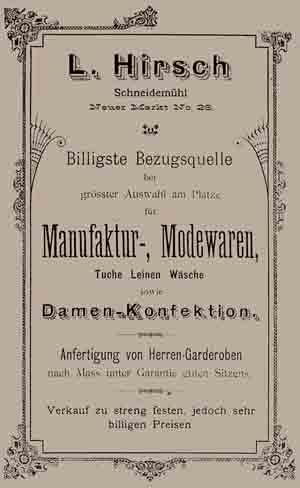
Lesser Hirsch — Cheapest source in town for ready-made and fashion ware,
made-to-measure suits for men,
finest craftsmanship. Solid but low prices.
Kleine Kirchen Strasse
[now ul. Bohaterów Stalingradu]
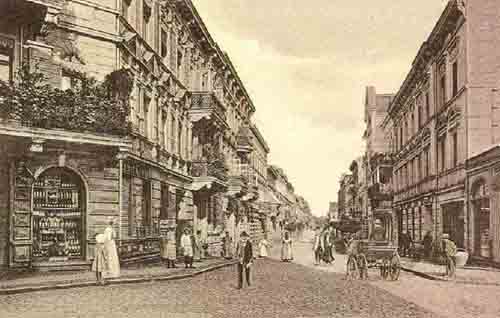
.
(Photo courtesy of H. Simonstein, Chile)
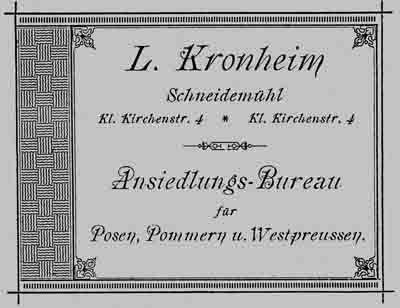
Immigration bureau for Posen, Pomerania and West Prussia
Breite Strasse
[now ul. 11 Listopada]