Here, you can see my questions, answers, references, book reviews or just some brainstorming on a variety of subjects. Comments and ideas are welcome.
"Once freedom has exploded in the soul of man, the gods no longer have
any power over him" Sartre- The Flies
By no means I want to sound like an expert on the ideas below. I am just an engineer who likes thinking and sharing his thoughts with people. I dream of a better community and a better peaceful world and believe that it can be achieved with communication. Click here for a page about writing on the net.
"We must not cease from exploration and the end of all our exploring will be to arrive where we began and to know the place for the first time." -- T. S. Eliot
From time to time people say that it is futile to think about some of the subjects (like "meaning of life"). Let me say that I would like to have nice and clear answers. But if not, so what? The fun is in thinking and searching.
"The way I look at it - and I borrow this idea from Richard Dawkins - the universe has been around for 15 billion years, during which time I haven't existed. According to astrophysicists we have another 15 billion years to go, during almost all of which time, I won't exist. Then there's this tiny flicker in the middle when I find myself here. I want to know what that means. Where did I come from? Where am I going? What am I doing here? And quickly, I haven't got long." -- Steve Grand
"I do not know what I may appear to the world; but to myself I seem to have been only like a boy playing on the seashore, and diverting myself in now and then finding a smoother pebble or prettier shell than ordinary, whilst the great ocean of truth lay all undiscovered before me." -- Isaac Newton (ranked with Archimedes and Gauss as one of the three greatest mathematicians in all history)
"The reasonable man adapts himself to the world; the unreasonable man persists in trying to adapt the world to himself. Therefore, all progress depends on the unreasonable man." -- George Bernard Shaw, Man and Superman
"I don't want to believe...I want to understand!" -- Carl SAGAN
"It's easier to invent the future than to predict it." -- Alan Kay
"Most people dream of success...Some wake up and work hard at it."
Evolution and its Effect on Religion and Philosophy
Evolution has always been an exciting subject for me. In religion classes, we were told that evolution was nonsense and Darwin was a stupid man. That had the opposite effect on me in that I became more interested in evolution and respected Darwin. What I want to discuss is why still there are a lot of people insisting on denial of evolution.
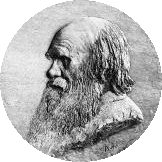
Charles DARWIN
One of the reasons seems to be the fact that usually it is misunderstood. Evolution is considered as a theory of complete chance. Almost always it has been said that a complex organism such as human, consisting of billions of atoms cannot be by chance. So, it is God's work. But a very important point is ignored. That is the natural selection mechanism. Ok, there is a chance factor which is mutation but only the qualified "mutants" can survive.
Another point is the age of earth and universe. I think that we have immense difficulty in assesing time scales larger than our life span. Life has reached this stage not in some 1000-10000 years. It did it in more than 4 billion years. That's easy said but I personally don't have an idea of how long time that is. Practically for me it means infinity.
" The belief in a design of the world and all of its creatures by a wise and omnipotent creator necessitated also a belief in a perfect world, or at least, as Leibniz phrased it, "the best of all possible worlds". When Darwin shifted from design to selection, he credited natural selection with the same capacity to produce perfection as a designing creator. The modern evolutionary biologist is more modest in his claims on behalf of selection. He knows of many structures and other adaptations that are less than perfect and ascribes this to the chance component during the variation-producing first step. The selecting forces during the second step of natural selection can make use only of such variation as was made available during the first step. Perfection can not be attained if the right variants are not available. "
This paragraph is taken from the foreword of the excellent book " DARWINISM DEFENDED-A Guide to The Evolution Controversies " by Michael Ruse.
An important conclusion of these discussions is that how far people are from scientific (or lets say "logical") thinking and reasoning. The way they use to attack evolution is a characteristic method that I observe: Don't mention the most crucial aspects, attack the remaining nonsense and enjoy your victory.
Note1: We humans think that we are some sort of end product of evolution. In fact, there is no proof that it is so. We are just another species that seems to last! (watch discovery channel for interesting discussions on these matters).
Note2: It is not fruitful and meaningful to discuss "scientific" or "logical" subjects with people that do not have a "scientific" or "logical" way of thinking. First, the point of "how to think and present ideas" must be made clear. Check this link for basic critical thinking.
General Science Links
| http://www.edge.org/3rd_culture/ |
| http://www.edge.org/ |
| http://www.transhumanism.ndtilda.co.uk/welcome.htm |
| Link about the legendary Sputnik |
A previous chat on evolution and environmental matters with "Jimmy", a marine biologist.
Links about evolution
| http://sites.netscape.net/nathanerice/truth | Interesting site with arguments against evolution. |
| http://www.origins.org/menus/special.html | This page features miscellaneous articles of special interest concerning intelligent design and philosophical theism. |
What is Love ?
Everybody wants it, but what is love? Check this link for a starter.
What is life, what makes it valuable and meaningful ?
I guess this is one of the "universal" questions. Especially the "meaning " is a big question.
Click here for some nice reading about this subject. Here is another interesting link for excellence.
"We are what we repeatedly do. Exellence, then, is not an act, but a habit. " -- Aristotle
Everybody needs a consistent philosophy and view of life. The first step in doing this is to learn "systematic and logical" thinking. The second one is to give an answer to what "life" is and how we came to the point at which we are now. This answer should include both biological and sociological aspects. The third step is to answer why life is valuable.
For example, what do you think about the genetic manipulation of human beings? I support it and suggest the book of John Harris, "The value of Life" for very interesting topics and views.
We try to follow a principle which we call as "Efendilik Principle". Its rough outline can be stated as follows (these principles are in development):
RespectFamily Tradition Friends Environment Part of respecting the environment: Don’t eat more than you need to stay healthy. It is a waste of natural resources because human beings are immense entropy generators. When developing standards use this criterion: only things that must be included should be there. Anything falling into the "might be needed", "nice to have" categories must be discarded. This is especially important if you develop standards and document templates to follow in your workplace.
"Rules are intended for the guidance of wise men, and to be followed blindly by fools."
"Kill one man and you are a murderer. Kill millions and you are a conqueror. Kill everyone and you are God." -- Jean Rostand
"There are two types of people in this world, good and bad. The good sleep better, but the bad seem to enjoy the waking hours much more." -- Woody Allen
What should be the average scientific level of people ?
I think that todays communities are still very ignorant, especially when it comes to scientific matters. We don't question, if at all, about topics like politics, economics, genetics, military research that have a huge impact on our lives (and our pockets). The easy way out is to blame the state, the education system etc. but what about our own responsibility of "gettin a grip" on these? Nobody has the "right" to be ignorant!
Check out Paul Graham for very interesting and diverse articles. Especially this one.
"But it's simply not efficient for us to try to help people who are not willing to help themselves...So, while it isn't necessary to already be technically competent to get attention from us, it is necessary to demonstrate the kind of attitude that leads to competence - alert, thoughtful, observant, willing to be an active partner in developing a solution. If you can't live with this sort of discrimination, we suggest you pay somebody for a commercial support contract instead of asking hackers to personally donate help to you." http://www.catb.org/~esr/faqs/smart-questions.html
"Along with oversimplification, using secondary sources, being weak on background, a lack of attention to detail, getting taken in by the halo effect, and a general attitude problem among some of the people who have reported on the history of technology, there has been a belief in things happening by magic. Intense intellectual effort and in-depth technical expertise vanish to be replaced by tales of inspiration and guesswork. The legend tells us that scholarship and hard work are not necessary in order to usher in a new age. Yet the same legends speak with awe of the 80+ hour-per-week grind of the faithful, driven employees. What were they doing all those hours? Drop out, turn on, assume the lotus position, eat jelly beans, have pizza-and-beer parties and fortune will surely follow, sing the storytellers. The truth lies elsewhere." Jef Raskin (http://www.jefraskin.com/forjef/jefweb-compiled/published/holes.html)
"It has become almost a cliché to remark that nobody boasts of ignorance of literature, but it is socially acceptable to boast ignorance of science and proudly claim incompetence in mathematics." Richard Dawkins
"I can think of very few science books I've read that I've called useful. What they've been is wonderful. They've actually made me feel that the world around me is a much fuller . . . much more awesome place than I ever realised it was . . ." Simon Jenkins
"It's often said that people 'need' something more in their lives than just the material world. There is a gap that must be filled. People need to feel a sense of purpose. Well, not a BAD purpose would be to find out what is already here, in the material world, before concluding that you need something more. How much more do you want? Just study what is, and you'll find that it already is far more uplifting than anything you could imagine needing." Richard Dawkins
"The significant problems we face cannot be solved by the same level of thinking that created them."Albert Einstein
"If you can't explain something to a six-year-old, you really don't understand it yourself."Albert Einstein
"You live and learn. Or you don't live long."Lazarus Long
"Think how stupid the average person is -- then realize that half of 'em are stupider than that!"George Carlin
What is democracy, globalization and how does international economics work ?
Why do we have national moneys ? Why do we have national states ? Why the hell can't we live in peace without bothering about religion, ethnic origin, nationality or football team dammit??!! Ooops sorry, got carried away ;)
"My personal feeling is that citizens of the democratic societies should undertake a course of intellectual self-defense to protect themselves from manipulation and control, and to lay the basis for more meaningful democracy." Noam Chomsky, Necessary Illusions.
Books that I like
Here you can see what kind of books I read or plan to read. I put reviews for the ones that I have finished.
Paul Krugman, 1998, W. W. Norton & Company, Inc.
Subject: Economics
Edward Yourdon, 1999
Subject: Software development and management
Tracy Kidder, 1981, 2000
Subject: Computer engineering-popular works, general corporation
4. The Red Queen - Sex and The Evolution of Human Nature
Matt Ridley, 1993
Subject: Human evolution, social evoluiton, sex
5. THE FIFTH DISCIPLINE: The Art & Practice of The Learning Organization
Peter M. Senge, 1990
Subject: Organizational effectiveness
6. Neccessary Illusions - Thought Control in Democratic Societies
Noam Chomsky, 1989
Subject: Mass media-political aspects
7.Thriving on Chaos - Handbook for a Management Revolution
Tom Peters, 1987
Subject: Management
8. An Anatomy of Thought - The Origin and Machinery of the Mind
Ian Glynn, 1999
Subject: Neuropsychology, Philosophy of mind
9. Sociobiology - The New Synthesis
Edward O. Wilson, 1975, 2000
Subject: Social Behaviour in Animals
10. Modern Exterior Ballistics-The Launch and Flight Dynamics of Symmetric Projectiles
Robert L. McCoy, 1999
Subject: Ballistics
Richard Dawkins, 1996
Subject: Evolution, natural selection
12. The Future of Life
Edward O. Wilson, 2002
Subject: Nature conservation, environmental degradation
13. Creation: Life and How to Make it
Steve Grand, 2001
Subject: Artificial intelligence, artificial life
14. The 7 Habits of Highly Effective People
Stephen R. Covey, 1990
Subject: Success - Psychological aspects. Character.
Dietrich Dörner, 1996
Subject: decision making, problem solving and psychological aspects of planning.