To the Board of Education:
This letter is to address the issue and controversies with reading the novel, Adventures of Huckleberry Finn by Mark Twain, in public schools throughout the country. Many concerns have been brought up about whether or not the novel should be required or banned to teach in schools. These debates mainly focus on the use of the word “nigger” and the depiction of an African American character included the novel. I argue that the novel should be neither required nor banned from the school reading curriculum. If for some reason a student feels uneasy about reading and discussing the book in class they should be given a similar alternative assignment.
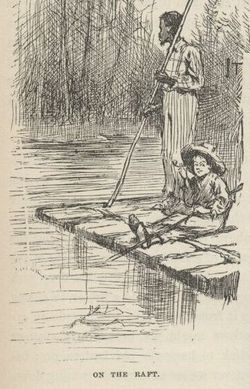
Well, first of all, why should this novel be taught to students? Some may argue, because of the overall message it conveys to the reader and because the story is a great American “classic”. As you are already aware, the novel primarily focuses on how a young boy, Huckleberry Finn, and an adult slave, Jim, travel away from their home. Huck helps Jim to become free while seeking some adventure along the way. The novel has endured the factor of time and people are still interested in reading it from when written in 1876. However the novel has caused controversy ever since a month after its publication when being expelled from the Concord, Massachusetts Public Library.
Parents and students have made many arguments such that the novel should not be a required reading assignment, and sense that the language makes them feel uncomfortable. Would those people who feel very strongly about expressing the message to the reader care less if they know a student feels uncomfortable and/or disrespected while reading the novel? And are there other ways to get the message across to the reader? The message expressed in the novel is unique and would be hard to express in another way. However, shouldn’t the students have the ability to make their own choice of whether or not they should feel uncomfortable in order to obtain the meaning of the novel? And at the same time not decreasing their chances of passing their English course?
Those in favor of the novel may wonder why the word “nigger” has so much importance for African Americans, since this is a word often heard in music, on television, and sometimes used by some in everyday dialogue. Not to mention the story is written based on the time period when there were slaves and “nigger” was just what everyone, those owning and not owning slaves, used when referring to blacks. Mark Twain most likely used this language to make his literary work appear more realistic and did not intend to offend his audience. The best logical explanation to this argument would be that you could never really understand those who feel that certain way until you have been in their exact same position. Those who share uneasy feelings about the novel should not be judged on why they feel that way.
The portrayal of Jim, the main African American, in the novel contributes to the inferiority some blacks feel while discussing the novel in class. Jim is described as a typical uneducated slave. An example is when Jim and Huck argue over why humans speak different languages. When Huck decides to compare different animals to different nationalities, Jim quickly catches on and rhetorically asks him, “Is a Frenchman a man?” (Twain, 60) It is clear that Jim wins the argument, but the audience knows that Huck is right. Even though Jim uses the most logic in his explanation, he is uninformed and the bottom line is that he is wrong. Twain could have used this as a metaphor. Slaves were the ones who did almost all of the work, but the whites were the ones who received the credit. It would be hard to judge whether Twain did this just to demonstrate how things were or if he wanted to depict Jim and blacks in general as fools.
Another similar example is found towards the end of the novel. When the two boys finally set Jim free, Tom tells Aunt Sally and Huck that Jim had been free because of Miss Watson’s death. Some may argue that Jim is portrayed as a buffoon because he dedicated so much thought and emotions into his run away while being free the entire time and just not knowing it. Is this example another metaphor just used to demonstrate the status of blacks, or is it a racist interpretation used to point and laugh at them? There is insufficient evidence in the novel to accurately prove either side right. Some students may interpret these events by the second explanation and therefore feel strongly offended.
Throughout the novel Jim is characterized as being a very gullible and passive, but genuinely good person with high morals. There are ways in which Tom and Huck take advantage of this and use it to obtain humor and/or adventure. In chapter 14, Huck almost falsely convinces Jim that what they just went through did not happen and Jim had only dreamed it. However, Jim realizes Huck is trying to trick him and feels ashamed. In this case people could argue either way about Jim’s representation. Jim is the “good guy” even though Huck feels guilty for what he did, “It made me feel so mean I could almost kissed his foot to get him to take it back.” (Twain, 65) Another similar example is when Tom uses Jim’s reputation as a runaway slave for entertainment. Tom knew that Jim was legally free and did not even advise Huck until he made his adventure out of it. This either shows that Tom does not take Jim’s freedom seriously or that Tom is the kind of mischievous character that just likes to have fun.
In the Notice before chapter 1 starts, Twain states, “PERSONS attempting to find a motive in this narrative will be prosecuted; persons attempting to find a moral in it will be banished; person attempting to find a plot in it will be shot.” This might suggest that Mark Twain did not mean for the novel to be analyzed as thoroughly as it was and just be read for the great story it holds. He could have also mentioned this so people don’t overanalyze it and believe that the book is sending a racist message to the reader, while in reality it could be exactly what he is doing. However, there is almost no evidence provided to interpret (what he states NOT to do) the exact message he was trying to get to the reader.
On that note, I will state my solution to the problems encountered in public schools pertaining to Adventures of Huckleberry Finn. Educators who feel the importance to teach this novel to students should also create an alternative assignment for those who do not feel comfortable reading and discussing the book in class. Because of the language used and the way some may feel Jim is portrayed in the novel, there are plausible arguments that some African Americans do feel uneasy about being required to read the Mark Twain’s work of fiction. Therefore, this novel should not be a mandatory reading assignment in public schools.
My Portfolio:
 Email me!
© Slav K. 2006