|
New Welding Technology – saving technologies of welding and welding materials for construction metals and alloys
 |
| The specification statement of engineering problems and their solution: |
 |
|
Obtaining of qualitative welded joints at welding of articles of aluminium
alloys hinders formation of defects (oxide inclusions, pores, poor joint
welds reverse side formation, etc.) in joint welds because of activity
and specific physical and chemical properties of aluminium and its alloys.
Even at welding by the most reliable and widely spread in industry welding
TIG, presence of defects in joints weld is observed, reducing mechanical
and operating properties of welded joints, especially in basic structures
and units. At the method of welding oxide film, promoting defects formation
is removed only from the face of welding as the result of cathode sputtering
effect with argon ions and from the reverse side oxide film remains
and causes formation of faulty fusions, oxide inclusions and pores.
Besides, because of great fluidity of aluminium at its welding a large
number of burning-through is observed, as well as big joint weld root
sagging, reducing resistance of welded joints to dynamic loads and its
fatigue strength. The suggested technology is in special flux application
(thickness of articles to 4 mm) at welding of aluminium and its alloys,
applied as paste or flux tapes (thickness of articles to 10 mm), fixed
on the welded edges from the reverse side. The fluxes and flux tapes
application promotes defects removal, improvement of joint weld root
formation and penetration protection against environmental effect, that
increases mechanical and operating properties and characteristics of
welded joints accordingly (Appendix 1). From the economic point of view
the technology allows to reduce expenses on welding materials (wire
and argon), operations on welded edges trimming before welding and quality
control of welded joints.
At welding TIG of structural metals and alloys with more than 3 mm
in thickness, for obtaining of qualitative welded joints it’s
necessary to perform Y- or V-butt preparation of welded edges and perform
welding in several passes that makes difficult the process of joints
obtaining from both technical and economic points of view. Methods of
welding with high-energy concentration (plasma welding and laser welding),
allowing to perform welding of similar thicknesses for one pass, are
not widely used in industry. Improvement of penetration ability of a
welding arc at usual welding TIG proved to be possible at usual welding
in the medium of activating fluxes, promoting increase of energy concentration
in arc and allowing to perform welding of articles to 10 mm in thickness
for one pass without welded edges preparation (Appendix 2). The method
was known as A-TIG method of welding and patented by the Paton Welding
Institute (Ukraine) for welding of steels and titanium, and for welding
of aluminium and its alloys by the Tashkent Technical University (Uzbekistan).
The list of flux for different metals and welding methods.
A development worker suggests new fluxes for the mentioned method of
welding of aluminium and its alloys (Appendix 3), all types of steels
(Appendix 4), titanium and its alloys and alloy on the nickel basis
(Appendix 5). The use of the flux allows to increase efficiency of the
welded structures and articles production by several times by removal
of the operation of the welded edges preparation, reduction of a number
of welding passes, electricity consumption as well as welding materials
reduction.
|
| Advantage compare with existing technologies: |
|
|
The use of the suggested technologies conduces complete defects removal,
discovered at control by non-destructive methods (radiography, ultrasound
and electromagnetic methods also hermetically control). The mechanical
properties welded joints, made with fluxes, are not lower than 0,9 of
the basic metal properties and fracture of tested samples takes place
by the basic metal or along the alloy line.
|
| Rights on the intellectual property: |
|
|
Three patents of the Republic of Uzbekistan were issued, one of them
is patenting by PCT system. There are European and Australian patents.
There are application on PCT system and an Inventor’s Certificate
of the USSR on the methods of welding aluminium alloys with activating
and scouring flux.
|
| Competitive technologies: |
|
|
Competing technologies of TIG welding of aluminium alloys and dealing
with application of different engineering solutions (application of
special liners, blowing with argon, etc.) don’t allow to eliminate
all welding problems being solved at application of the suggested technology
with flux application. The technology of welding A-TIG of aluminium
and its alloys is unique in world practice. There are competitive fluxes
for A-TIG method of welding of stainless steels suggested by Paton Welding
Institute – “PATIG” (http://www.weldingtorch.co.uk/patign.html)
and “FASTIG” (http://www.engineering.usu.edu/ite/Undergrad/Welding/Sr%20Posters/MikeMartinez/mikem.html)
suggested by Edison Welding Institute (EWI). Comparative test has demonstrated
that “PATIG” and “FASTIG” are less effective
than “HC-10M” flux. For example, minimum weld energy for
full penetration of 316L steel with thickness to 6,0 mm on “FASTIG
SS-7” flux – 6,000 J/cm, on “PATIG” flux –
5,100 J/cm, and “HC-10M” flux 3,900 J/cm.
The new proposed fluxes for fusion welding of aluminium and it’s
alloys, all types of steel, titanium and it’s alloys, and also
nickel based alloys in inert gas medium allow to increase productivity
of weld constructions by minimising of joint weld, the weld passes numbers,
electric energy and expenditure of welding materials. For example, the
using of activated fluxes will allow to economise $15.6 and 65% time
for aluminium alloys welding, $19.8 and 62% time for stainless steel
welding, and $13.6 and 67% time for carbon and low-allow steel welding
on 39.4 inch of joint weld.
For the use of flux for welding of aluminium alloys in aircraft industry
of the USSR Engineering manual TR 1.2.200-83 and operating instructions
PI 1.4.1555-2000 (Russia) were issued. There are specifications
TU Uz 64-15191715-002-98 of 25.08.98 for
the flux application at A-TIG welding technique being in force on the
territory of Uzbekistan. Besides, the French Agency issued quality certificates
for the fluxes, i. e. welded joints, obtained at A-TIG welding (with
a flux for aluminium Al-7- # 3NA98B003, with a flux for carbon
steel # 3NA98B004 and with a flux for stainless steel #
3NA98B005). The quality certificates meet standards NF EN 288-4
edition 1993+A1 (for aluminium and its alloys) and NF EN 288-3
edition 1992+A1 (for steels) for high-pressure apparatus.
|
| Industrial test and applying: |
|
|
At present the TIG welding technology with the clearing flux use from
the reverse side:
- has been in introduced at enterprises P/b M-5050 and P/b G-4184
(Moscow), Voronej Aircraft Industrial Amalgamation, Kazan Aircraft works,
Saratov Aircraft works (Russia) and Tashkent Aircraft Industrial Amalgamation
named after Chkalov V.P. (Uzbekistan) at welding of aircraft articles
of the series IL, Yak and MIG;
- in 1990-1991 work on introduction of a new welding technology at
Feodosiya Production Amalgamation “More” (Ukraine, Crimea)
was performed for welding of casing structures of aluminium alloy 1561
of gas-turbine ships with hydrofoils “”Voskhod” and
“Tsiklon”;
- from 1997 work is performed with Japanese firms “Toyota Motors
Corporation” and “Sumitomo Corporation” on introduction
of the technology of 5083 and 6061 aluminium alloys welding at “Toyota
Motors Corporation” firm works.
|
| Whereas the sollowing work is performed with application of the A-TIG welding technique: |
|
|
- in collaboration with scientists of the laboratory of materials
ISITEM of Nantes University and “C.D.S” firm representatives
(tentative distributor in Europe) production tests of new fluxes for
welding of steels, titanium and inkonel at the French enterprises “Aerospatical”
(Sant-Nasaire), “Creusot Loire” (Cresot), “Polysoude”
(Nantes) and “Leduc” (Nantes) have been performed;
- the flux of mark YC-27A for steel welding was introduced
and taken for application by “Ulyanovsk-Eneroremont” enterprise
(Ulyanovsk, Russia) for welding of articles and structures of carbon
and low-alloy steels at assembly and repair of power units of heat and
electric power stations;
- in Uzbekistan the flux of mark YÑ-27A is introduced
by “Uzbekkhimmash” works (Chirchik city) for high pressure
tanks welding.
|
| Presentation of new productions at the International Exhibitions: |
|
|
In October 1998 – presentation of new technologies and flux at
the International Exhibition on Vehicles High-Pressure in Paris (France)
together with the French “C.D.S.” corporation.
In April 1999 - presentation of new technologies and flux at the International
Industrial Exhibition in Hanover (Germany) together with the French
“Elitig” corporation.
In November 2000 - presentation of new technologies and flux at the
International Industrial Exhibition “FABTECH-2000” (Cleveland,
OHIO, USA) together with the American corporation “M.B. Industries
Inn” (see photo).
In November 2001 - presentation of new technologies and flux at the
International Industrial Exhibition “FABTECH-2001” (Chicago,
IL, USA) together with the American corporation “M.B. Industries
Inn”.
INTERNATIONAL INDUSTRIAL EXHIBITION “FABTECH-2000”
14-17 November 2000 (Cleveland, OHIO, USA)
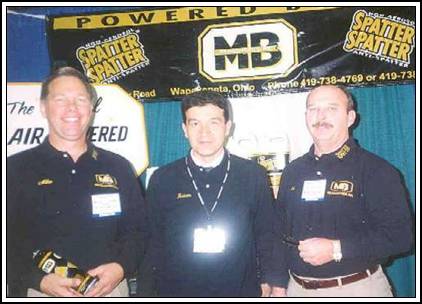
Pictured at FABTECH-2000 are Dr. Rustam Saidov (center)
of the Agency for Promotion of Research and Innovative Projects; Michael
Borges (left), President of MB Industries, Inc.; and Ed Jackson (right),
Sales Manager, MB Industries, Inc.
|
 New Welding Technology
