|
|
|
|
|
Reflux/Failure to Thrive
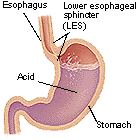
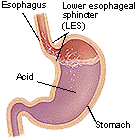
Reflux occurs when the muscle at the opening of the stomach (which keeps milk in the stomach until it is empties into the small intestine) opens up at the wrong times, causing the milk to back up into the esophagus (the tube that leads from the throat to the stomach). The gastric juices are acidic, and can burn and irritate the throat and esophagus. There is a great need for information and support on this subject.
Let's take a look at what happens in the stomach and esophagus. Pay special attention to the lower esophageal sphincter, or LES.
Acid reflux disease symptoms can occur at any time, but most occur during the daytime, especially after meals, at which time there is more reflux of acid. (Information
found on
http://www.priloseconline.com) Gastro Esophageal (Answers
by Debbi Donovan is the Director of ParentsPlace.com. She is a Board
Certified Lactation Consultant, as well as a retired La Leche League
Leader. Ivillage.com info)
A small amount of reflux, or regurgitation of stomach acids into the esophagus, is very common in infants. In the majority of cases, GER is caused by the baby's immature intestinal tract. Testing can be invasive and inconclusive and is often avoided, instead relying on the parent's documentation of colicky episodes. "Many infants who have little or no clinical symptoms of reflux experience reflux of some barium into the esophagus." (Hillemeier AC: Gastro esophageal Reflux. Ped Clin N Amer 1996;43:197) Breastfed babies experience less GER. A 1996 study, "Gastro esophageal reflux and cow's milk allergy in infants: a prospective study" (Iacono G et al., J Allergy Clin Immunology (1996) 97:3 822-827) found that 41.8% of cases of gastro esophageal reflux (GER) was associated with, and probably caused by, an allergy to cow's milk. It was concluded that all babies who present with GER should be screened for cow's milk allergy. Smoking has also been linked to gastro esophageal reflux. In the July 1996 issue of the Journal of the Oklahoma State Medical Association, Alaswad, Toubas, and Grunow, shared their research, Environmental tobacco smoke exposure and GER in infants with apparent life-threatening events. Infants who experienced a life-threatening event were studied to see if second-hand cigarette smoke may have played a part in GER. A strong correlation was found between elevated esophageal pH and exposure to second-hand smoke. The more cigarettes smoked, the greater chance of GER. The authors of this study concluded that environmental exposure to smoke plays a significant contributing role in the development of GER in infants. If your baby experiences frequent or forceful vomiting, chronic coughing or wheezing, difficulty breathing, inconsolable crying, painful and persistent night waking, breast refusal or slow weight gain and growth, it is very important that he be properly evaluated by his Health Care Provider to rule out any underlying medical condition, including GER. You may find it helpful to feed your baby with reflux more frequently, so the feeds will be smaller and more manageable for your baby. Baby carrying in a sling can also work wonders for babies with GER. The more upright position during and following a feed seems helpful for their digestion. There is also less crying in babies that are carried and this is very important to the baby with GER because babies experience more reflux when crying. Mylicon may be recommended by your baby's Health Care Provider to break down or lessen intestinal gas, while other medications may be used to help decrease or neutralize stomach acid, or improve intestinal coordination. The good news is that almost all babies outgrow this condition. Most babies at six months of age are experiencing significantly less difficulty with reflux, and by 18 months only 10 percent of babies still are experiencing these problems. Best wishes! Below are some helpful links on Reflux Roni MacLean
Breastfeeding the baby with reflux Reflux, breastfeeding & co-sleeping |


 Concerning
fussy nursers and nursing strikes, I thought that was what I was going
through with my now eight month old. She would often scream when I tried
to nurse, but would not take a bottle or solids. Her doctor just
diagnosed gastro esophageal reflux. She is nursing great now. She gained
12 ounces the first week on meds to control reflux. Can you explain this
condition?
Concerning
fussy nursers and nursing strikes, I thought that was what I was going
through with my now eight month old. She would often scream when I tried
to nurse, but would not take a bottle or solids. Her doctor just
diagnosed gastro esophageal reflux. She is nursing great now. She gained
12 ounces the first week on meds to control reflux. Can you explain this
condition? Thank
you for helping to remind us that
Thank
you for helping to remind us that