|
 |
 |
 |
 |
 |
 |
 |
 |
 |
Discovery Of the Ozone Hole in the Antarctica:
It was in the 1970s, for the first time, that some atmospheric
chemists pointed out that nitrogen oxides spelled out by supersonic
airplanes developed by the United States and France were causing
destruction of the ozone molecules in the stratosphere.
�����In 1974, ozone depletion became a big environment issue. Mario J. Molina and F. Sherwood Rowland of the University of California announced that chlorofluorocarbon gases or CFCs, which have many applications in industry, were leading to the destruction of ozone, and as a result, allowing the penetration of harmful light rays called UV-Bs to our atmosphere. This announcement enabled them together with Paul Crutzen to receive the Nobel prize of chemistry.
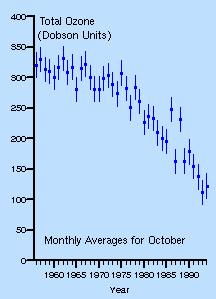
�����Later, in 1984, a research group of the British Antarctic
Survey (BAS) who were monitoring the atmosphere on Halley Bay,
Antarctica, discovered that there was a large and rapid decrease
of ozone levels above the continent--the ozone hole. This abnormal
drop of ozone levels were so unusual that at the beginning
scientists thought their instruments were defective.