|
 |
 |
 |
 |
 |
 |
 |
 |
 |
Chemical Process of Ozone Depletion:
Factories and homes spew out CFCs. CFCs have a carbon-chlorine bond which is dissociated by UV radiation when they reach the stratosphere, and produces a free chlorine atom (Cl). For example:
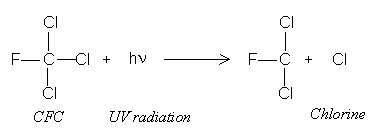
Then, the chlorine atom (a quite reactive atom) collides with
an ozone molecule (O3). As a result,
ozone is dissociated into an oxygen
molecule (O2) and there is also
formation of chlorine oxide (ClO).
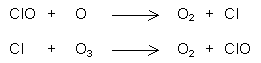
The reaction is summarized as follow:

The resulting chlorine oxide (ClO) can react with oxygen atoms
and give Chlorine atoms. The chlorine will be used again to destroy
other ozone molecules. The reaction is summarized as follow:
CFCs are not alone responsible for all the ozone decomposition in the stratosphere. There are some gases that have the same effect on ozone molecules. One type of gas that affects stratospheric ozone consist in Halons. Halons have a structure similar to the one of CFCs but they have a carbon-bromine bond instead of the carbon-chlorine bond. When these gases reach the stratosphere, UV rays dissociate the bond. The free bromine atoms dissociate ozone atoms into oxygen molecules, and so on.
Why in Antarctica ?
After all, there are no factories and homes susceptible to spew out some CFCs and other depleters in the Antarctica continent.
The answer is in the climate. During the winter polar night,
a storm wind develops from the middle to the lower
stratosphere.
This strong wind is known as polar vortex. The polar vortex
isolates the air over the polar region. Next, the temperature
drops to -80�C and special clouds called Polar Stratospheric
Clouds or PSCs are formed. Then, when sun light returns, ozone
is dissociated faster because all the gases are gathered and ready
to react.