Theory of Shading.
Light is mystical.
Almost all life on earth is dependent on light.
Light is holy.
Mankind equates light with knowledge and goodness: darkness with death
and ignorance.
Light is mysterious.
On at least two occasions, great minds have turned their attention
to this mystery. Isaac Newton was considering the origin of color
in white light and discovered natural laws that formed the basis of modern
science. Albert Einstein was considering the speed of light and formulated
the laws of relativity.
For the beginning artist, however, it is enough to observe light falling
on an object. To do this, three things are needed:
1. a light source.
2. an eye.
3. an object.
1. Until a century or so ago, there were only two common light sources
on earth: the sun and fire. The illumination that the sun provides
is different from that of fire mainly in that it is very, very far away.
So far away that, for all practical purses, its rays fall parallel to each
other on terrestrial objects. Fire on the other hand is much
closer and its rays radiate in all directions. This has a consequence
for the artist studying its effects.
2. When an eye looks at an object it doesn't see the light that has
fallen on the object directly, iT sees only the light that has been
reflected off of the object. The more light that is reflected off,
the higher the value of the surface. If little or no light is reflecting
off of a surface, we would say the surface is black.
Our visual abilities are very sophisticated. We are uncanny at discerning
the true color of a surface. We are not fooled into thinking a white cat
is gray even though we see it in low light. Nor will we choose unripe
apples that are "reddened" by a setting sun. It is this very ability
that beginning artists must learn to defeat, if they are to see the effects
of light accurately. The artist must see how the cat is grayed by
the darkness and the redness of the apples.
3. The object is everything. What is its color. Its shape. Is it translucent?
Transparent? Glistening? Dull?
Consider:
A white surface will reflect 90 % of the light that falls on it. If
a quantity equal to 10 "rays" of light fall on the white card, 9 rays quantity
will be reflected.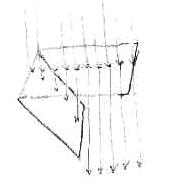 Some of that will find its way into the viewer's eye. If the
surface is turned 45 degrees, only 5 rays of light will be distributed
across the card and only half as much will find its way to the viewer's
eye. Although the viewer will know that both cards are
white, the viewer will experience a lower value for the tipped card than
the level card. The important variable is the angle of the surface
to the direction of the light source. The more perpendicular the
surface is to the source's direction, the higher the value will be
that the viewer experiences. A more acute angle results in a lower
value perceived.
Some of that will find its way into the viewer's eye. If the
surface is turned 45 degrees, only 5 rays of light will be distributed
across the card and only half as much will find its way to the viewer's
eye. Although the viewer will know that both cards are
white, the viewer will experience a lower value for the tipped card than
the level card. The important variable is the angle of the surface
to the direction of the light source. The more perpendicular the
surface is to the source's direction, the higher the value will be
that the viewer experiences. A more acute angle results in a lower
value perceived.
This is the basis for understanding light and shade.
