High Contrast Shading
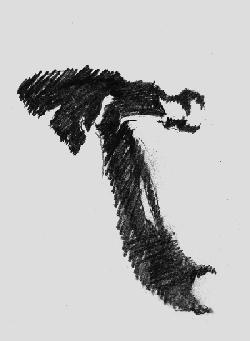 Look carefully at this illustration of a hammer. Notice that there
are no contour lines delineating the handle or head. You may think
you see edges buried in the black and white areas, but it is an "optical"
illusion. The brain is "filling in information in order to make sense
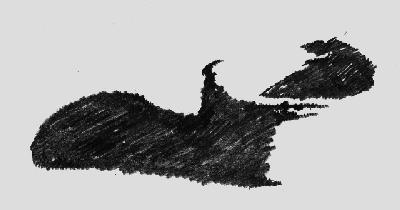
of the image. This is true also for the image of the container
at the top of the page.
Look carefully at this illustration of a hammer. Notice that there
are no contour lines delineating the handle or head. You may think
you see edges buried in the black and white areas, but it is an "optical"
illusion. The brain is "filling in information in order to make sense
of the image. This is true also for the image of the container
at the top of the page.
Do this: (40 minutes)
Use an unshaded (incandescent) light bulb to lluminate
four opaque objects. Select simple objects, such as a ball, a can, a sea
shell, a fruit or vegetable, and position each carefully with respect to
the light so that the light/dark pattern reveals sufficient information
about the object that the viewer can identify it. Try to chose objects
that have little or no confusing pattern of colors on their surface.
Look at one of the objects. Shut one of your
eyes to "flatten the scene. Close your other eye until you can barely
see anything at all. Notice that any colors have largely disappeared.
Notice that all you can see is a light and dark pattern.
With a soft lead pencil, duplicate that pattern.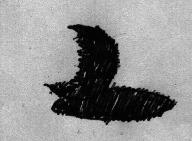
DO NOT DRAW OUTLINES OF THE SHAPES WITH THE INTENTION OF FILLING THEM
IN.
Start by creating a small "puddle" of dark with your pencil in a place
that corresponds to the darkest part of the light/dark pattern. Usually
this is where the cast shadow "touches the object. Enlarge this puddle
both into the cast shadow and the darkened side of the object. Continue
enlarging it, shaping it as you do until it fills the dark shape that is
the cast shadow and the object's dark side. Look for any other dark
shapes that are created by the interaction of the object with the light.
Create them the same way. Do not draw lines to "connect" edges. Let
the mind's eye complete the image.
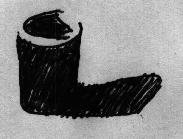 Pay
attention to the actual shape of the image. Use your knowledge of
perspective to see accurately. Think about relationships of parts
of the shapes: How they contribute to the viewer's understanding of the
object. For instance, the two dark shapes in this image relate to
one another in a way that creates the illuminated lip of the top of the
cylinder
Pay
attention to the actual shape of the image. Use your knowledge of
perspective to see accurately. Think about relationships of parts
of the shapes: How they contribute to the viewer's understanding of the
object. For instance, the two dark shapes in this image relate to
one another in a way that creates the illuminated lip of the top of the
cylinder
