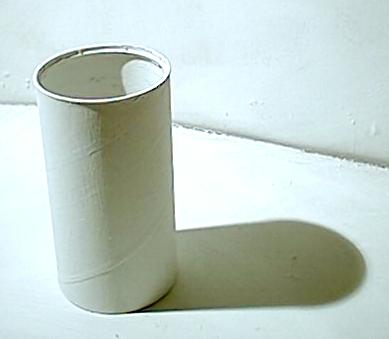
Observing the angle of the light source as it illuminates half the cylinder
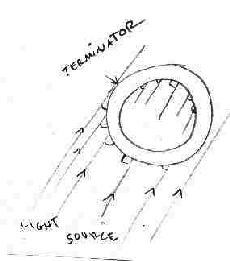
is neccessary to understand its shading. As the birds-eye illustration
below demonstrates, the part of the constantly curving exterior surface
of the cylinder that receives the light most directly (squarely) happens
to be nearest the source. However, the interior of the cylinder is
also illuminated, at least near the top, and, since it curves in a opposite
manner, the part of it that is the high value is farthest from the light.
This change of angle produces a lowering of value on the illuminated surface
toward the terminator.
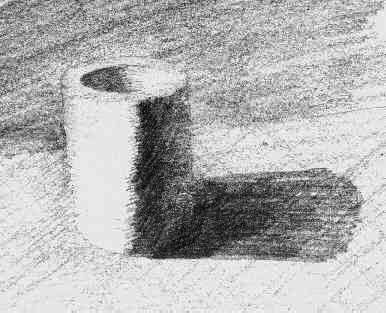
The shading of the interior curvature of the cylinder is the reverse
of the exterior. The relative positions of the interior and exterior
terminators are on a diameter of the cylinder's circular cross section.
The reflected light from the table washes out some of the terminator
and shadow at the bottom. Notice the darkening of the cast shadow
near the cylinder's base and its sharp and fuzzy edge.

|
|