The Cube and Rectangular Prism (Box)
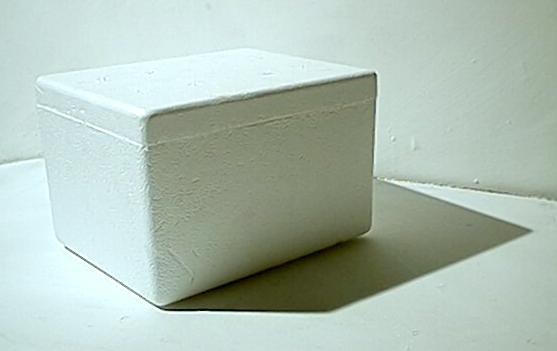
.In the above view of a styrofoam box, two of the three visible surfaces
are illuminated directly by the light source, the top and the front. These
two illuminated surfaces are of different values depending on the angle
formed between the surface and the direction to the light source.
The top of the box is receiving the light at a more perpendicular angle.
Therefore its value is higher. The light is raking down on the near
side at a smaller angle. Its surface is darker. However, notice
that the surface of this side is slightly lighter near the bottom.
This is due to the effect of reflected light bouncing up off of the table's
surface and illuminating this sides bottom. This is a common occurrence
and illustrators must include its effects if they wish their drawing to
have verisimilitude (define). Why
does this reflected light have an effect only at the bottom of the vertical
surface?
The source light is not falling on the back side. Yet we can see it.
Why?
Notice on the backside, the surface is a lower value near its bottom
than its top. Why?
Observe two qualities of the cast shadow.
1. Its edge is sharp and hard when it is near that part of the box's
surface doing the casting and fuzzy (soft) when it is far. Why?
2. The cast shadow is darker near the base of the cube. Why?
