WHY?
-
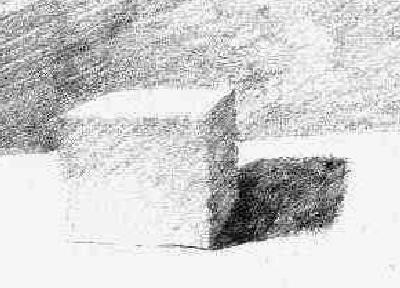
On the vertical surface, why does the reflected light have an effect only
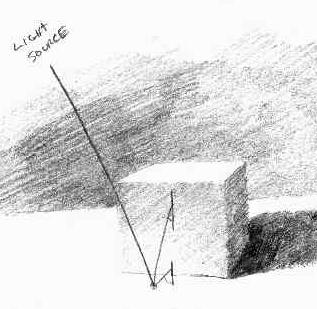
at the bottom? Consider the light reflected from a spot on
the table nearby. (see illustration) Notice that the angle
changes as light from that spot illuminates the vertical side of the box
at a higher position. Remeber the basic principle of shading has
to do with the angle of illumination. The fact that the illuminated
surface is closer to the spot is also a factor.
-
The source light is not falling on the back side. Yet we can see it.
Why?
The light source illuminates more than just the cube and table. It
scatters its light onto much of the room. All thses surfaces, in
turn, reflect light. As a consequence, light is bouncing in all directions
throughout the room. However, statistically, more of that light will
bounce back in an opposite direction from the light source.
This results in the counterintuitive result that The Moon is
a good example of an object brightly illuminated yet without the presence
of significant reflected light. We cannot see its dark side.
-
Notice on the backside, the surface is a lower value near its bottom than
its top. Why? The reflected light from the table is cut off
by the cast shadow.
Observe two qualities of the cast shadow.
-
1. Its edge is sharp and hard when it is near that part of the cube's surface
doing the casting and fuzzy (soft) when it is far. Why? The
width of the light source scatters the image of the edge.
-
2. The cast shadow is darker near the base of the cube. Why? The
reflected light that would normally come from the surrounding room is cut
off by the dark side of the cube.
