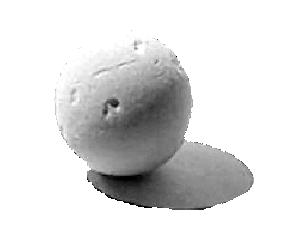
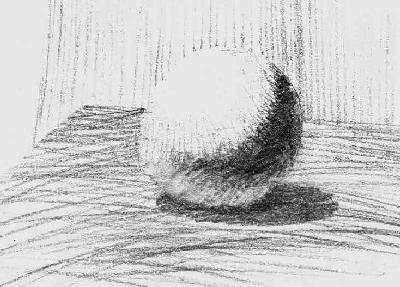
The perspective of the sphere is nonexistent: it is simply a circle, larger if close, smaller if far. The shading is more complicated. The lessons of the lazy cylinder are useful. The sphere can be thought of as a cylinder that curves in all directions. For the sun or a distant light source, the illuminated side is half of the sphere, a hemisphere. Its terminator is a great circle whose plane is perpendicular to the direction of the light.. A great circle is a circle that encompasses the largest girth of the sphere. For instance, on the sphere of earth, the equator is a great circle as are any of the latitude or longitude lines. A great circle can be drawn thru any point on the surface of the sphere.
The highest value of the illuminated hemisphere is the point on
the sphere's surface closest to the light because the light ray is perpindicular
to it there. The value diminishes slightly until the terminator is
reached. 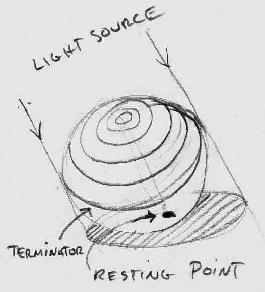

|
|