COLOR THEORY
 Color is the combination of those qualities that make one part of
the an image different from another. There are three such qualities:
Color is the combination of those qualities that make one part of
the an image different from another. There are three such qualities:
HUE -
Hue is a color quality
that is related to the frequency of light. The chemistry in our retinas
that makes our eyes sensitive these frequencies is sensitive
to a narrow range of frequencies of the electromagnetic spectrum and interprets
those frequencies as hues.
 Standard color theory has only six hue names. Starting with
the lowest frequency, they are red, orange, yellow, green, blue and violet
(or purple which is the same hue). This sequence is remembered by art and
physics students by employing the mnemonic (define)
acronym of Roy Gbv. the name of a fictional eastern European boy.
Standard color theory has only six hue names. Starting with
the lowest frequency, they are red, orange, yellow, green, blue and violet
(or purple which is the same hue). This sequence is remembered by art and
physics students by employing the mnemonic (define)
acronym of Roy Gbv. the name of a fictional eastern European boy.
In theory, there are an infinite number of unnamed intermediate hues
between each of these named hues. Actually, the human eye can detect
less than a half a million. Theory arranges these hues in a circle
( the Color Wheel) by joining red to violet. One of the significant
consequences of this configuration is that any hue may change only in the
direction of one of its two adjacent hues, e.g. violet can only get redder
or bluer. Another consequence is that if the 6 named hues are equally
spaced around the wheel, hues diametrically opposite each other are complementary
pairs. Three of the hues, red, yellow and blue, are called primary
hues. The remaining three are "secondary". The primaries are
so called because mixing two of them will create high intensity secondary.
Mixing adjacent secondaries will not create
a high intensity primary. The reason for this lies in the complex
chemistry of the optical sensory cells in the eye and the way the visual
cortex of the human brain interprets
the signals from that chemistry.
INTENSITY -
Intensity (or chroma) refers
to the amount of hue in a color. A color that is as brilliant, as
"pure" , as "rich" as it can be, is at full intensity and may be said to
be "saturated." A color that display
a low intensity of its hue may be said to be diminished or neutralized.
"Fire engine red " is saturated. "Dusty pink" is diminished.
In fact, a vibrant, "shocking pink" is not a full intensity color since
it is a mixture of white and red and therefore not purely red.
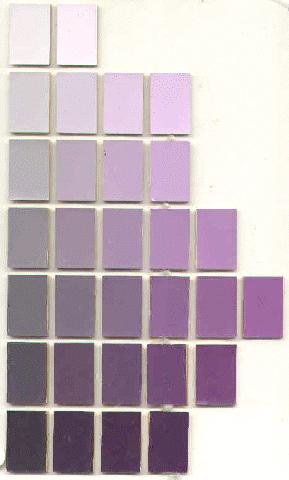
A range of intensity would result from mixing varying proportions
of gray and violet paint. The fifth horizontal row down in the cart
below represent this range. All the swatches are "violet-ish".
None of the swatches are lighter or darker. But some swatches are
very violet, some not so violet and some hardly violet at all. The
swatches vary only in intensity.
All the chips below are the same hue of violet. Each horizontal
row of the chart displays colors of the same value. The only difference
between the colors is value.
VALUE -
In the chart above, each vertical
row consists of equal intensity colors which vary only in value.
Value simply refers to the lightness or darkness of a color. (The term
"value" betrays the science lab origins of modern color theory, based
as it is on the work of two mid twentieth century scientists, Ostwald and
Munsell. In a largely unsuccessful effort to objectify the
phenomena, scientists tried to use instruments to measure lightness
or darkness. The term "value" refers to the numbers on the scale
of the photometer (light meter) they used.) A higher value is brighter.
The addition of white or black raises or lowers a color's value without
changing its hue. However, this addition will diminish its intensity.
since there will be less hue in the mix.
Every hue has a "natural"
value which is the value of the color when its hue is saturated.
Yellow has the highest natural value. Violet has the lowest.
There is a red hue and a green hue whose natural values are the same.
A "tint" of a hue is any color of that hue whose
value is above the hue's natural value. Addition of white
to a saturated color will produce tints but such admixtures are not the
only colors that are tints. Adding any gray that is lighter than
the hue's natural value to a saturated color will produce a neutralized
tint. admixtures of pure white and a saturated color are called "saturated
tints."
A "shade" is any color lower in value than
the natural value of color's hue.
These three qualities, hue, intensity and value, are independent
of one another. Every color can be adequately described in terms
of them. Determining a color's hue, its intensity and value is both
necessary and sufficient to define it.
( The theoretical definition of color requires these three qualities.
This results in the absurdity that theoretically, white, black and gray
are not colors! They are termed "achromatic
colors", an oxymoron since "achromatic" means "non color". Many artists
ignore this embarrassment, figuring that if it comes in a tube like
a color, paints with a brush like a color and mixes with the other colors
like a color, then it is a color).
